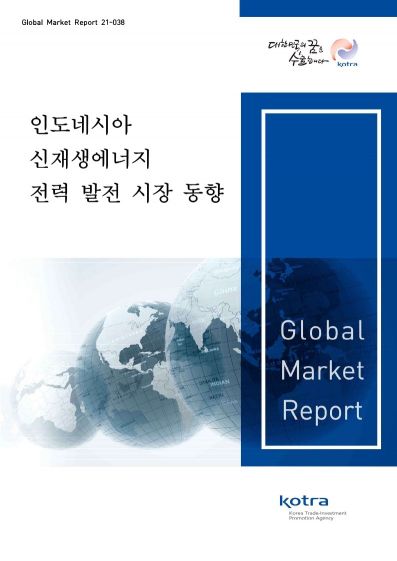
[Asia Economy Reporter Kim Heung-soon] KOTRA announced on the 6th that it has published a report titled "Trends in the Indonesian Renewable Energy Power Generation Market." The report presents trends in Indonesia's power demand and supply, development trends by major renewable energy sources such as hydropower, and entry strategies for Korean companies.
Due to its geographical and environmental conditions, Indonesia possesses the largest renewable energy potential among Southeast Asian countries. According to KOTRA, the actual utilization (generation capacity) compared to the estimated renewable energy potential of approximately 464GW is only 10.5GW (2.3%), which is about 30% of Vietnam's (35.6GW) renewable energy generation capacity, the highest in Southeast Asia. Indonesia is the world's 4th most populous country (about 270 million people) and has achieved high economic growth of 5-6% over the past decade, except for last year which recorded negative growth due to COVID-19. KOTRA explained that per capita electricity consumption is also low compared to other Southeast Asian countries, indicating high market potential.
Focus on Development in Hydropower, Geothermal, and Bioenergy... Solar and Wind Expected to Increase
Among currently operating renewable energy sources, hydropower (58.6%), geothermal (20.3%), and bioenergy (18.1%) have high utilization rates. Solar and wind power have only recently begun to be developed. Korean companies have mainly entered the hydropower sector, where power plant installation and operation are relatively easier, but recently they are considering expanding into various fields such as geothermal, biomass, and solar power. However, land acquisition and obtaining development permits are known to be challenging. Due to Indonesia's topographical characteristics, expansion of transmission and distribution infrastructure is also urgently needed.
Following government policies, Indonesia mandates the use of domestically produced components, but equipment that is difficult to procure locally is imported from overseas. Accordingly, exports of domestic products in the wind, solar, and geothermal sectors are steadily occurring. KOTRA explained that exporting companies can seek export opportunities by registering on the vendor lists of ordering parties or EPC companies or by collaborating with companies already registered. It also added that obtaining international standard certifications is important to participate in local tenders.
Kim Tae-ho, Head of KOTRA's Economic and Trade Cooperation Headquarters, said, "As the transition to a carbon-reducing society accelerates, competition among global companies to secure new markets is fierce," and added, "We will support Korean companies' market entry by providing timely information on potential markets." This report can be downloaded from the KOTRA repository.
© The Asia Business Daily(www.asiae.co.kr). All rights reserved.
![Clutching a Stolen Dior Bag, Saying "I Hate Being Poor but Real"... The Grotesque Con of a "Human Knockoff" [Slate]](https://cwcontent.asiae.co.kr/asiaresize/183/2026021902243444107_1771435474.jpg)















