On the 6th, the '58th Trade Day' Ceremony... Samsung Electronics Exports Surpass $110 Billion
[Asia Economy Reporters Hyeyoung Lee and Hyunjin Jung] At the center of South Korea achieving a historic milestone of $1 trillion in trade volume in the shortest period ever this year, and Samsung Electronics setting an all-time export record of $110 billion, was none other than semiconductors. While other ‘key contributors’ such as petroleum products, automobiles, and steel also played their parts this year, the export contribution of semiconductors remained the highest. Samsung Electronics, the ‘world’s number one semiconductor company,’ is maintaining its leadership in the memory semiconductor market where it has strengths, while accelerating efforts to expand market share and secure technological competitiveness to achieve global number one status by 2030 through large-scale global investments centered in South Korea and the United States.
Exports Led by Semiconductors... Memory Power Remains Strong
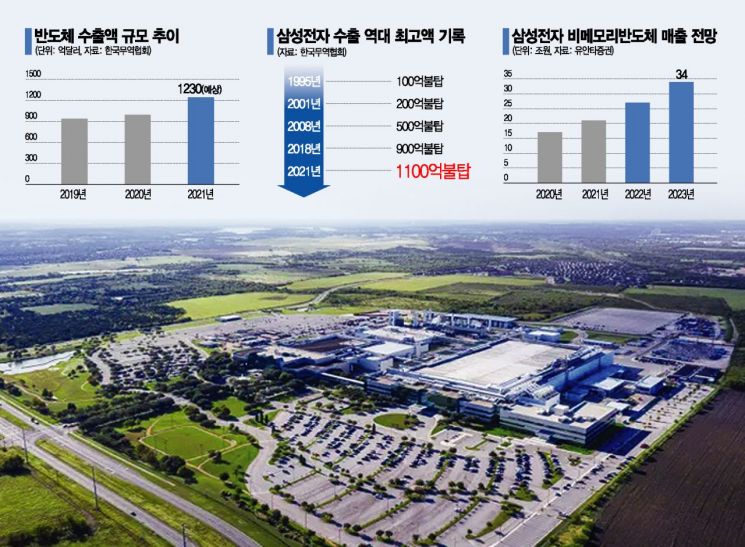
According to the Korea International Trade Association’s Institute for International Trade and Commerce on the 6th, South Korea’s semiconductor export value is expected to surpass $120 billion for the second time in history, following 2018. Despite a decline in fixed transaction prices for memory semiconductors in the second half of this year, the volume increased significantly, driving the export growth trend. The contribution rate of export growth from semiconductors as a single item is 20.4% this year, which is about one-quarter of the 92.3% seen in 2018 during the so-called ‘semiconductor supercycle,’ but it remains the highest among the 13 major key items.
Samsung Electronics has led South Korea’s exports centered on semiconductors. According to the Korea International Trade Association, Samsung Electronics was the first domestic company to achieve the ‘Export Tower’ record of $10 billion in 1995, followed by the $20 billion tower in 2001, $50 billion tower in 2008, and $90 billion tower in 2018, rapidly expanding its export scale as the country’s largest company. In particular, in the memory semiconductor market including DRAM and NAND flash, Samsung Electronics has shown a ‘super gap’ compared to other competitors, recording its highest-ever performance in the third quarter this year. The proportion of memory semiconductors in Samsung Electronics’ semiconductor sales approached 80% as of the third quarter.
Lee Jae-yong’s ‘New Samsung’... Accelerating System Semiconductor Expansion
Samsung Electronics is now focusing on expanding system semiconductors. Vice Chairman Lee Jae-yong, noting the high growth potential, announced the ‘System Semiconductor Vision 2030’ in 2019 and has been growing the business centered on foundry (semiconductor contract manufacturing). This expansion of system semiconductors by Samsung Electronics is also expected to contribute to the expansion of South Korea’s exports. The Korea International Trade Association explained, “As global market changes accelerate, new growth items such as system semiconductors are gaining attention,” and noted that the export growth rate of system semiconductors from January to October this year showed a high growth rate of 31.5% due to favorable foundry market conditions.
In the market, considering Samsung Electronics’ successive announcements of large-scale investments, it is expected that the sales scale of non-memory semiconductors, i.e., system semiconductors, will double in three years. Yuanta Securities recently projected in Samsung Electronics’ sales forecast that the foundry sales, which were about 17 trillion won last year, will increase to 34 trillion won by 2023. In fact, this year, Samsung Electronics’ foundry business unit’s customer base has exceeded 100 companies. Considering that the number of customers was around 30 when Samsung Electronics separated the foundry business unit in 2017, it has nearly tripled in four years. Samsung Electronics aims to secure more than 300 customers within the next five years.
From Giheung, Hwaseong, and Pyeongtaek to Austin and Taylor in the U.S.
To this end, Samsung Electronics is pouring large-scale investments into production bases both domestically and overseas. Samsung Electronics has committed to investing 171 trillion won in system semiconductors by 2030. Through this, it is expected to strengthen the global production system connecting domestic semiconductor production bases in Giheung, Hwaseong, and Pyeongtaek in Gyeonggi Province with Austin and Taylor in the United States, nearly doubling production capacity in the future.
The recently announced $17 billion investment for the second foundry plant in the U.S., the Taylor plant, is expected to be a key production base for expanding Samsung Electronics’ system semiconductor market share. The new foundry line, to be built on a 5 million square meter (1.5 million pyeong) site in Taylor, is scheduled to begin construction in the first half of next year (January to June) and aims to start operations in the second half of 2024 (July to December). This investment, the largest ever in Samsung Electronics’ U.S. history, is expected to generate an economic effect of 50 trillion won in Williamson County, where the plant will be built, and nearby Travis County in Texas.
Samsung Electronics Vice Chairman Kim Ki-nam said in an interview with reporters at the Trade Day event, “(Regarding next year’s facility investment) nothing has been decided yet. We will decide on additional investments after observing market conditions.”
© The Asia Business Daily(www.asiae.co.kr). All rights reserved.
![Clutching a Stolen Dior Bag, Saying "I Hate Being Poor but Real"... The Grotesque Con of a "Human Knockoff" [Slate]](https://cwcontent.asiae.co.kr/asiaresize/183/2026021902243444107_1771435474.jpg)
















