Sustained Growth, Establishing a Major Trend
Global ESG ETF Net Assets Increase 62% Year-on-Year
ESG Investment Expected to Accelerate with Upcoming Disclosure System Changes
[Asia Economy Reporter Song Hwajeong] Since last year, ESG (Environmental, Social, and Governance) funds have established themselves as a major trend, and this year they have continued to grow steadily with ongoing capital inflows. As ESG investment is expected to accelerate further in the future, the growth of related funds is also anticipated to continue. ESG investment is likely to benefit from increasing the proportion of value stocks and large-cap stocks.
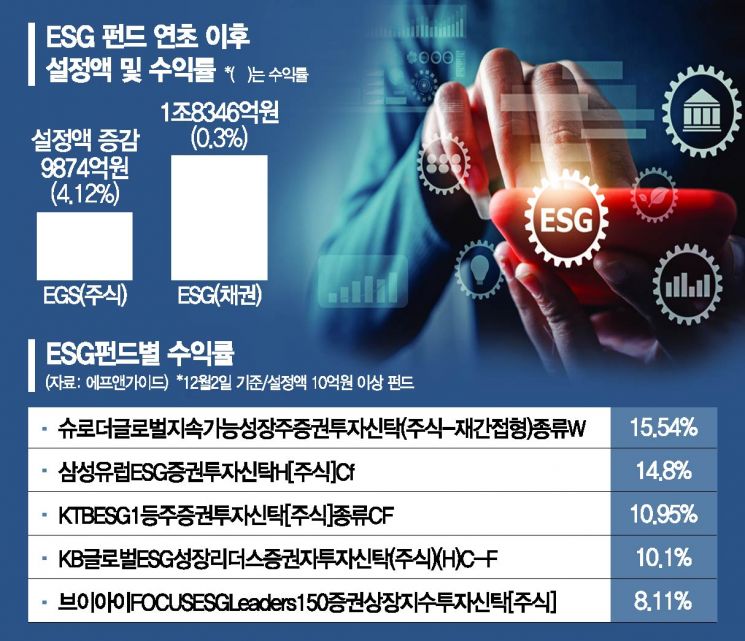
According to financial information provider FnGuide on the 6th, as of the 2nd, ESG equity funds (43 funds) with assets under management of 1 billion KRW or more saw capital inflows of 987.4 billion KRW since the beginning of the year, while bond funds (12 funds) attracted 1.8346 trillion KRW. Consequently, the assets under management for ESG equity funds increased to 1.643 trillion KRW for equities and 2.3876 trillion KRW for bonds. Net assets reached 2.5534 trillion KRW and 2.3067 trillion KRW, respectively. The year-to-date returns were 4.12% for ESG equity funds and 0.3% for bond funds.
Socially Responsible Investment (SRI) funds also saw significant growth. The number of funds increased from 46 at the same time last year to 77. Assets under management rose from 1.0241 trillion KRW last year to 4.014 trillion KRW. Net assets increased from 1.3367 trillion KRW to 4.9485 trillion KRW. The year-to-date return for SRI funds reached 4.86%.
Researcher Kim Jae-eun of NH Investment & Securities stated, "The assets under management and net assets of SRI funds are at higher levels than in 2008, when green industry-related funds such as water funds and global warming funds were actively launched," adding, "Capital inflows and new fund launches are occurring in types other than equities, and the volatility of performance appears to have improved compared to the past."
The growth of ESG funds is clearly evident worldwide. According to NH Investment & Securities, as of the end of October, the total net assets of global ESG Exchange-Traded Funds (ETFs) reached 380 billion USD, a 62% increase from 235 billion USD at the end of last year. Since last year, capital inflows have been concentrated, with 113 billion USD flowing in by October this year, up from 86 billion USD last year.
With upcoming changes in disclosure regulations, ESG investment expansion is expected to accelerate further. In the European Union (EU), the scope of mandatory ESG disclosures was expanded in March this year from pension funds to financial companies such as banks, insurance companies, and asset managers, leading to an increase in related products. South Korea will also strengthen mandatory ESG disclosures for KOSPI-listed companies with assets exceeding 2 trillion KRW starting in 2025. Accordingly, these companies will be required to disclose sustainability management reports and corporate governance reports. After 2030, this will expand to all KOSPI-listed companies, so the number of related products is expected to increase rapidly.
The combination of ESG and active ETFs is also expected to increase. Researcher Kim said, "Active ETFs combine the institutional advantages of ETFs with active funds that can achieve excess growth compared to market returns through manager discretion. Considering that active equity funds have experienced capital outflows in recent years, products combining the long-term theme of ESG with active ETFs could present opportunities for asset management companies."
In future ESG investments, attention should be paid to large-cap stocks by market capitalization and economically sensitive value stocks. Researcher Kim explained, "Next year's export growth rate is estimated to be 10%, with exports of items affected by bottlenecks being deferred and capital goods orders from advanced countries continuing, which is expected to create a favorable environment for large-cap stocks by market capitalization and economically sensitive value stocks," adding, "Among domestic equity ESG products, it is necessary to select ETFs and active funds with a higher proportion of value stocks rather than growth stocks, and large-cap stocks rather than mid-cap stocks."
© The Asia Business Daily(www.asiae.co.kr). All rights reserved.

















