From the 6th, 6 people in the Seoul metropolitan area and 8 people in non-metropolitan areas are limited... Vaccine Pass also applies to restaurants and cafes
Youth unvaccinated cannot attend academies from February next year
Citizens express dissatisfaction, "If unvaccinated, can't go to study rooms or academies?"
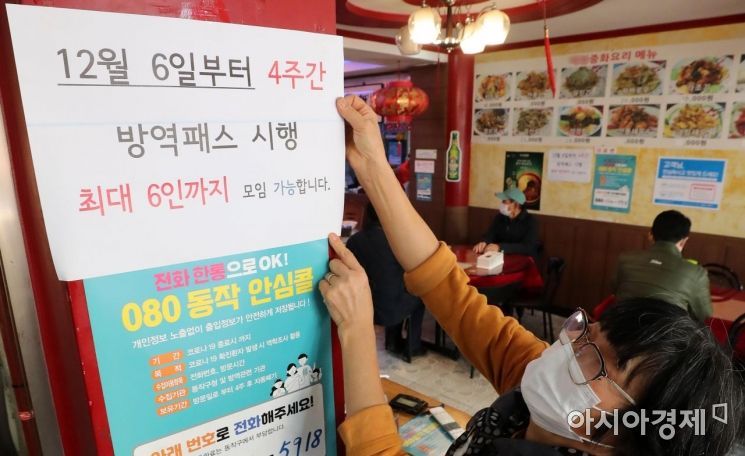 On the 5th, the owner of a Chinese restaurant in Dongjak-gu, Seoul, is posting a notice related to the quarantine pass. The photo is unrelated to specific expressions in the article. Photo by Hyunmin Kim kimhyun81@
[Asia Economy Reporter Heo Midam] "Now, if you don't get vaccinated, you can't even go to restaurants or send your children to academies."
As the special quarantine measures began today (the 6th), controversy over fairness has emerged. The government applied the vaccination certificate and negative test confirmation system (quarantine pass) to places frequently visited by youth, such as academies and study rooms, while not applying it to multi-use facilities like amusement parks and department stores, sparking debate. Additionally, there are criticisms that the criteria are ambiguous because quarantine passes were not applied to high-risk places such as markets, marts, and religious facilities. Experts emphasize that the quarantine pass is a protection strategy for the unvaccinated.
According to the Central Disaster and Safety Countermeasures Headquarters (CDSCH) recently, from today for four weeks, the number of private gatherings allowed regardless of vaccination status has been reduced from 10 people in the metropolitan area and 12 in non-metropolitan areas to 6 in the metropolitan area and 8 in non-metropolitan areas.
Also, the quarantine pass, which was previously applied restrictively to some high-risk facilities such as indoor sports facilities, karaoke rooms, bathhouses, and entertainment venues, has been expanded to multi-use facilities with high usage frequency such as restaurants and cafes. Accordingly, when using restaurants, cafes, academies, PC rooms, movie theaters, performance halls, libraries, study rooms, study cafes, museums, and art galleries, a certificate proving that 2 weeks (14 days) have passed since completing vaccination or a PCR negative confirmation is required.
However, since restaurants and cafes are essential facilities, unvaccinated individuals using them alone do not need to present a negative confirmation separately. Also, when holding private gatherings at restaurants and cafes, up to one unvaccinated person is allowed within the maximum permitted range by region.
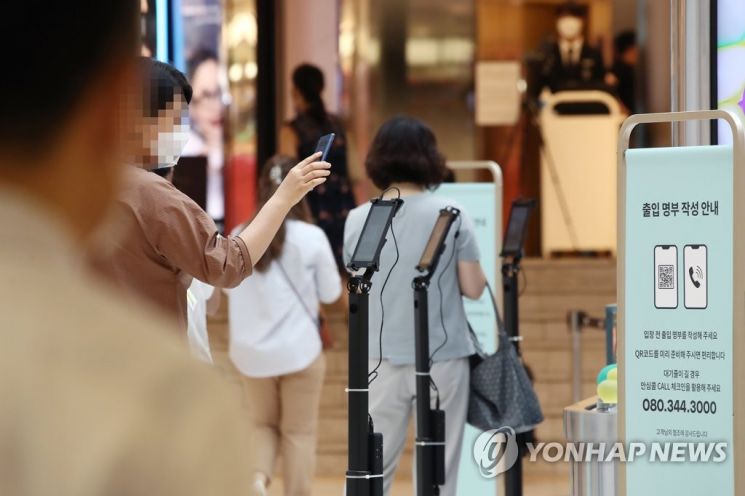 Visitors are scanning QR codes to enter the Lotte Department Store Main Branch in Jung-gu, Seoul. The photo is unrelated to specific expressions in the article. Photo by Yonhap News.
Citizens are expressing dissatisfaction with the government's quarantine guidelines. Kwon (25), an office worker who has not been vaccinated, said, "I have seen several cases around me suffering from side effects after vaccination. In particular, one acquaintance even went to the emergency room after vaccination," adding, "Because there are many such cases around me, I was reluctant to get vaccinated." He continued, "Vaccination should be a personal choice. If someone is afraid and refuses, how can they be discriminated against like this?"
Some argue that it is inappropriate to apply the quarantine pass to academies where masks are worn during classes while not applying it to places like religious facilities or department stores where group infections frequently occur.
Criticism has grown especially as the quarantine pass is planned to be applied to adolescents who had not been subject to it before. The CDSCH announced that to prevent the spread of COVID-19 among youth, the quarantine pass will be applied to those aged 12 to 18 (grades 6 to 12) starting February 1 next year.
On mom cafes and other online communities, critical responses include, "Isn't this just forcing kids to get vaccinated? They say you must have either vaccination or a PCR negative certificate to go to academies or study rooms, so unvaccinated students have to get tested every time they go," "This doesn't seem right. What are they trying to do by requiring a quarantine pass even for quiet libraries?" and "Isn't it a bit much to apply the quarantine pass to study rooms and academies frequently visited by students while not applying it to places like marts?"
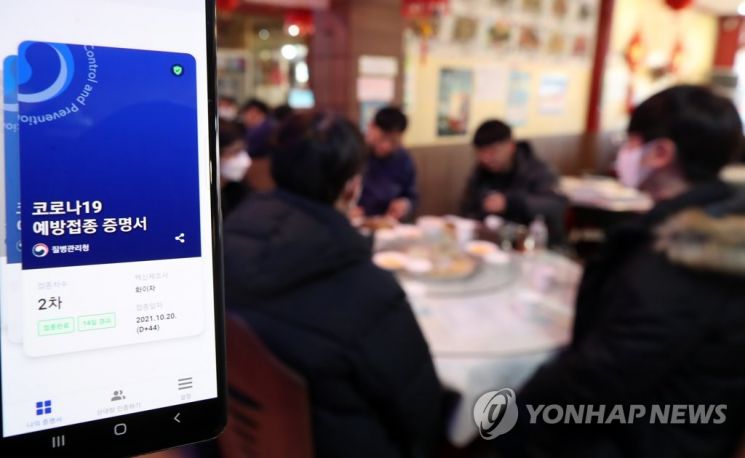 The government will limit the maximum number of private gatherings to 6 people in the metropolitan area and 8 people in non-metropolitan areas for 4 weeks starting from the 6th to control the rapidly spreading COVID-19 outbreak since the beginning of 'daily recovery.' The photo shows citizens dining at a Chinese restaurant in Daebang-dong, Dongjak-gu, Seoul. [Image source=Yonhap News]
There are also criticisms that the criteria for facilities subject to the quarantine pass are ambiguous. Previously, the government designated retail stores, markets, marts, department stores, wedding halls, funeral halls, first birthday parties, amusement facilities (amusement parks, water parks), arcades, outdoor sports facilities, lodging facilities, and religious facilities as exceptions to the quarantine pass because it is difficult to uniformly check the pass. However, controversy arose because high-risk places for group infections such as department stores and religious facilities were included.
Relatedly, on the 26th of last month, a petition criticizing the government's quarantine policy was posted on the Blue House's public petition board.
In a petition titled "Strongly oppose the vaccine pass (also known as quarantine pass) once again," the petitioner strongly demanded the withdrawal of the vaccine pass expansion policy.
The petitioner, who identified themselves as a high school sophomore living in Suseong-gu, Daegu, said, "I had an unfavorable view of the introduction of the vaccine pass as With Corona was implemented. Personally, I have not even received the first vaccine dose yet due to anxiety about side effects, and I don't understand why there is such a frenzy to expand the vaccine pass," expressing frustration. As of 11 a.m., the petition had received about 238,000 endorsements.
Experts emphasize that the quarantine pass is one of the strategies to protect the unvaccinated. Professor Lee Jaegab of the Department of Infectious Diseases at Hallym University Kangnam Sacred Heart Hospital said on Facebook on the 4th, "The quarantine pass requires unvaccinated people to take responsible actions by submitting a negative test certificate since they have not been vaccinated," adding, "The quarantine pass is a protection strategy for the unvaccinated."
He continued, "If it were mandatory vaccination, then unvaccinated people would have to bear the costs of testing or treatment themselves, or only be allowed to work from home, or be fined, or, like in Germany, be prohibited from going out except for essential purposes. Our country has not prepared or implemented such policies yet," he emphasized.
© The Asia Business Daily(www.asiae.co.kr). All rights reserved.
![Clutching a Stolen Dior Bag, Saying "I Hate Being Poor but Real"... The Grotesque Con of a "Human Knockoff" [Slate]](https://cwcontent.asiae.co.kr/asiaresize/183/2026021902243444107_1771435474.jpg)

















