Professor Kwon Hyuk of Pusan National University Law School, Report on 'Policy Tasks for the Advancement of Labor Relations Legal System'
[Asia Economy Reporter Kim Hyewon] #. A, a parent of two children, used 'time' from their working hours account to leave work two hours early to match the daycare pick-up time. They are using the hours saved by working 45 hours per week for a year before their child was born. B is experiencing burnout syndrome as a worker and has many concerns about the future. They have planned to use a long-term leave, such as a sabbatical year, to rest, study, and recharge for one year.
This is a story from Germany, where the working hours account system is implemented. It operates like a savings account for working hours, where employees save overtime hours when workload is high and use them as leave or time off when work is lighter.
In South Korea, there have been calls to reform the outdated labor laws that do not fit the era of the Fourth Industrial Revolution by introducing the working hours account system as an alternative. Professor Kwon Hyuk of Busan National University Law School stated this in a report titled "Policy Tasks for the Advancement of Labor Relations Legal System," commissioned by the Korea Economic Research Institute on the 5th.
The report diagnosed the need to move away from uniform labor time regulations under labor law and seek flexible regulatory methods. As work styles diversify with telecommuting and remote work, and workers freely set their commuting hours, expanding labor autonomy is necessary. However, current labor laws rigidly regulate working hours, limiting their ability to respond to demand.
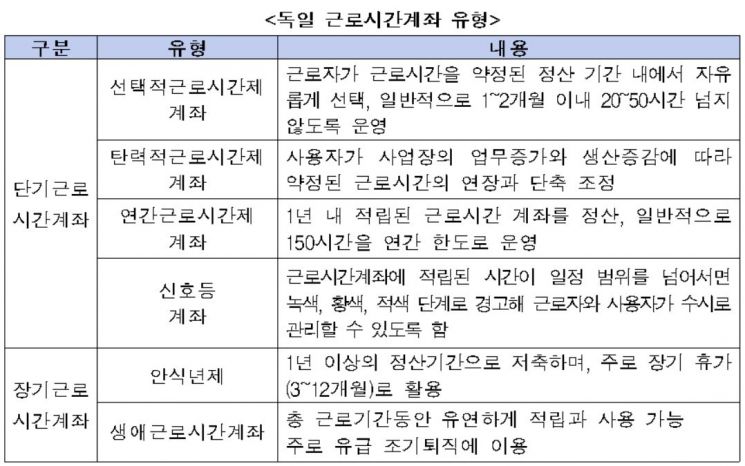
In Germany, when the working hours account system is adopted through collective agreements, workers can autonomously adjust their working hours as needed. Types of working hours accounts include short-term accounts with settlement periods set monthly or yearly, and long-term accounts with periods longer than one year. Time saved in long-term accounts can be used for childcare, parenting, retraining, sabbaticals, and paid early retirement, which is advantageous. Generally, these accounts are time-based but can also be operated as monetary accounts (converted into wage claims).
According to actual operation data in Germany, about 81% of workplaces with over 250 employees used long-term working hours accounts as of 2016, indicating active utilization. Professor Kwon said, "In Germany, collective agreements related to the working hours account system are increasing. Considering the working hours life cycle, the system guarantees autonomy by allowing workers to secure long-term rest for illness treatment, education, or training according to their needs, making it a model suitable for labor-management coexistence."
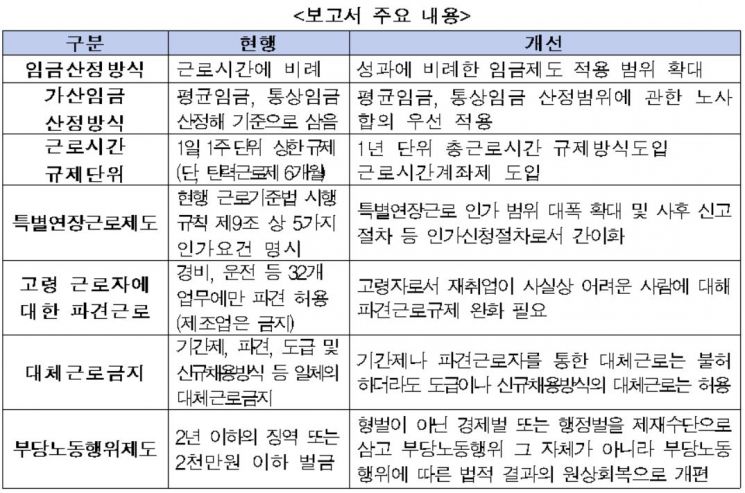
The current Labor Standards Act assumes a simple worker model centered on manual labor and maintains a wage system proportional to working hours. However, since work quality and performance do not correlate with hours worked, the report suggests reforming to a performance-based wage system rather than one based on hours. Furthermore, the Labor Standards Act uniformly regulates premium pay for night and holiday work, but concepts like average wage and ordinary wage used for calculation are unclear and complex, causing unnecessary and repetitive disputes between labor and management.
Professor Kwon stated, "While specific wage decisions should be reached through labor-management agreements, it is contradictory not to recognize diversity in premium pay or wage calculation methods reflecting industrial environment changes. In the Fourth Industrial Revolution era, performance systems based on working hours do not function well, so efforts to universalize performance-based wage systems should proceed simultaneously."
"Regulatory Sandbox Needed Including Relaxation of Dispatch Regulations for Older Workers"
The report also expressed the opinion that labor law regulations on older workers should be relaxed in the era of low birthrate and aging population. It argued that employment policies for older workers should focus more on providing opportunities to work rather than employment stability. Providing work opportunities to older workers who want to work is considered an important task in the low birthrate and aging era.
Moreover, it suggested relaxing regulations on older worker employment in laws related to non-regular workers. For example, current dispatch laws allow dispatch only for 32 tasks such as security and driving, banning dispatch in manufacturing where it is actually needed. The report proposes easing dispatch labor regulations for older workers who have abundant experience in these tasks but face practical reemployment difficulties due to age. It also argues that securing social safety nets for older workers through old-age pensions or wage compensation is an effective employment measure for older workers.
Additionally, Professor Kwon pointed out the need to improve the employer’s prohibition on substitute labor and unfair labor practices systems, which do not align with global standards. For instance, while it is difficult to use fixed-term or dispatched workers for substitute labor, banning substitute labor through subcontracting or new hiring is considered excessive regulation. Furthermore, he argued that strike actions involving workplace occupation infringe on employer property rights and may violate the labor rights of workers not participating in the strike, thus requiring strict regulation.
Professor Kwon said, "South Korea is the only country that imposes imprisonment as a criminal penalty for violations of unfair labor practices. Instead of penalizing the unfair labor practices themselves, sanctions should be imposed only when orders to remedy unfair labor practices are not followed. The focus should be on restoration, and sanctions should be reformed from criminal penalties to economic or administrative penalties."
Choo Kwangho, Director of Economic Policy at the Korea Economic Research Institute, stated, "Future labor laws should move away from uniform and rigid Labor Standards Act systems to labor contract law systems that respect labor-management autonomy considering industries and work methods. Labor law upgrades are essential to effectively protect various types of labor providers and create more jobs."
© The Asia Business Daily(www.asiae.co.kr). All rights reserved.
![Clutching a Stolen Dior Bag, Saying "I Hate Being Poor but Real"... The Grotesque Con of a "Human Knockoff" [Slate]](https://cwcontent.asiae.co.kr/asiaresize/183/2026021902243444107_1771435474.jpg)
















