Severe Cases Remain in the 700s for Five Days, Rapid Bed Depletion... Nationwide Utilization Rate at 79%
954 Waiting for Beds in the Capital Area, 23 in Non-Capital Areas... 15,000 Under Home Treatment
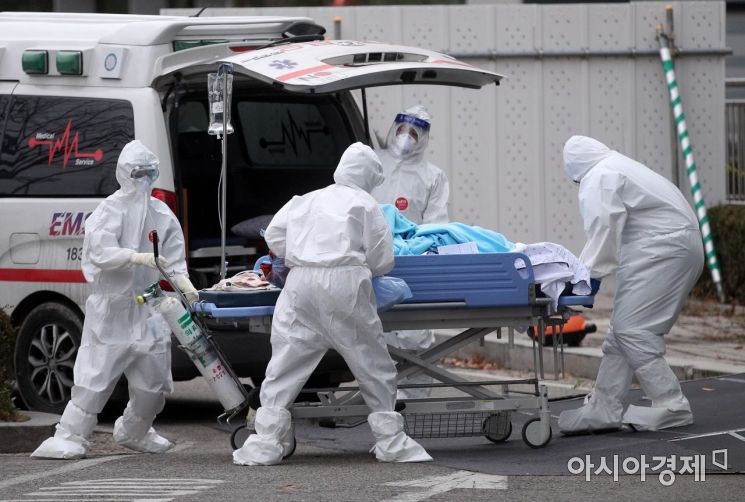 As the number of critically ill COVID-19 patients continues to hit record highs daily, medical staff are transferring patients at Seoul Medical Center in Jungnang-gu, Seoul on the 2nd. Photo by Kim Hyun-min kimhyun81@
[Asia Economy Reporter Yoo Byung-don] As the number of critically ill COVID-19 patients has remained in the 700s for five consecutive days, the capacity of intensive care unit (ICU) beds in the Seoul metropolitan area has reached a critical point. With new confirmed cases consistently around 5,000 daily, bed waiting times have become serious not only in the metropolitan area but also in non-metropolitan regions.
According to the Central Disaster and Safety Countermeasure Headquarters (CDSCH) on the 5th, as of 5 p.m. the previous day, the ICU bed occupancy rate in Seoul was 91.1%, with 318 out of 349 beds in use.
In Incheon, the occupancy rate was also 91.1% (72 out of 79 beds in use), while Gyeonggi Province recorded a slightly lower rate of 79.0% (289 out of 366 beds).
Overall, the metropolitan area’s ICU bed occupancy rate stands at 85.5%, but Seoul and Incheon have surpassed 90%. Although there are a total of 115 ICU beds remaining, not all of them are immediately available for use.
ICU beds are difficult to operate at 100% capacity due to admission and discharge procedures and the need to secure spare beds. Additionally, the medical staff capable of caring for critically ill patients is limited at each hospital, so even if beds are available, some hospitals cannot admit additional patients.
The CDSCH is transferring patients to non-metropolitan areas when it is difficult to allocate beds within the metropolitan area, but the nationwide ICU bed occupancy rate is also high at 79.1%. In the Gyeongbuk, Gangwon, Chungbuk, and Chungnam regions, only one bed remains in each area.
The occupancy rate for semi-critical care beds in the metropolitan area is 68.5% (268 out of 391 beds).
Semi-critical care beds are for patients whose condition has improved from critical or who are at high risk of worsening to critical. Without proper utilization of these beds, the crisis in critical patient treatment is bound to worsen.
The infectious disease dedicated treatment bed occupancy rate in the metropolitan area is 76.9% (4,097 out of 5,326 beds), and the residential treatment center occupancy rate is 69.4%.
As of midnight on the same day, 954 patients in the metropolitan area have been waiting for bed allocation for more than a day, with 299 of them waiting for more than four days.
Additionally, 418 patients have been waiting for more than one day, 164 for more than two days, and 73 for more than three days.
Among those waiting for beds, 541 patients, accounting for 56.7%, are elderly aged 70 or older. A significant number of the remaining patients have underlying conditions such as hypertension and diabetes.
The number of patients waiting for beds in non-metropolitan areas increased by 19 from the previous day to 23. Until the 2nd, there were no patients waiting for beds in non-metropolitan areas, but as confirmed cases have recently increased, especially among the elderly, the process of patient screening, classification, and bed allocation is under strain.
There are currently 14,944 patients undergoing home treatment nationwide.
The number of critically ill patients hospitalized due to COVID-19 is 744, remaining above 700 for five consecutive days since the 1st (723 → 733 → 736 → 752 → 744), and the number of deaths has ranged between 30 and 70 per day over the past week.
© The Asia Business Daily(www.asiae.co.kr). All rights reserved.
![Clutching a Stolen Dior Bag, Saying "I Hate Being Poor but Real"... The Grotesque Con of a "Human Knockoff" [Slate]](https://cwcontent.asiae.co.kr/asiaresize/183/2026021902243444107_1771435474.jpg)















