FKI Publishes ESG White Paper for K Corporation... "Business Portfolio Restructuring"
Visible Changes Including Global M&A and Active ESG Bond Issuance
[Asia Economy Reporter Lee Hye-young] It has been revealed that the top 30 domestic conglomerates plan to make a massive investment totaling 153.2 trillion KRW in ESG (Environmental, Social, and Governance) related businesses in the environmental sector by 2030. This indicates that major companies are rushing to restructure their business portfolios around ESG.
On the 5th, the Federation of Korean Industries (FKI) announced these findings through the 'K-Company ESG White Paper,' published based on sustainability reports and surveys of companies belonging to the top 30 groups and members of the K-ESG Alliance operated by FKI.
FKI pointed out that among the 153.2 trillion KRW investment plans of the top 30 companies, global mergers and acquisitions stand out. Representative examples include SK's acquisition of shares in TBM, a Japanese eco-friendly materials company; SK Ecoplant's acquisition of four waste treatment companies including Daewon Green Energy; Hanwha Solutions' acquisition of RES France (strengthening solar and wind power businesses) and US hydrogen high-pressure tank manufacturer Cimarron; and Hyosung Heavy Industries' joint venture with Germany's Linde to build the world's largest liquefied hydrogen plant.
Regarding the companies' transformation efforts, FKI analyzed, "They are changing their group business portfolios entirely to ESG themes," adding, "The keywords for business restructuring by group were SK's renewable energy, hydrogen economy, batteries (electric vehicles, etc.), and circular economy; Hanwha Group's renewable energy and hydrogen economy; and Hyundai Motor and Hyosung Group's hydrogen economy."
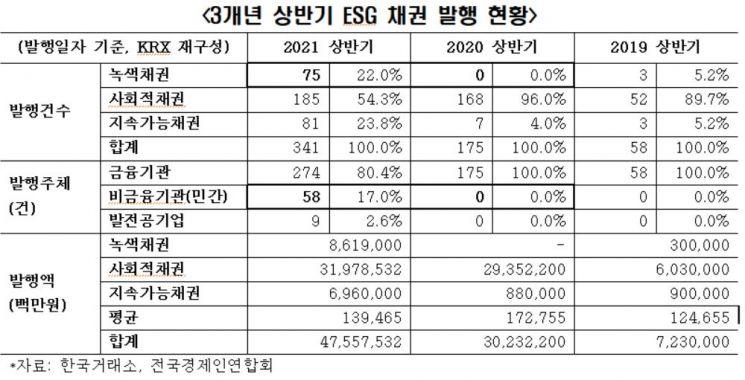
FKI also noted that this year marked the first year companies implemented green financing through ESG bond issuance.
Looking at the first half performance over the past three years, private companies had no record of ESG bond issuance until last year. However, this year, ESG bond issuance has become active, centered on the top 10 groups including Hyundai Motor, SK, LG, Lotte, Hanwha, POSCO, GS, and Hyundai Heavy Industries.
The number of companies declaring carbon neutrality has also increased. The target years for achievement are LG by 2030, SK Corporation and SK Networks by 2040, Hyundai Motor and Kia by 2045, and SK Telecom, Hanwha Solutions, and Coway by 2050.
Looking at specific goals based on core businesses, CJ CheilJedang is targeting the carbon-zero alternative meat market, and GS Caltex has introduced 2 million barrels of carbon-neutral crude oil for the first time in Korea. LG Electronics and others have adopted carbon accounting systems, while Samsung Fire & Marine Insurance and others have introduced internal carbon pricing. Korean Air is proactively implementing the International Civil Aviation Carbon Offset and Reduction Scheme for International Aviation (CORSIA), which must be mandatorily adopted by 2027, and is currently conducting a pilot operation this year.
Samyang Corporation developed biodegradable plastics based on plant-extracted bio-material isosorbide, and Lotte Chemical's ongoing Project LOOP was cited as a representative case of the plastic circular economy.
Companies have also pursued various initiatives in the social sector, including human resource management, diversity enhancement, healthcare accessibility, supply chain ESG expansion, human rights management, and community activities.
In terms of human resource management, GS Retail operates 'New Start,' a support program for retirees' entrepreneurship, and CJ Logistics introduced Blue Delivery (creating jobs for the hearing impaired) and Orange Delivery (creating jobs for women with career interruptions).
POSCO operates an 'Eco-friendly Consulting Support Team' to assist partner companies, and Hyundai Motor and Hanwha Solutions run supply chain ESG evaluation and support systems. Interest in human rights management has also increased. Samsung Card conducted company-wide human rights due diligence based on its human rights management declaration, and S-Oil conducted due diligence not only on the company but also on its partners.
FKI also highlighted that Korean companies are actively participating in domestic and international initiatives.
Thirteen companies participate in the global campaign 'RE100,' which commits to using 100% renewable energy. Nineteen companies (excluding financial and public institutions) have officially declared support for the Task Force on Climate-related Financial Disclosures (TCFD). According to FKI, 54 out of 85 companies surveyed for this white paper, accounting for 64%, disclosed their climate change response status following the TCFD reporting format.
© The Asia Business Daily(www.asiae.co.kr). All rights reserved.
![Clutching a Stolen Dior Bag, Saying "I Hate Being Poor but Real"... The Grotesque Con of a "Human Knockoff" [Slate]](https://cwcontent.asiae.co.kr/asiaresize/183/2026021902243444107_1771435474.jpg)

















