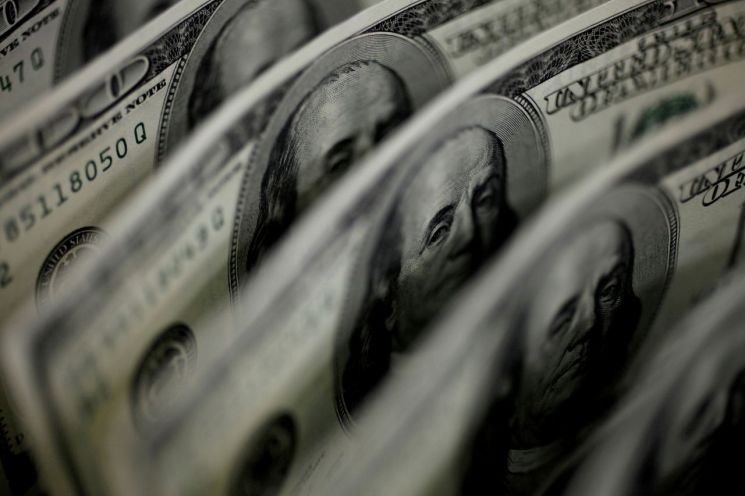
[Asia Economy Reporter Song Hwajeong] Amid the continued weakness of the Korean won (rise in the won-dollar exchange rate) throughout this year, it is expected that the won-dollar exchange rate will show a gradual downward trend until the first half of next year due to improvements in supply and demand conditions.
According to Hana Financial Investment on the 4th, the persistent weakening trend of the won this year was largely influenced by supply and demand factors. The continued net selling trend of foreign investors in stocks increased the volatility of the won-dollar exchange rate, and the expansion of overseas investments by individual investors also induced the won's weakness. Compared to 2019, the scale of individual overseas stock investments has increased about tenfold. However, recent changes in supply and demand conditions have begun to appear. Jeon Gyu-yeon, a researcher at Hana Financial Investment, analyzed, "Since November, foreign stock funds have shifted to net buying as exports of major items including semiconductors showed strong performance and expectations for business improvement emerged. Additionally, foreign bond funds, which are relatively less volatile, have maintained net purchases, leading to a decline in the won-dollar exchange rate."
Hana Financial Investment forecasted the won-dollar exchange rate to be around 1,160 won in Q1, 1,150 won in Q2, 1,160 won in Q3, and 1,170 won in Q4 next year. Researcher Jeon explained, "Although volatility risks remain around the December Federal Open Market Committee (FOMC) meeting, if a supply-demand environment favorable to the won is created and the US dollar shows a slightly weak trend, the won-dollar exchange rate will exhibit a gradual downward trend until the first half of next year."
Although exchange rate volatility is expected to increase in December, the dollar's slightly weak trend is projected to be maintained. Recently, US Federal Reserve (Fed) Chair Jerome Powell hinted at a hawkish monetary policy stance, increasing the likelihood of accelerating tapering (asset purchase reduction) at the December FOMC. Powell reversed his previous claim that inflation was temporary and announced plans to advance the tapering schedule. According to the original path, tapering, which was scheduled to end in June, is expected to conclude around March to April next year, potentially setting the stage for interest rate hikes if inflation remains high. Financial markets have priced in about a 70% chance of rate hikes starting in June next year. However, concerns over economic slowdown due to the spread of the Omicron variant have caused US interest rates to fall, and the dollar has reflected related risks. Despite Powell's hawkish stance, the US dollar index is hovering near 96 points, showing mixed trends.
Researcher Jeon stated, "With international oil prices falling to the $60 per barrel range and global supply chain disruptions improving, if inflationary pressures ease in the first half of next year and service sector employment recovers at a somewhat slow pace due to variant virus concerns, the probability of rate hikes immediately after tapering ends in the first half of next year is low." He added, "Although uncertainty in the foreign exchange market due to the variant virus has increased, if the Fed does not bring forward the timing of rate hikes, the dollar is likely to maintain a slightly weak trend."
© The Asia Business Daily(www.asiae.co.kr). All rights reserved.
![Clutching a Stolen Dior Bag, Saying "I Hate Being Poor but Real"... The Grotesque Con of a "Human Knockoff" [Slate]](https://cwcontent.asiae.co.kr/asiaresize/183/2026021902243444107_1771435474.jpg)















