[Asia Economy Reporter Jang Hyowon] The government expressed regret over the radiation impact assessment report released by Tokyo Electric Power Company (TEPCO) of Japan, which claimed that the discharge of contaminated water from the Fukushima nuclear power plant has minimal environmental impact.
On the afternoon of the 3rd, the government announced that it held a video conference with Japan’s working-level officials regarding the draft of the "Radiation Impact Assessment Report on the Marine Discharge of Contaminated Water from the Fukushima Nuclear Power Plant" recently released by TEPCO (hereinafter referred to as the Radiation Impact Assessment Report).
The meeting included explanations from the Japanese side about the Radiation Impact Assessment Report announced by TEPCO on the 17th of last month, questions from the Korean government, and responses from the Japanese side.
Attending from Korea were officials at the director level from five ministries under the task force (TF) for responding to Fukushima contaminated water (Office for Government Policy Coordination, Ministry of Foreign Affairs, Nuclear Safety and Security Commission, Ministry of Science and ICT, Ministry of Oceans and Fisheries). Japan was represented by officials from the Ministry of Foreign Affairs, Agency for Natural Resources and Energy, and TEPCO.
TEPCO, the operator of the Fukushima Daiichi Nuclear Power Plant, stated in the Radiation Impact Assessment Report that even if the contaminated water from Fukushima is diluted with seawater and discharged into the ocean, the impact on humans and the environment is confirmed to be extremely minimal.
Furthermore, after analyzing the concentration and diffusion of tritium within a 10 km radius of the Fukushima Daiichi Nuclear Power Plant’s offshore area, it was evaluated that the area where tritium concentration increases due to marine discharge of contaminated water is limited to within 2 to 3 km from the Fukushima Daiichi Nuclear Power Plant.
The government said, "During the meeting, we expressed regret over Japan’s release of the report based on the premise of marine discharge," and "we reiterated our concerns to Japan regarding the uncertainties about the impact of marine discharge on humans and the environment."
It also explained, "We raised questions about the key assumptions and methodologies of the report presented by TEPCO and requested additional data from the Japanese side."
The government added, "We repeatedly demanded transparent information disclosure and sincere consultations from Japan to neighboring countries, including Korea, which are concerned about the marine discharge of nuclear power plant contaminated water."
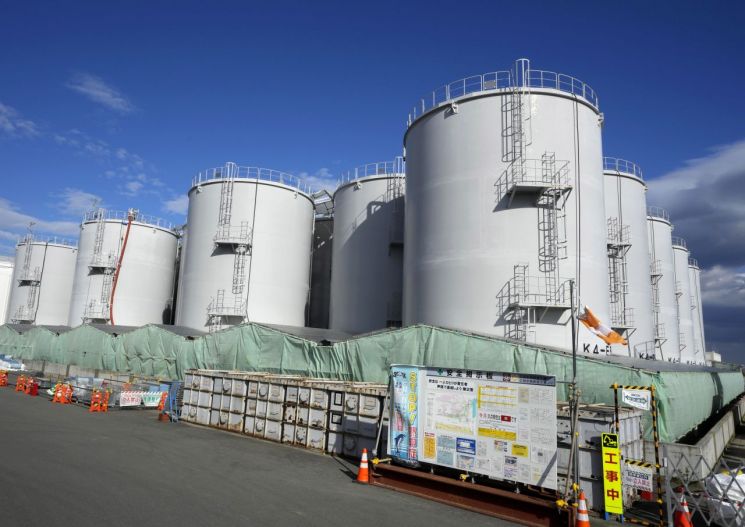
TEPCO has been treating contaminated water generated at the Fukushima Daiichi Nuclear Power Plant, which suffered a core meltdown during the 2011 Great East Japan Earthquake, using a device called the Advanced Liquid Processing System (ALPS) and storing it in tanks on the nuclear power plant site. However, even after treatment, tritium, a radioactive substance contained in the contaminated water, cannot be removed.
The government emphasized, "We will continue to actively respond to the Fukushima nuclear power plant contaminated water issue, prioritizing the health and safety of the public."
© The Asia Business Daily(www.asiae.co.kr). All rights reserved.
![Clutching a Stolen Dior Bag, Saying "I Hate Being Poor but Real"... The Grotesque Con of a "Human Knockoff" [Slate]](https://cwcontent.asiae.co.kr/asiaresize/183/2026021902243444107_1771435474.jpg)















