Japan Meteorological Agency: "No Evidence to Suggest Increased Likelihood of Massive Earthquake"
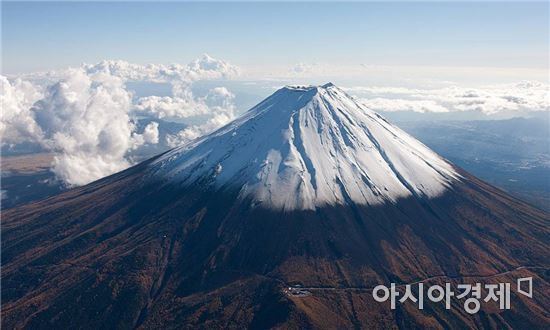
[Asia Economy Reporter Na Ye-eun] In Japan, a series of earthquakes measuring around magnitude 5 have occurred at approximately three-hour intervals, spreading anxiety among residents.
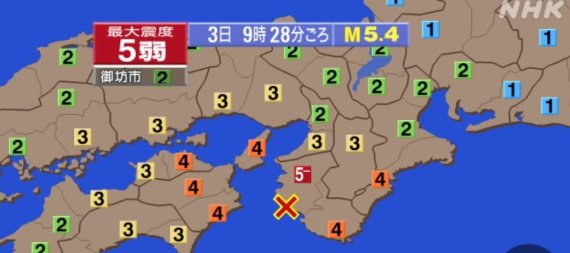
At around 6:37 a.m. on the 3rd, a magnitude 4.8 earthquake struck the eastern part of Yamanashi Prefecture, centered on the Fuji Five Lakes (Fujigoko) area. Less than three hours later, at about 9:28 a.m., a strong magnitude 5.4 earthquake followed in the Kii Channel (Kiisui-do), located between Wakayama Prefecture and Tokushima Prefecture, approximately 500 km away from Fujigoko.
In both earthquakes, minor physical damages such as broken glass, cracks in aging buildings, and power outages in some areas were reported. Fortunately, no serious physical damage such as casualties or building collapses has been confirmed.
The maximum seismic intensity of the two earthquakes was observed as lower 5 (5- on the Japanese Meteorological Agency seismic intensity scale). A 5- intensity is generally felt as frightening by most people, who feel the need to hold onto something.
However, in Japan, where disaster preparedness is well established, daily life is quickly restored after such earthquakes, except for minor transportation disruptions.
Nevertheless, the two consecutive earthquakes today instilled a unique sense of fear among the Japanese in several respects.
First, the epicenter of the Fujigoko earthquake was located on the slopes of Mount Fuji, Japan’s highest peak and an active volcano, about 30 to 40 km from the summit, which triggered fears that it might be a precursor to a Mount Fuji eruption.
It has been about 10 years since a strong earthquake with a seismic intensity of 5- was observed in Yamanashi Prefecture, which surrounds Mount Fuji. The last time was in January 2012, when the epicenter was also Fujigoko, and the magnitude was 5.4.
In Japan, a Mount Fuji eruption is considered one of the greatest disasters alongside the "directly beneath Tokyo metropolitan area earthquake" and the "Nankai Trough megaquake," which is expected to originate from the Nankai Trough offshore area. A major eruption of Mount Fuji is predicted to cause unimaginable large-scale damage, such as lava flows covering 27 basic local governments.
However, the Japan Meteorological Agency has stated that this earthquake does not indicate a possibility of a Mount Fuji eruption, and local media have also denied any connection.
Yoshimoto Mitsuhiro, director of the Mount Fuji Volcano Disaster Prevention Research Center, said in an NHK interview, "The epicenter of this earthquake is located where the Philippine Sea Plate under the sea, including the Izu Peninsula, collides with the land plate, and earthquakes have repeatedly occurred in this area in the past," adding that this earthquake does not appear to be directly related to Mount Fuji’s activity.
He continued, "It is well established that when Mount Fuji’s volcanic activity intensifies, very small earthquakes called 'deep low-frequency earthquakes' increase at a depth of 10 to 20 km northeast of the summit," and added, "No changes were observed in the monitoring data before or after this earthquake."
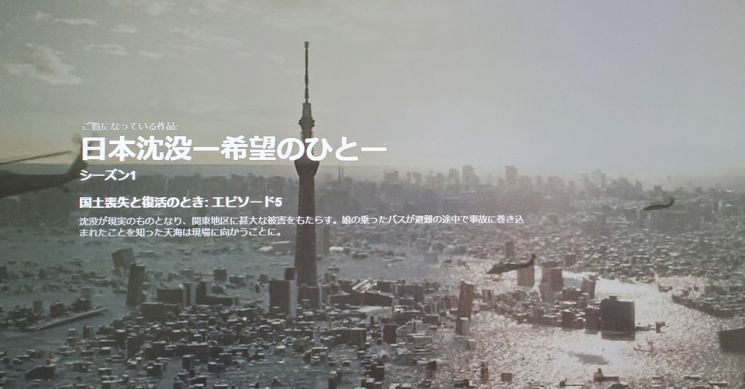
Notably, the epicenter of the Wakayama earthquake coincidentally falls within the expected range of the Nankai Trough megaquake.
The Japan Meteorological Agency explained about the Wakayama earthquake, "It appears to have occurred within the land plate lying on top of the subducting oceanic plate," and added, "Considering the mechanism and scale expected for the Nankai Trough megaquake, which is anticipated to occur at the plate boundary, there is no basis to say that the possibility of a megaquake has increased due to today’s earthquake."
Additionally, Professor Yamaoka Kogogo of Nagoya University stated in an interview with Kyodo News, "Since the epicenters of today’s two earthquakes are more than 500 km apart, their correlation seems low, and there is no need to feel unnecessary anxiety."
© The Asia Business Daily(www.asiae.co.kr). All rights reserved.
![Clutching a Stolen Dior Bag, Saying "I Hate Being Poor but Real"... The Grotesque Con of a "Human Knockoff" [Slate]](https://cwcontent.asiae.co.kr/asiaresize/183/2026021902243444107_1771435474.jpg)

















