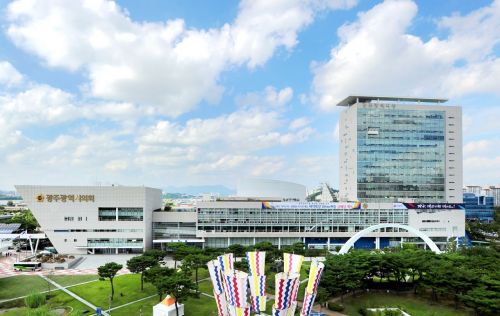
[Asia Economy Honam Reporting Headquarters Reporter Yoon Jamin] Gwangju Metropolitan City has opened the era of 3 trillion won in national funding.
Gwangju City announced on the 3rd that 3.2155 trillion won was finally confirmed by the National Assembly in next year's main budget, securing the largest amount of national funding ever.
This is an increase of 348.9 billion won (12.2%) compared to the previous year's national funding amount of 2.8666 trillion won, reflecting 116 new projects with 167.6 billion won and 280 ongoing projects with 3.0479 trillion won.
Considering that the government budget increased by 8.9% compared to the previous year, this is regarded as a remarkable achievement.
Thus, Gwangju City has newly opened the era of 3 trillion won in national funding just three years after entering the era of 2 trillion won in national funding.
The average annual growth rate compared to 2018 is 13%, which is much higher than the national budget growth rate of 9.1% during the same period.
This achievement is analyzed as a result of significantly reflecting Gwangju City's long-cherished projects such as the ultra-wide-area high magnetic field research infrastructure construction planning research service to attract national basic facilities for future new industry development, the establishment of Gwangju Medical Center to strengthen public healthcare in the post-COVID-19 pandemic era, and the construction of the Gwangju Biennale Exhibition Hall to solidify the status of cultural city Gwangju.
In addition, it is evaluated as a result of Gwangju City's active efforts at the political level in the National Assembly and political circles to secure national funding, focusing on future food industry projects through the construction of an artificial intelligence industrial ecosystem such as the construction of the Urban Railway Line 2 and the K-Health National Medical AI Service and Industrial Ecosystem.
Especially, 2022 is a year for Gwangju City to prepare for leap and growth into a Green-Smart-Fun City based on the valuable fruits so far, with urgent pending projects reflected, and the promotion of core projects to open a ‘bigger and stronger Gwangju era’ is expected to gain more momentum.
Looking at the details of national funding secured by sector, newly reflected projects during the National Assembly review process for major cultural and tourism projects for a refined cultural Gwangju include ▲Construction of Gwangju Biennale Exhibition Hall (3 billion won) ▲Creation of Media Theme Content Experience Tourism Platform (1.8 billion won) ▲Creation of Asia Art Plaza (1 billion won) ▲Creation of Central Asia Historical Theme Tourism District (1 billion won) ▲Creation of Asia Digital Culture Space (500 million won) ▲Creation of Bitgoeul Yeongsangang Renaissance Theme Park (420 million won) ▲Support for the 450th Anniversary Project of Gobong Gidaeung (100 million won) ▲Cultural and Artistic Cluster Project around ACC (100 million won). The creation of an Asian art talent hub space was increased by 1.72 billion won to 5.5 billion won, and the repair and maintenance of the Catholic Gwangju Archdiocese Office was increased by 290 million won to 470 million won.
In the government budget proposal, 129 projects worth 164.3 billion won were reflected, including the creation of the advanced immersive cultural content theme park (G-Planet) (500 million won), investment in the 4th fund for fostering the Asia Culture Center City (10 billion won), creation of the Asia e-sports industry support center (750 million won), and creation of a permanent performance hall in Sajik Park (1 billion won).
Newly reflected projects during the National Assembly review process for major projects to build the foundation of AI city Gwangju and prosperous economic Gwangju include ▲Ultra-wide-area high magnetic field research infrastructure construction planning research service (1 billion won) ▲K-Health National Medical AI Service Industrial Ecosystem Construction (8 billion won) ▲RE100 full-cycle process support technology development and demonstration (1.8 billion won) ▲Creation of Social Economy Innovation Town (950 million won) ▲Gwangju Nam-gu Energy Knowledge Industry Center (1 billion won) ▲Healthcare Big Data Platform-based AI Startup Cultivation (300 million won) ▲Establishment of Regional Specialized Manufacturing Base (3.3 billion won) ▲Establishment of Technology Commercialization Collaboration Platform (2.25 billion won) ▲Support for Advancement of Photonics Industry Ecosystem (300 million won). The hub-spoke-based convergence brain research project was increased by 700 million won to 1.5 billion won.
In the government budget proposal, 106 projects worth 446.3 billion won were reflected, including the creation of an AI-centered industrial convergence complex (66.69 billion won) and the construction of the Labor-Management Co-growth Support Center (9 billion won).
Newly reflected projects during the National Assembly review process for major projects to expand the social safety net and create a green city include ▲Establishment of Gwangju Medical Center (1 billion won) ▲Establishment of Integrated Care System for People with Developmental Disabilities in Gwangju (1.5 billion won) ▲Maintenance of Sewage Pipeline in Seochang 1 District (500 million won) ▲Reinforcement of Yeongsangang Resident Waterfront Space (100 million won) ▲Installation of Nonpoint Pollution Reduction Facilities in Central Neighborhood Park (300 million won). The Gwangju Green Rainwater Infrastructure Project was increased by 300 million won to 1.1 billion won.
In the government budget proposal, 74 projects worth 1.8427 trillion won were reflected, including the construction of a facility for people with disabilities (6.7 billion won), creation of a clean air industry cluster (14.2 billion won), establishment of UNESCO World Geopark East Asia Platform (7 billion won), construction of the 2-2 phase of the metropolitan sanitary landfill (1.6 billion won), leading smart sewage pipeline maintenance (16.6 billion won), and construction of a public children's rehabilitation medical center (3.4 billion won).
Major projects to expand social infrastructure for citizens' comfort such as SOC reflected in the government budget proposal include ▲Construction of Gwangju Urban Railway Line 2 (275 billion won) ▲Road construction between Sangmu District and Advanced Industrial Complex (4 billion won) ▲Road construction for Energy Valley access (7.6 billion won) ▲Construction of Gwangju-Gangjin Expressway (180 billion won) ▲Establishment of Gwangju Metropolitan Driver's License Test Center (9.5 billion won) ▲Construction of Gwangju-type lifelong housing (17.6 billion won) ▲Creation of AI-based one-stop system city bus public garage (1.8 billion won), totaling 38 projects worth 71.93 billion won.
Regarding the people-centered democratic human rights coexistence city and human rights system establishment, the expansion of the 5.18 World Record Heritage Preservation Facility (200 million won) increased during the National Assembly review process, and the 5.18 Democratization Movement Records Integrated DB Construction (1.9 billion won), establishment of the National Trauma Healing Center (4.4 billion won), improvement of Daenam-daero alignment (6 billion won), and construction of Disaster Management Resource Integrated Management Center (840 million won) were reflected in the government budget proposal, totaling 46 projects worth 35.3 billion won.
Among the major new projects reflected during the National Assembly budget review process is the ultra-wide-area high magnetic field research infrastructure construction planning research service with 1 billion won, one of the three core large-scale research facilities in the physical field, also called the second semiconductor industry. Along with the city's core AI industry project, this will firmly lay the foundation for future food industry projects that will be responsible for Gwangju's next 100 years.
Also, to strengthen public health care, which has become significantly important due to COVID-19, 1 billion won was newly reflected for the design service fee for the establishment of Gwangju Medical Center (total project cost 219.5 billion won), providing a foothold to secure citizens' health rights through strengthening publicness such as establishing an emergency response system.
Furthermore, 3 billion won was newly reflected for the design service fee for the construction of the Gwangju Biennale Exhibition Hall (total project cost 116.8 billion won), which has raised concerns about artwork damage and visitor safety due to internal leakage caused by facility aging since its establishment in 1995, laying the foundation to enhance the status of cultural city Gwangju through the construction of a world-class exhibition space.
To expand the nationwide model of the most severe 24-hour 1:1 care system, which Gwangju City implemented for the first time in the country this year, 1.5 billion won was reflected as a pilot project for the establishment of an integrated care system for people with developmental disabilities in Gwangju.
In addition, 8 billion won for K-Health National Medical AI Service and Industrial Ecosystem Construction, 1 billion won for Asia Art Plaza Creation, 1.8 billion won for RE100 full-cycle process support technology development and demonstration, 1 billion won for Gwangju Energy Industry Knowledge Industry Center Construction, and 500 million won for Seochang 1 District Sewage Pipeline Maintenance were reflected during the National Assembly review process.
This achievement in securing national funding by Gwangju City is evaluated as the result of strategic national funding activities by Gwangju City, which quickly discovered new projects from the beginning of the year in line with government policy directions and directly visited central ministries such as the Ministry of Economy and Finance to explain from the stage of government reflection.
In particular, it is analyzed as the result of all-out efforts during the National Assembly review process, where Mayor Lee Yong-seop and city executives frequently met with the National Assembly Speaker, leaders of ruling and opposition parties, floor leaders, the chairman and members of the National Assembly Budget Committee, held policy meetings with local lawmakers, budget policy consultations with ruling and opposition parties, and visits to high-ranking government officials for explanations.
Also, local lawmakers played a significant role in securing national funding. They actively shared information related to Gwangju City and national projects, maintained constant contact with relevant ministries, and actively explained the necessity of projects, playing a crucial supporting role in reflecting national funding for local pending projects.
Mayor Lee Yong-seop said, “Our city is realizing the construction of a ‘just and prosperous Gwangju’ in the 7th local government term, and now we must take a step further to open the ‘bigger and stronger Gwangju era.’ Through the National Assembly review, the budget to support this has been secured, providing an opportunity for Gwangju's great transformation.”
He added, “I thank government officials, political circles, and all members of the local community who have worked together to secure the budget, and especially appreciate the hard work of our city officials who have worked tirelessly.”
© The Asia Business Daily(www.asiae.co.kr). All rights reserved.
![Clutching a Stolen Dior Bag, Saying "I Hate Being Poor but Real"... The Grotesque Con of a "Human Knockoff" [Slate]](https://cwcontent.asiae.co.kr/asiaresize/183/2026021902243444107_1771435474.jpg)















