Korea's Aging Rate Twice as Fast as Japan's, but Pension Benefits Are Half...
Elderly Facing Difficult Livelihoods Consider Reemployment
Experts Say "Enable the Elderly to Work"
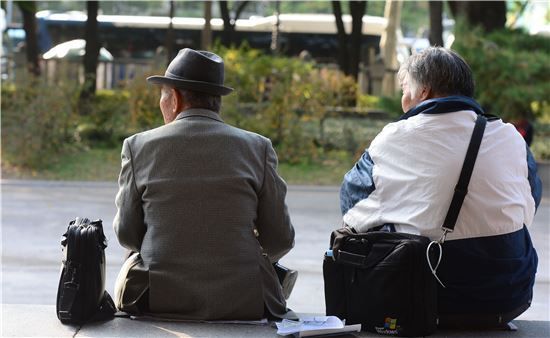 As the issue of elderly poverty worsens, calls for measures to address the problem continue to grow. The photo is unrelated to specific expressions in the article. Photo by Asia Economy DB.
[Asia Economy Reporter Heo Midam] While the speed of aging in South Korea is about twice as fast as that of Japan, it has been revealed that proper retirement measures such as pensions are insufficient, becoming a social issue. Most elderly people manage their monthly living expenses with pensions after retirement, but there are quite a few who do not receive pensions, and even those who do receive them find the amounts insufficient, according to the survey.
As a result, elderly people who find their livelihood bleak tend to seek jobs again rather than enjoying life after retirement. Experts emphasized the need to provide jobs for the elderly.
Recently, although South Korea’s aging speed is unprecedentedly fast worldwide, a survey showed that retirement measures are inadequate.
The Korea Economic Research Institute (KERI), under the Federation of Korean Industries, commissioned the polling agency Mono Research to investigate the pension receipt status of 500 elderly people aged 65 and over in both Korea and Japan. The results showed that over the past 10 years, South Korea’s elderly population aged 65 and over increased by an average of 4.2% annually, twice as fast as Japan’s 2.1%.
KERI projected that if this trend continues, South Korea’s elderly population ratio (15.7%) will exceed the OECD average (18.8%) by reaching 19.2% in 2024, and by 2045, it will surpass Japan (36.8%) at 37.0%, becoming the country with the highest elderly population ratio in the OECD.
While the elderly population that the state must support is steadily increasing, South Korea’s income measures for the elderly are insufficient compared to Japan. Among South Korea’s elderly, 83.9% receive public pensions, and 21.8% receive private pensions. These figures are more than 10 percentage points lower than Japan’s 95.1% and 34.8%, respectively.
The average pension amount in South Korea was also half that of Japan, with 828,000 KRW per month compared to Japan’s 1,644,000 KRW. For couple households, South Korea’s average monthly pension was 1,384,000 KRW, only 50.8% of Japan’s 2,726,000 KRW.
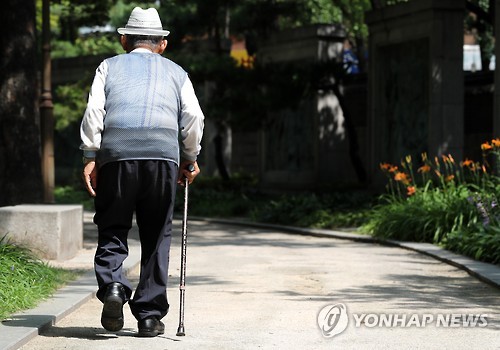 An elderly man is walking down the street with a cane. The photo is unrelated to specific expressions in the article. [Image source=Yonhap News]
Consequently, concerns about elderly poverty continue to rise. Kim, a worker in his 20s, said, "As average life expectancy increases, urgent measures for the elderly are needed. Most people want to work hard when young and live comfortably in old age. But now, it seems like they suffer their whole lives." He added, "More effective measures should be prepared so that the elderly can enjoy a healthy retirement."
Another worker in his 30s, Jung, said, "I feel that elderly issues are not someone else’s problem. As my parents approach retirement age, these issues hit closer to home. It hurts my heart every time my parents say, ‘What will I do for a living after retirement?’"
Meanwhile, the number of elderly people returning to the workforce due to bleak livelihoods is increasing.
According to OECD data, South Korea’s employment rate for those aged 65 and over was 34.1% last year. This figure far exceeds the OECD average of 14.7% among 38 member countries. South Korea surpassed Iceland (31%), which had held the top spot, becoming number one for the first time. In other words, one in three elderly people in South Korea works even after retirement age.
In this regard, advanced countries that faced aging societies earlier have long prepared for elderly poverty through a combination of some level of state guarantees and the activation of private pensions.
Representative countries are the United States and Germany. The U.S. offers a 'Catch-up Policy' that provides additional income tax deductions for citizens over 50 who join private pensions. Germany currently provides income tax deductions and subsidies for private pension contributions through the 'Riester Pension' system.
Experts suggested that South Korea also needs to provide quality jobs for the elderly, similar to advanced countries. Professor Kim Taegi of Dankook University’s Department of Economics said, "A common feature of countries facing aging crises is that they view the elderly as a labor force. The more the elderly work, the less welfare costs are incurred," adding, "Sometimes special education is needed for them to secure jobs."
© The Asia Business Daily(www.asiae.co.kr). All rights reserved.
![Clutching a Stolen Dior Bag, Saying "I Hate Being Poor but Real"... The Grotesque Con of a "Human Knockoff" [Slate]](https://cwcontent.asiae.co.kr/asiaresize/183/2026021902243444107_1771435474.jpg)
















