Consumer Prices Up 5.2% YoY... Highest in 10 Years and 3 Months
Petroleum Products Surge 35.5% in One Year
Early Cold Snap Drives Vegetable Prices Up Too
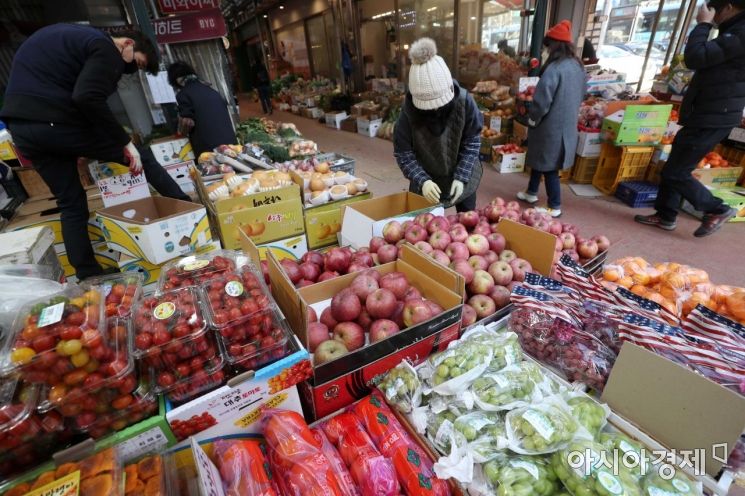 According to the Consumer Price Trends for November announced by Statistics Korea on the 2nd, the consumer price index last month was 109.41 (2015=100), an increase of 3.7% compared to the same month last year. This is the highest level since December 2011 (4.2%). It recorded the largest increase in 9 years and 11 months. On this day, citizens are shopping at Yeongcheon Market in Seodaemun-gu, Seoul. Photo by Moon Honam munonam@
[Sejong=Asia Economy Reporter Son Seon-hee] ‘Pork, eggs, lettuce, cucumber…’ These are items whose prices have surged into double digits compared to last year. In particular, the price of cucumbers has doubled over the past year. Due to an earlier-than-usual drop in temperature, poor agricultural yields last month have impacted food prices. Throughout the second half of the year, soaring oil prices have caused fuel costs to spike by more than 30%, and rent prices have also increased, deepening the financial worries of ordinary citizens. The COVID-19 pandemic has already strained the economy, and now high inflation is adding fuel to the fire.
◆Perceived inflation hits highest level in 10 years... Fuel tax cuts still ‘insufficient’= According to the ‘November Consumer Price Trends’ released by Statistics Korea on the 2nd, the living cost index last month recorded 110.74 (2015=100 base), marking a 5.2% increase compared to the same month last year. The living cost index is calculated based on 141 items that consumers frequently purchase and spend on, such as food and daily necessities, making it a so-called ‘perceived inflation’ measure. The increase in perceived inflation last month was the largest in 10 years and 3 months since August 2011 (5.2%). This means consumers felt the highest price rise in a decade.
By item, petroleum prices surged by a staggering 35.5% compared to a year ago, the largest increase in 13 years and 4 months since July 2008 (35.5%). Agricultural, livestock, and fishery product prices rose by 7.6% during the same period, and personal service prices, including dining out, increased by 3.0%. These three categories contributed 78.7% to the overall inflation increase.
Petroleum prices pushed the overall industrial product price increase rate to 5.5%, the largest rise in about 10 years since December 2011 (6.4%).
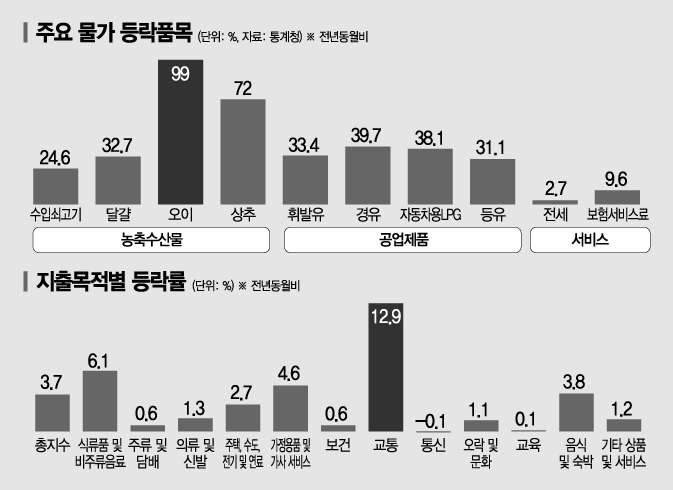
◆Early cold snap drives vegetable prices up... Housing prices also rise= This year, winter started earlier than usual, causing vegetable prices last month to rise 9.3% compared to a year ago. Centered on vegetables, agricultural products rose 5.7%, livestock products 15%, resulting in an overall 7.6% increase in agricultural, livestock, and fishery product prices. The sharp temperature drop recently led to poor crop yields, and demand for kimchi-making increased earlier than usual, significantly impacting prices.
Service prices also rose 2.2% compared to the same month last year. Personal service prices, including dining out, increased by 3.0%. The rise in dining prices is primarily attributed to increased ingredient costs due to higher agricultural, livestock, and fishery product prices.
Rent also increased by 1.9%, the largest rise since June 2016 (1.9%), before the Moon Jae-in administration took office.
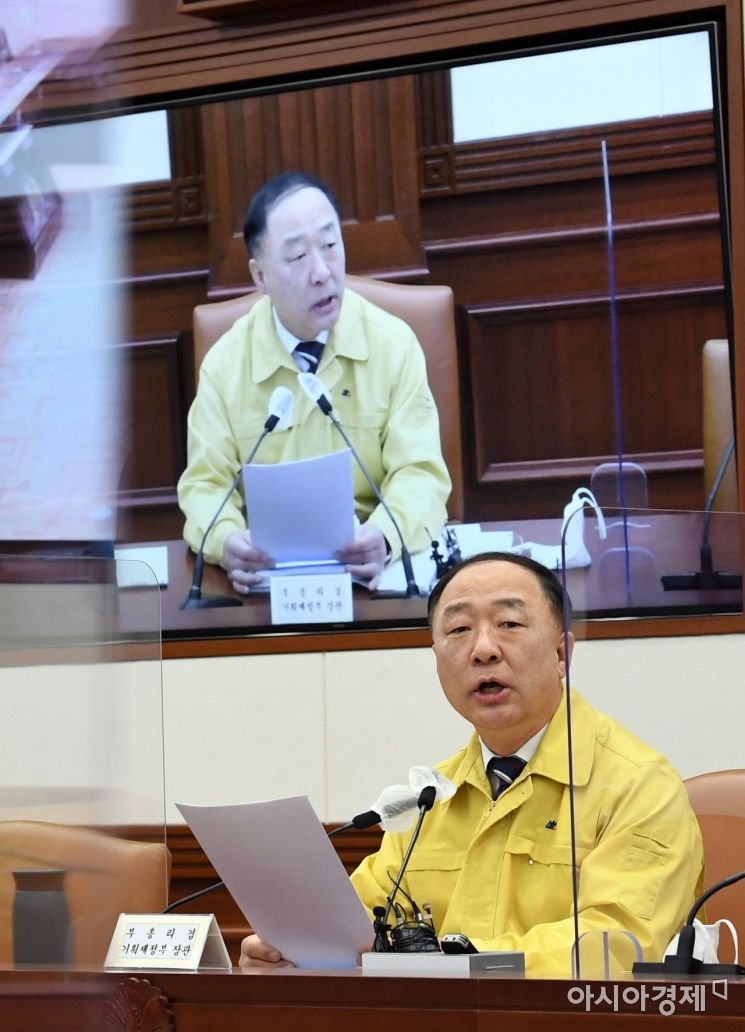 Deputy Prime Minister and Minister of Economy and Finance Hong Nam-ki is delivering opening remarks at the Emergency Economic Central Countermeasures Headquarters meeting held on the 2nd at the Government Seoul Office in Jongno-gu, Seoul. Photo by Kim Hyun-min kimhyun81@
◆Government introduces ‘price responsibility system by ministry’... Annual inflation expected to exceed 2.3% = The government expects that the effect of the fuel tax cut will be fully reflected this month, and that the price increase will moderate compared to last month as demand for kimchi-making vegetables declines earlier. Meanwhile, to stabilize prices in everyday shopping for ordinary citizens, the government plans to introduce a ‘price responsibility system by ministry’ centered on the central government and establish comprehensive price situation rooms in local governments nationwide.
Hong Nam-ki, Deputy Prime Minister and Minister of Economy and Finance, held an emergency economic central countermeasure meeting at the Government Seoul Office on the same day and said, "In December, the rise in prices is expected to slow due to the easing of international oil price increases and the effect of the fuel tax cut," adding, "On an annual basis, the inflation rate is expected to be similar to the Bank of Korea’s forecast of 2.3% and the OECD’s forecast of 2.4%."
However, with the recent serious spread of the Omicron variant and other COVID-19 developments, there remains a possibility that economic and inflation uncertainties will expand depending on future quarantine conditions.
© The Asia Business Daily(www.asiae.co.kr). All rights reserved.
![Clutching a Stolen Dior Bag, Saying "I Hate Being Poor but Real"... The Grotesque Con of a "Human Knockoff" [Slate]](https://cwcontent.asiae.co.kr/asiaresize/183/2026021902243444107_1771435474.jpg)


















