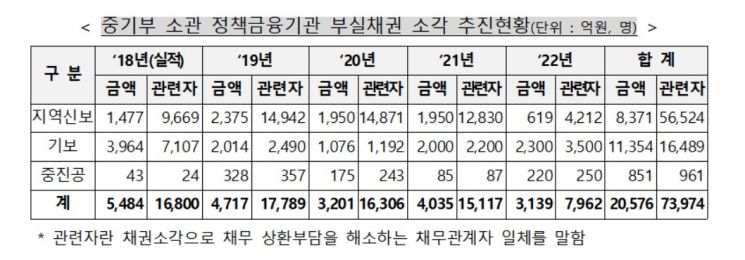
 Status of Non-Performing Loan Write-Offs at Policy Financial Institutions under the Jurisdiction of the Ministry of SMEs and Startups. [Table=Ministry of SMEs and Startups]
[Asia Economy Reporter Kim Jong-hwa] "Writing off non-performing loans has a greater effect of removing obstacles to recovery."
This is why the Ministry of SMEs and Startups regularly writes off non-performing loans every year. Since 2018, the Ministry has been regularly writing off non-performing loans held by three policy financial institutions under its jurisdiction: regional credit guarantee foundations, the Korea Technology Finance Corporation, and the Small and Medium Business Corporation.
This year, on the 25th of last month, during the '2021 Rechallenge Day' event, non-performing loans worth 403.5 billion KRW were written off. Through this, 15,117 people were able to shed an average debt of 27 million KRW per person and start anew. From 2018 to this year, a total of 1.7437 trillion KRW worth of non-performing loans have been written off, freeing 66,012 people from the shackles of debt. Next year, the write-off of 313.9 billion KRW worth of non-performing loans is planned, and 7,962 people are expected to spread their wings for recovery.
There was criticism that writing off non-performing loans could increase the risk of moral hazard, as habitual debt defaulters might increase. However, as positive effects appeared by removing obstacles to recovery for debtors who could not engage in economic activities due to the burden of debt, concerns about moral hazard have diminished.
A, who successfully restarted a business after becoming a non-performing loan write-off company at the Korea Technology Finance Corporation in 2012, said, "I went through corporate bankruptcy and personal bankruptcy, and my wife underwent two surgeries for cerebral hemorrhage. At the age of 60, I had a strong trauma about trying again," and calmly added, "However, the write-off of non-performing loans became a motivation to take on new challenges."
B, who succeeded in recovery last year after being a write-off target of the Korea Credit Guarantee Foundation Central Association, said, "I believe that if you don't give up and keep trying, you can achieve anything," and added, "Through the write-off of non-performing loans, I was able to restore my credit."
Institutionally, the possibility of moral hazard is almost nonexistent. The targets for non-performing loan write-offs are debts confirmed by court rulings such as bankruptcy declarations or discharge decisions, and individuals or companies who have completed all credit recovery and personal rehabilitation procedures.
An official from the Ministry of SMEs and Startups said, "We believe there are no people or companies who intentionally delay payments, go through bankruptcy and arduous personal rehabilitation procedures, and wait for write-offs," and added, "We must help people resume economic activities through the write-off of non-performing loans. It is desirable to reduce the statute of limitations for debt extinction from five years to about three years to support more people benefiting."
There is also an opinion that non-performing loans should be written off to reduce welfare costs. Kim Jeong-sik, Professor Emeritus of Economics at Yonsei University, diagnosed, "People who cannot recover credit cannot work if left as is. Ultimately, welfare costs increase," and said, "Writing off non-performing loans to restore their credit and enable economic activities results in a reduction of welfare costs."
© The Asia Business Daily(www.asiae.co.kr). All rights reserved.
![Clutching a Stolen Dior Bag, Saying "I Hate Being Poor but Real"... The Grotesque Con of a "Human Knockoff" [Slate]](https://cwcontent.asiae.co.kr/asiaresize/183/2026021902243444107_1771435474.jpg)















