Institute for Basic Science
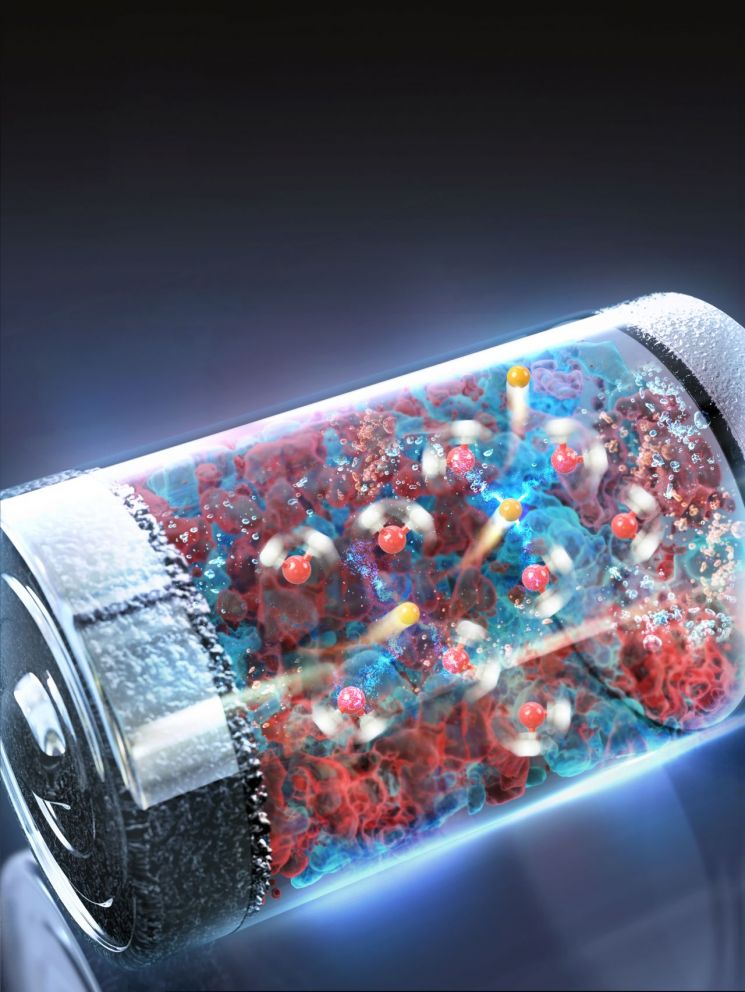
[Asia Economy Reporter Kim Bong-su] Domestic researchers have developed a core technology for next-generation lithium-ion batteries that pose no fire risk. This lays the groundwork for improving the performance of aqueous electrolyte lithium-ion batteries.
The Institute for Basic Science (IBS) announced on the 1st that the research team led by Minhaeng Cho from the Molecular Spectroscopy and Dynamics Research Center, in collaboration with Professor Ho-Chun Lee’s team at Daegu Gyeongbuk Institute of Science and Technology (DGIST), identified the correlation between the state of water molecules and lithium-ion transport speed in aqueous electrolyte lithium-ion batteries.
Lithium-ion batteries are used in most small electronic devices such as smartphones and laptops. The problem is that the currently used lithium-ion batteries employ flammable organic solvents, which pose a fire risk. Although aqueous electrolyte lithium-ion batteries that replace organic solvents with non-flammable water have been developed, performance improvements are still needed.
Aqueous electrolyte lithium-ion batteries, based on water, have excellent stability and are attracting attention as alternatives to conventional lithium-ion batteries. To use aqueous electrolytes at high voltages, salts must be dissolved at ultra-high concentrations to prevent water from electrolyzing at high voltages. Theoretically, this increases the viscosity of the electrolyte, hindering lithium-ion transport. However, in reality, ultra-high concentration electrolyte lithium-ion batteries enable fast lithium-ion transport despite high viscosity, but the mechanism behind this had not been clearly elucidated.
The joint research team observed the behavior of water molecules in aqueous electrolytes according to salt concentration using advanced spectroscopic techniques called ‘infrared excitation probe spectroscopy’ and ‘dielectric relaxation spectroscopy.’ Previously, it was expected that in ultra-high concentration solvation environments, all water molecules would interact with lithium salts, completely breaking hydrogen bonds between water molecules.
By increasing the salt concentration to saturation levels, the researchers confirmed that even at an ultra-high concentration of about 28 molal (mol/kg, indicating the number of moles of solute dissolved per 1 kg of solvent), a significant amount of water molecules still form hydrogen bonds with other water molecules. Notably, water molecules that form hydrogen bonds with other water molecules exhibited faster rotational dynamics than those hydrogen-bonded to the anions of lithium salts. Faster rotational dynamics indicate that the solvation structure of lithium ions changes rapidly, increasing the likelihood of lithium-ion movement.
Researcher Jun-gyu Kim explained, “This study is the first case to describe the dynamics of water molecules in ultra-high concentration aqueous electrolytes at the molecular level,” adding, “This discovery was possible because infrared excitation probe spectroscopy allowed us to distinguish the hydrogen bonding partners of each water molecule.”
Director Cho also stated, “Our research team is conducting microscopic studies on various water-based electrolytes using infrared excitation probe spectroscopy,” and added, “We expect to provide fundamental knowledge for designing next-generation lithium-ion batteries that can promote lithium-ion transport.”
The research results were published online on the 26th of last month in the international journal ACS Energy Letters (IF 23.101), published by the American Chemical Society (ACS).
© The Asia Business Daily(www.asiae.co.kr). All rights reserved.
![Clutching a Stolen Dior Bag, Saying "I Hate Being Poor but Real"... The Grotesque Con of a "Human Knockoff" [Slate]](https://cwcontent.asiae.co.kr/asiaresize/183/2026021902243444107_1771435474.jpg)
















