KAIST and KIST Joint Development
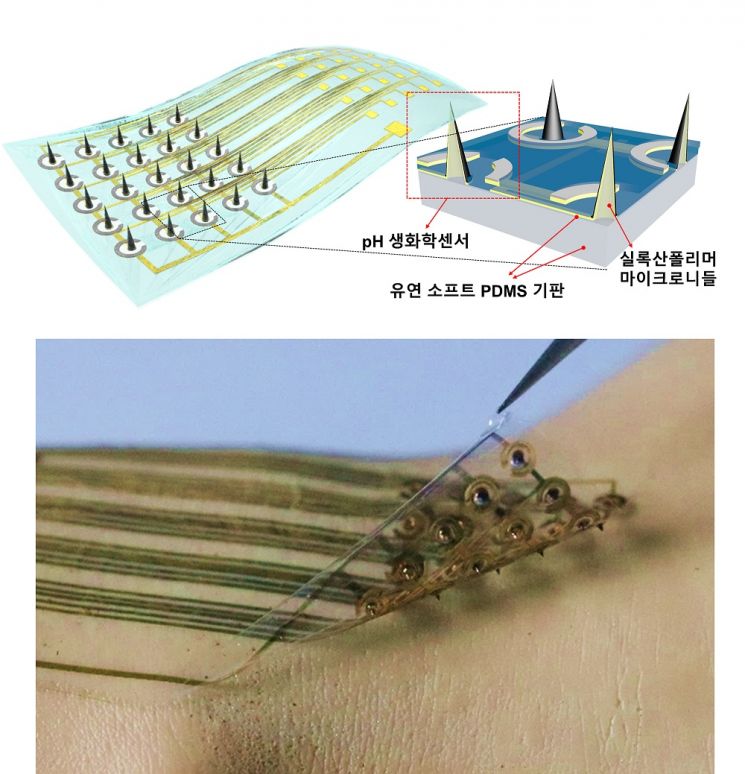 Overview diagram and actual photo of the flexible microneedle biochemical sensor. Provided by KAIST·KIST
[Asia Economy Reporter Kim Bong-su] A technology has been developed that can diagnose diabetes and peripheral artery disease simply by attaching a soft patch without drawing blood with sharp needles.
The Korea Advanced Institute of Science and Technology (KAIST) announced on the 1st that Professor Bae Byung-soo of the Wearable Platform Materials Technology Center, in collaboration with Dr. Lee Won-ryeong of the Korea Institute of Science and Technology (KIST) and Dr. Jung Seung-hwan of Seoul National University Hospital, developed a medical sensor platform technology in which mechanically stable microneedles are bonded onto a flexible substrate, enabling application for diagnosing peripheral artery disease.
This technology overcomes the limited access to biofluids, a common limitation of typical wearable diagnostic devices, by minimally invasive use of microneedles, enabling biochemical disease diagnosis. Using the wearable microneedle sensor, they measured the pH (degree of acidity or alkalinity) distribution of a peripheral artery disease model to confirm its diagnostic potential.
Wearable diagnostic devices are expected to be used in diagnosing various diseases such as heart disease, brain disorders, diabetes, and metabolic diseases by fabricating thin-film sensors on soft substrate materials to measure bioelectrical signals (electrocardiogram, electromyogram, electroencephalogram, etc.) and biochemical signals (glucose, lactate, pH, etc.). However, the accessible biofluids have been limited to sweat, tears, and the like, restricting continuous monitoring.
To address this, the research team applied a polymer based on a siloxane (Si-O-Si) framework, synthesized through their self-developed sol-gel process, as the microneedle material to the wearable device platform, completing a wearable microneedle biochemical sensing platform capable of continuous biofluid monitoring through microneedles.
To demonstrate the utility of the wearable microneedle biochemical sensing platform, the team deposited polyaniline, which shows changes in surface energy in response to pH, onto the microneedles, enabling application as an independent pH sensor array. The microneedle pH sensor using polyaniline exhibited high mechanical stability, maintaining over 80% sensor sensitivity even after 1,000 insertions into pig skin and 1.5 mm bending deformation tests.
Using the wearable microneedle pH sensor, the research team measured the pH distribution of skin-proximal biofluids in a peripheral artery disease model to verify its usefulness as a disease diagnostic device. Most patients with mild or chronic peripheral artery disease do not show clinical symptoms that indicate the onset or progression of the disease. However, monitoring pH changes can detect lactic acidosis caused by hypoxia, thereby appropriately detecting tissue damage due to ischemic injury.
The team created a peripheral artery disease model by surgically ligating the arterial blood flow at the hip joint leading to the right leg, artificially worsening blood flow. Subsequent pH measurements of subcutaneous biofluids through microneedles showed increased acidity toward the distal end, demonstrating the applicability of the wearable microneedle sensor.
Professor Bae Byung-soo, who led the research, explained the significance of the study: “By bonding rigid microneedles onto a soft, flexible substrate to create a disease diagnostic microneedle film that can be attached to the skin, it is expected to be used as a wearable device for biochemical diagnosis not only of peripheral artery disease but also diabetes and metabolic diseases.”
The research results were published online in the international journal Science Advances.
© The Asia Business Daily(www.asiae.co.kr). All rights reserved.
![Clutching a Stolen Dior Bag, Saying "I Hate Being Poor but Real"... The Grotesque Con of a "Human Knockoff" [Slate]](https://cwcontent.asiae.co.kr/asiaresize/183/2026021902243444107_1771435474.jpg)















