Announcement of Deposit-Taking Institutions' Industry-Specific Loans in Q3
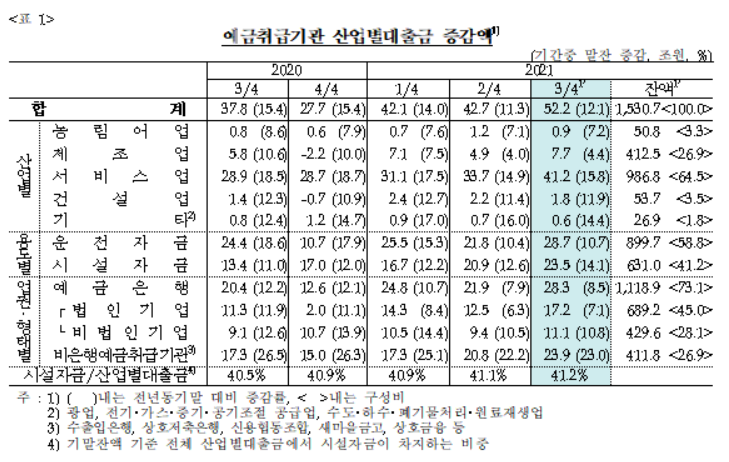
[Asia Economy Reporter Jang Sehee] The increase in loans for the real estate industry rose significantly from 12.1 trillion won in the second quarter to 13.8 trillion won in the third quarter. This was due to the government's loan regulations and the still high investment returns on commercial real estate.
According to the 'Industrial Loans by Deposit-taking Institutions in the Third Quarter' statistics released by the Bank of Korea on the 1st, loans for all industries as of the end of the third quarter (end of September) amounted to 1,530.7 trillion won, an increase of 52.5 trillion won compared to the end of the second quarter. The increase was also 9.5 trillion won larger than the 42.7 trillion won increase in the second quarter.
By industry, manufacturing loans increased by 7.7 trillion won over three months. The growth rate accelerated compared to 4.9 trillion won in the second quarter. This is analyzed to be influenced by the ongoing domestic and international economic recovery and rising raw material prices. Loans for the service industry also increased by 41.2 trillion won.
The increase in loans for the real estate industry was 13.8 trillion won, due to expanded investment in commercial real estate.
Song Jaechang, head of the Financial Statistics Team at the Bank of Korea's Economic Statistics Bureau, explained, "Following the second quarter, the investment returns remained high in the third quarter," adding, "Investment funds are moving into officetels, shopping centers, and the like."
However, in the construction and agriculture, forestry, and fisheries sectors, loan increases were 1.8 trillion won and 900 billion won respectively, showing a decrease compared to the previous quarter.
By loan purpose, working capital loans increased by 21.8 trillion won, and facility capital loans rose by 23.5 trillion won.
Looking at the loan increase by lending institutions in the third quarter, deposit banks saw an increase from 2.8 trillion won to 5.6 trillion won, while non-bank deposit-taking institutions recorded a similar increase of 2.1 trillion won compared to the previous quarter.
Meanwhile, Song explained regarding the future impact of Omicron, "We need to observe the factors unique to Omicron a bit more, but the demand for working capital loans may increase in the future."
© The Asia Business Daily(www.asiae.co.kr). All rights reserved.
![Clutching a Stolen Dior Bag, Saying "I Hate Being Poor but Real"... The Grotesque Con of a "Human Knockoff" [Slate]](https://cwcontent.asiae.co.kr/asiaresize/183/2026021902243444107_1771435474.jpg)















