Yuanta Securities Report
Bovespa Index Q4 Return -7%
Worst Performance Among 50 Countries Worldwide
Turkey Central Bank Cuts Interest Rates
Lira Value Drops Over 30% This Month

[Asia Economy Reporter Minji Lee] Brazil and Turkey are expected to face increasingly sluggish financial market conditions due to weak economic fundamentals and government policies that fail to take these into account.
According to Yuanta Securities on the 1st, Brazil's representative index, the Bovespa Index, posted a Q4 return of -7.4%, the worst among 50 countries worldwide. The year-to-date return was -13.6%, also the lowest among major countries. During the same period, the ACWI (All Country World Index) rose 14.2%, highlighting Brazil's poor performance even more.
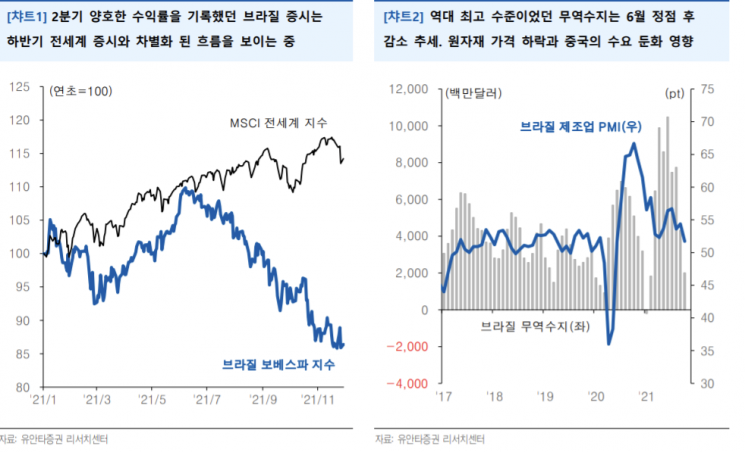
Brazil's biggest problem is the decline in commodity prices and reduced commodity imports from China. In Q4, the returns on Brazil's top three export items were soybean 0.5%, iron ore -9.5%, and crude oil -9.3%. Min Byung-gyu, a researcher at Yuanta Securities, explained, "Thanks to strong demand from China in the first half of the year, Brazil's trade balance reached a record high of $10.48 billion as of June, and the stock market return in Q2 approached 8.7%. However, the trade balance in October was $2 billion, and the manufacturing Purchasing Managers' Index recorded its lowest level since June last year, showing a mixed picture."
With significantly weakened fundamentals, populist government policies ahead of next year's presidential election are also limiting index recovery. President Bolsonaro, who took office in January 2019, made pension reform?a system accounting for about 44.5% of fiscal expenditure?a key campaign pledge, which led to a roughly 20% surge in the Brazilian stock market in the six months before and after his inauguration. However, this year, the pension's share of fiscal expenditure actually increased to 45.5%, and recently, various populist policies under the guise of subsidies have been rampant.
Researcher Min said, "There is a growing perception that Brazil's fiscal deficit next year will worsen beyond the current forecast (-7.4%). With both external and domestic demand sluggish, Brazil's economic growth rate is expected to be the lowest among 50 countries worldwide at 1.5%."
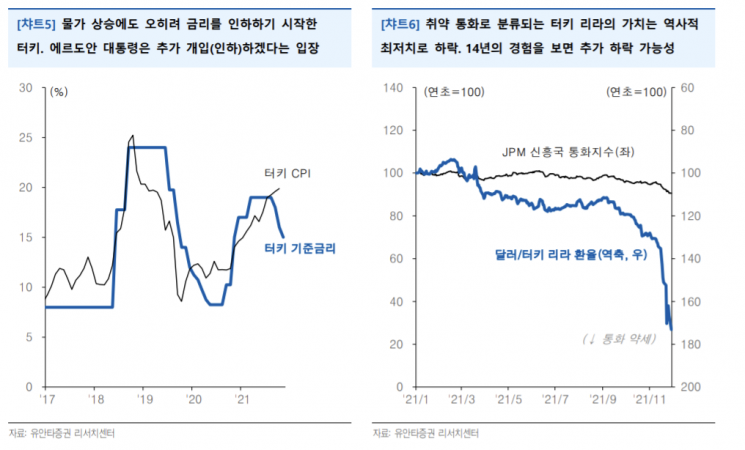
Turkey is being held back by the central bank's actions that contradict conventional wisdom. In October, Turkey's consumer price inflation reached 19.9%, necessitating rate hikes to control it; however, the central bank cut the benchmark interest rate by 100 basis points (1bp=0.01%) this month. Turkey's rate cuts have continued since September, with an additional 100bp cut expected this month.
This behavior by the Turkish central bank is analyzed to be due to President Erdo?an, who is seeking re-election in 2023, pressuring for rate cuts. Researcher Min Byung-gyu stated, "President Erdo?an, who believes that high interest rates cause high inflation, has expressed that rate cuts will continue. As the central bank's independence has been compromised, the Turkish lira depreciated by 33.8% in November alone, hitting a historic low against the dollar."
Finally, researcher Min advised, "Brazil and Turkey were selected as the 'five vulnerable currencies' in 2013, and high currency volatility continued the following year (Real weakened by 12.7%, Lira weakened by 8.8%), so close monitoring is necessary."
© The Asia Business Daily(www.asiae.co.kr). All rights reserved.
![Clutching a Stolen Dior Bag, Saying "I Hate Being Poor but Real"... The Grotesque Con of a "Human Knockoff" [Slate]](https://cwcontent.asiae.co.kr/asiaresize/183/2026021902243444107_1771435474.jpg)

















