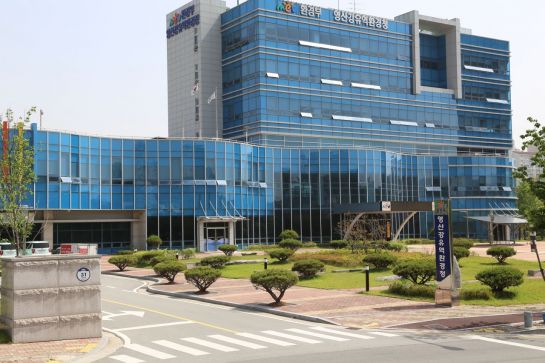
[Asia Economy Honam Reporting Headquarters Reporter Park Jin-hyung] The Yeongsangang River Basin Environmental Office (Director Ryu Yeon-gi) announced on the 30th that it is continuously strengthening cooperation systems with related organizations to prevent water pollution accidents and improve rapid response capabilities.
To enhance the response capability to water pollution accidents, a joint training with related organizations was completed this month in a non-face-to-face manner reflecting the COVID-19 situation, and next month, training will be conducted for local government disaster prevention officers.
As part of the Safe Korea Training, on the 18th, a 'Large-scale Water Pollution Accident Response Joint Training' was conducted with the participation of seven organizations including the Ministry of Environment, providing an opportunity to check the cooperation system among related organizations and enhance response capabilities.
On the 16th of next month, joint training with the Korea Environment Corporation will be held at the Naju Disaster Prevention Equipment Stockpile Center for local government officers and others, providing education on disaster prevention equipment, supplies, and disaster prevention procedures used in water pollution accidents.
Additionally, during vulnerable periods, the cooperation system with related organizations is being strengthened to establish a rapid response system in case of accidents.
During the seasonal and thawing period (January to April), when river flow is low and even a small amount of pollutant inflow can lead to accidents, measures such as operating a situation room and inspecting emission sources in potential pollution accident areas by related organizations have been promoted for prevention and response.
Furthermore, environmental pollution accidents are being prevented through river monitoring in the Yeongsangang and Seomjingang river systems, operation of automatic water quality measurement networks, and phased installation of buffer retention facilities in industrial complexes.
Using nine automatic water quality measurement networks installed at water sources and major rivers, drone footage, and environmental guardian monitoring, signs of water pollution are identified and responses to water pollution accidents are carried out.
Based on drone footage, investigations were conducted twice on the storage status of compost and liquid fertilizer around rivers, resulting in appropriate storage measures being taken at 36 locations.
In addition, to prevent various environmental pollutants generated in industrial complexes from directly flowing into rivers and causing water pollution accidents, 8.9 billion KRW in national funds are being supported this year for the installation of buffer retention facilities in four industrial complexes.
Director Ryu Yeon-gi of the Environmental Office stated, “Accidents such as oil spills can lead to secondary accidents like fish deaths, so prevention is important. We urge related workplaces and emission sources to thoroughly maintain operational facilities to prevent pollution accidents.”
© The Asia Business Daily(www.asiae.co.kr). All rights reserved.
![Clutching a Stolen Dior Bag, Saying "I Hate Being Poor but Real"... The Grotesque Con of a "Human Knockoff" [Slate]](https://cwcontent.asiae.co.kr/asiaresize/183/2026021902243444107_1771435474.jpg)















