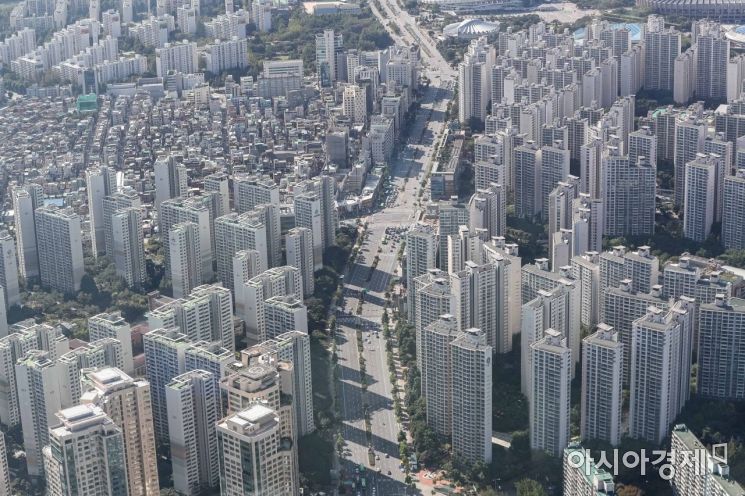
[Asia Economy Reporter Kangwook Cho] The polarization of housing prices nationwide is intensifying to an unprecedented level. The quintile ratio, which represents the price gap between high-priced and low-priced houses, has reached an all-time high not only in apartment sales but also in jeonse (long-term lease), showing a strong concentration toward high-priced apartments. In particular, the gap between the metropolitan area and other regions is widening, further increasing the disparity in housing prices.
According to the monthly housing market trend time series statistics from KB Real Estate on the 30th, the nationwide apartment quintile ratio was recorded at 9.3 for sales prices and 7.4 for jeonse prices. These figures increased by 0.7 and 0.5 respectively compared to the previous month, marking the highest levels since the survey began in December 2008.
The quintile ratio divides houses into five groups based on price, and is calculated by dividing the average price of the top 20% (5th quintile) by the average price of the bottom 20% (1st quintile). It indicates the price gap between high-priced and low-priced houses, with a higher ratio meaning more severe polarization. Nationwide, apartments in the top 20% are priced 9.3 times higher in sales and 7.4 times higher in jeonse than those in the bottom 20%.
This month, the average price of 1st quintile apartments nationwide was 125.75 million KRW, down 2.57 million KRW from last month, while the 5th quintile apartments averaged 1.16743 billion KRW, up 61.36 million KRW. During the same period, jeonse prices rose by 1.23 million KRW to 88.35 million KRW for the 1st quintile, and by 28.91 million KRW to 650.82 million KRW for the 5th quintile. The much larger price increase for apartments in the top 20% compared to the bottom 20% is interpreted as the cause of polarization.
This phenomenon is accelerating mainly in regional areas. For sales, the Seoul apartment quintile ratio remained at 4.1 this month, the same as last month, but the five major metropolitan cities (Busan, Daegu, Gwangju, Ulsan, Daejeon) and other regional areas recorded 5.7 and 6.5 respectively, the highest since the survey began. For jeonse, the quintile ratios in Seoul (3.9), the five major metropolitan cities (4.9), and other regional areas (6.2) all reached record highs.
Along with this, the price gap between apartments in the metropolitan area and other regions is widening further. In November, the average apartment price in the metropolitan area was 783.88 million KRW, while the average apartment price in other regions was 229.83 million KRW, resulting in a gap of 554.05 million KRW. This is the largest gap since statistics began. In particular, comparing the average prices of apartments in the top 20%, the gap between the metropolitan area and other regions has risen to over 1.1 billion KRW.
© The Asia Business Daily(www.asiae.co.kr). All rights reserved.
![Clutching a Stolen Dior Bag, Saying "I Hate Being Poor but Real"... The Grotesque Con of a "Human Knockoff" [Slate]](https://cwcontent.asiae.co.kr/asiaresize/183/2026021902243444107_1771435474.jpg)















