Professor Park Chi-young's DGIST Team Develops Supramolecular Complex for Long-Term Periodic Delivery of Ultra-Low Drug Doses
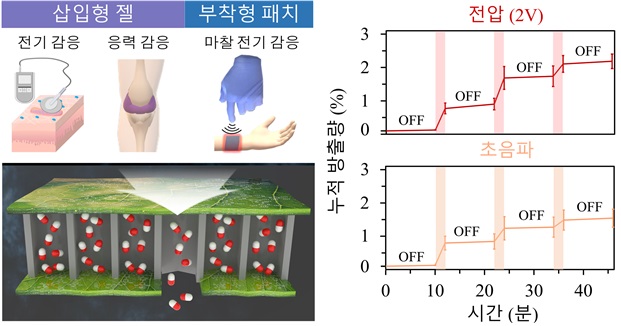 Schematic of functional nanoparticles and hydrogel release using tannic acid-iron ion coordination complexes. The tannic acid-iron ion coordination complex is rapidly coated onto drug-loaded functional nanoparticles to prevent continuous drug release and selectively respond to electrical and ultrasonic stimuli. The fabricated nanoparticles are fused with a hydrogel matrix, demonstrating the ability to release in response to electrical, ultrasonic, and triboelectric stimuli. Provided by DGIST
[Asia Economy Reporter Kim Bong-su] A smart drug delivery system that injects or attaches a tiny amount of drugs to the skin for long-term and periodic delivery has been developed. It is expected to enable much more convenient and precise patient-customized drug use compared to injections or oral medications.
Daegu Gyeongbuk Institute of Science and Technology (DGIST) announced on the 30th that Professor Park Chi-young's team from the Department of Energy Engineering succeeded in developing an injectable gel and skin-attachable patch using a supramolecular complex that enables long-term and periodic delivery of minute amounts of drugs. The developed complex is made of a nanomaterial responsive to low power and ultrasound, and it is expected to be utilized as a high-performance medical device in the future.
Developing a complex that responds to signals to release a specific amount of a drug has attracted much attention in smart drug delivery system research. However, such complexes are complicated to synthesize and require purification processes. There have been difficulties in development due to limitations in producing complexes that respond to various stimuli and release precise amounts of drugs.
The research team utilized the fact that the coordination complex of tannic acid and iron ions can be formed in a short time to successfully manufacture the complex quickly. They loaded drugs into mesoporous silica nanoparticles, which have multiple pores ranging from 2 to 50 nm, and coated them with the coordination complex to control drug release.
Additionally, the coated nanoparticles were made to selectively release minute amounts of drugs in response to electrical or ultrasonic stimuli, and these were fabricated into gel and patch forms that can be implanted in the human body. As a result, it was confirmed that gels or patches containing the complex could release a certain amount of drugs in response to stimuli such as ultrasound and triboelectricity. When the developed complex is implanted or attached in patch or gel form, the amount of drug release can be controlled remotely or through triboelectric response. This means it can operate without a battery, and it is expected to be applied in the production of wearable devices in the future.
Professor Park said, "The technology developed this time is a core technology that precisely responds to electrical signals, ultrasound, stress, triboelectricity, etc., and enables long-term delivery of appropriate drug amounts," adding, "It can also be applied to various attachable patches and implantable gel systems."
The research results were published online on September 9 in the international journal on nanomaterials, ‘ACS NANO.’
© The Asia Business Daily(www.asiae.co.kr). All rights reserved.
![Clutching a Stolen Dior Bag, Saying "I Hate Being Poor but Real"... The Grotesque Con of a "Human Knockoff" [Slate]](https://cwcontent.asiae.co.kr/asiaresize/183/2026021902243444107_1771435474.jpg)
















