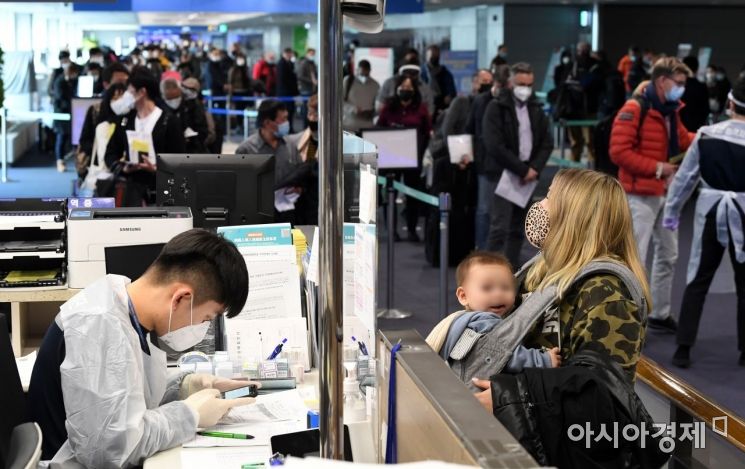
 As the COVID-19 variant virus 'Omicron' rapidly spreads worldwide, overseas arrivals departing from Khabarovsk, Russia, and Frankfurt, Germany, on the 29th are entering Incheon International Airport and undergoing screening. / Photo by Airport Photographers Group
[Asia Economy Reporter Lee Chun-hee] While countries around the world are locking their borders to prevent the influx of the 'Omicron' COVID-19 variant, health authorities have stated that they are not considering a complete ban on entry for all foreigners to block the variant virus.
Kim Ju-sim, head of the Overseas Entry and Exit Management Team at the Central Disease Control Headquarters, said at a COVID-19 briefing on the afternoon of the 29th, "We are currently not considering a complete ban on entry for all foreigners."
On the 26th (local time), the World Health Organization (WHO) designated the Omicron variant as a Variant of Concern (VOC). This variant has as many as 32 mutations in the 'spike (S) protein,' the binding site to human cells, raising concerns about increased transmissibility and immune evasion. This is about twice the number of spike protein mutations (16) found in the Delta variant, which is currently dominant in South Korea.
In particular, the Omicron variant has a large number of spike protein mutations that were previously found in variants such as Alpha, Beta, Gamma, Delta, and Lambda, which were associated with increased infectivity and immune evasion. This is why the WHO designated it as a major variant just three days after South Africa reported it on the 24th.
Accordingly, health authorities have designated eight countries?South Africa, Botswana, Zimbabwe, Namibia, Lesotho, Eswatini, Mozambique, and Malawi?as enhanced quarantine countries, high-risk countries, and countries excluded from quarantine exemption, effective from midnight on the 28th. As a result, visa issuance to these eight countries is restricted. Foreigners transiting through these countries will have their passports checked during boarding procedures, and boarding will be restricted. Even if they board and enter the country, entry will not be permitted.
Domestic residents, regardless of vaccination status, will be quarantined in temporary living facilities for 10 days. This applies even if they have completed all COVID-19 vaccinations in South Korea before departure. Regarding the shorter quarantine period compared to the known maximum incubation period of 14 days, Park Young-jun, head of the epidemiological investigation team at the Central Disease Control Headquarters, explained, "The average incubation period is mostly 4 to 5 days," adding, "Symptoms or confirmation usually appear within 10 days after infection." Based on existing research and domestic situations, the rate of missing confirmed cases on the 10th day test is extremely low, below 0.3%. Therefore, "to align with the phased daily recovery (With COVID-19) and for efficiency, both community and imported case quarantines have shifted to testing on the 10th day and releasing quarantine upon a negative result," he added.
 Japanese Prime Minister Fumio Kishida announced on the 29th at his official residence that new entry of foreigners will be temporarily banned to prevent the influx of the COVID-19 Omicron variant.
 [Image source=Yonhap News]
Currently, countries worldwide are rapidly closing their borders to prevent the influx of the Omicron variant. The Japanese government announced on this day that, as part of measures to block the Omicron variant, "entry of foreigners will be banned worldwide starting from the 30th." According to Japan's Ministry of Health, Labour and Welfare, a Japanese man who entered from Namibia in Africa the previous day tested positive for COVID-19 and is being analyzed to determine if he is infected with the Omicron variant.
Canada banned entry for foreign travelers who visited seven southern African countries, including South Africa and Mozambique, on the 26th. However, on the 28th (local time), two travelers returning from Nigeria in Central West Africa tested positive for the Omicron variant, triggering a major alert in quarantine efforts.
However, our authorities are currently not considering a complete ban on entry for all foreigners in relation to this. Kim also stated that even if the Omicron variant is detected in countries other than the eight designated countries, the option to include those countries in the entry ban list is not yet under consideration.
According to the Central Disease Control Headquarters, among the 333 people who entered from the eight countries designated as enhanced quarantine countries, high-risk countries, and quarantine exemption excluded countries?South Africa, Botswana, Namibia, etc.?over the past four weeks since the 28th, none have tested positive for COVID-19. Kim explained that regarding those entering via third countries from the eight countries, "Currently, there are no direct flights from the eight countries, so all entries are via transit," and "measures have been put in place for this."
© The Asia Business Daily(www.asiae.co.kr). All rights reserved.
![Clutching a Stolen Dior Bag, Saying "I Hate Being Poor but Real"... The Grotesque Con of a "Human Knockoff" [Slate]](https://cwcontent.asiae.co.kr/asiaresize/183/2026021902243444107_1771435474.jpg)
















