Nowon District: from 6,000 to 10,000 people
Dobong and Jungnang Districts: from 3,000 to 5,000 people
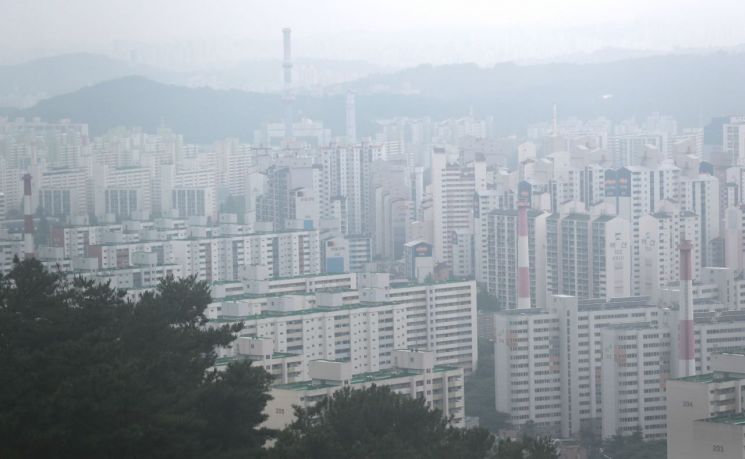
[Asia Economy Reporter Kim Min-young] The number of comprehensive real estate tax (종합부동산세) payers in areas where many low-income real demanders live, such as Nowon, Dobong, and Jungnang, has increased by 67% compared to last year. As housing prices surged even in the Gangbuk and Gangseo areas, where mid-to-low priced complexes are concentrated, the burden of the comprehensive real estate tax has increased not only in the Gangnam 3 districts but throughout all of Seoul. This has sparked controversy as the government's claim that the comprehensive real estate tax is a tax limited to the top 2% wealthy has become questionable. In particular, there are criticisms that despite the rise in housing prices being caused by government policy failures beyond homeowners’ control, the burden of the rapid price increase is being borne entirely by the public.
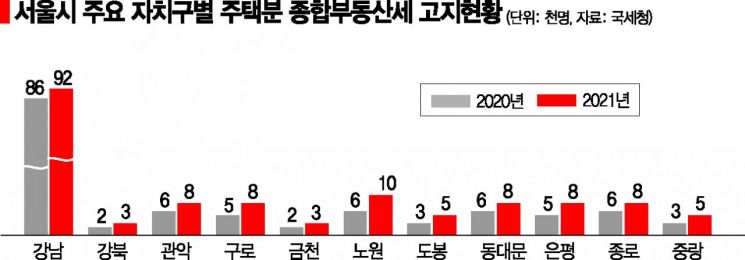
According to data titled ‘2021 Housing Comprehensive Real Estate Tax Notification Status by District in Seoul’ submitted by the National Tax Service to Rep. Choo Kyung-ho of the People Power Party on the 29th, the districts in Seoul with the largest increase in comprehensive real estate tax payers this year among the 25 districts were Nowon, Jungnang, and Dobong. Nowon District, which had 6,000 payers last year, increased to 10,000 this year, while Jungnang and Dobong each rose from 3,000 to 5,000. This represents a 67% increase in comprehensive real estate tax payers in just one year.
Although those paying the comprehensive real estate tax in Seoul are still concentrated in the Gangnam 3 districts, the increase in payers was larger in the Nodon area (Nowon, Dobong, Jungnang) compared to other regions. The number of payers in the Gangnam 3 districts rose by 10%, from 206,000 last year to 226,000 this year. Among them, Gangnam District only saw a 7% increase, from 86,000 to 92,000.
Relatively affordable districts such as Eunpyeong (60%), Guro (60%), Gangbuk (50%), and Geumcheon (50%) also saw more than a 50% increase in the number of comprehensive real estate tax payers compared to last year. Gwanak, Dongdaemun, and Jongno districts also experienced increases of over 30%. As the controversy over the comprehensive real estate tax spread, the government emphasized that it is a tax imposed only on the top 2%, but the actual notification status by district shows that payers have spread throughout Seoul.
The Nodobang area (Nowon, Dobong, Gangbuk) and Geumgwan districts (Geumcheon, Gwanak, Guro), where the number of comprehensive real estate tax payers increased significantly, have led the rise in Seoul apartment prices this year due to high-priced housing loan restrictions and relatively affordable housing prices. According to KB Real Estate Statistics, apartment sale prices in Nowon rose 26% compared to a year ago. During the same period, Dobong (21.48%), Guro (19.33%), Gangbuk (17.53%), Gwanak (15.37%), and Geumcheon (13.26%) also increased by more than 10%. Because of this, some criticize that government policies such as tightening loans and strengthening taxes have caused housing prices to skyrocket, and the resulting tax burden is being imposed on the public.
Seo Jin-hyung, president of the Korea Real Estate Society and professor at Gyeongin Women’s University, pointed out, "The original goal of introducing the comprehensive real estate tax was to stabilize real estate prices, but repeated government policy failures such as loan restrictions have only driven prices up. Taxation should achieve its purpose within the taxpayers’ ability to pay, but the rise in housing prices across all of Seoul has only increased the burden on homeowners."
© The Asia Business Daily(www.asiae.co.kr). All rights reserved.
![Clutching a Stolen Dior Bag, Saying "I Hate Being Poor but Real"... The Grotesque Con of a "Human Knockoff" [Slate]](https://cwcontent.asiae.co.kr/asiaresize/183/2026021902243444107_1771435474.jpg)
















