[Asia Economy Reporter Jeong Hyunjin] Amid the severe impact of COVID-19 on the nationwide accommodation and food service industries, it has been found that nearly half of these businesses are classified as marginal companies, with operating profits lower than interest expenses for three consecutive years. The number of marginal companies has increased by more than 10 percentage points compared to before the COVID-19 outbreak, especially in regions such as Jeju-do and Gangwon-do, where accommodation and food service industries are concentrated.
On the 29th, the Federation of Korean Industries announced the results of a survey on the proportion of marginal companies among Korean firms (subject to external audits, non-financial). As of last year, the overall proportion of marginal companies in Korea was 17.8%, meaning that 18 out of 100 companies failed to cover even their interest expenses with operating profits during the three years from 2018 to 2020. The number of companies reaching marginal status increased due to the impact of COVID-19, compared to 13.3% in 2018 and 15.5% in 2019.
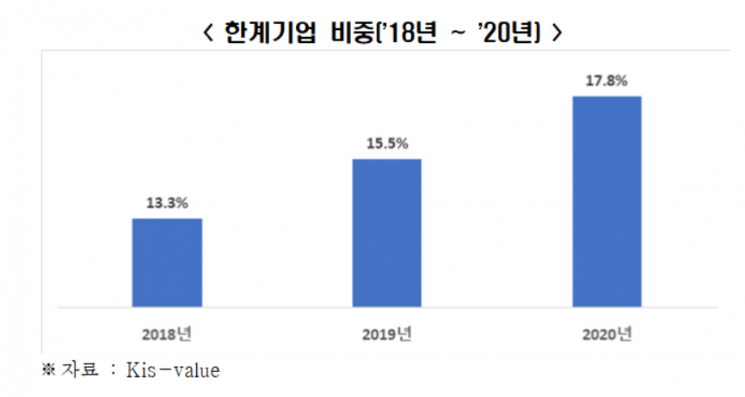
By industry, the proportion of marginal companies in the accommodation and food service sector was 45.4% last year, up 11.3 percentage points from 34.1% in 2018, showing the greatest impact from COVID-19. In particular, the proportion of marginal companies in the accommodation sector was 55.4% last year, an increase of 11.5 percentage points compared to 2018, while the food and beverage sector recorded 18.3%, up 10.7 percentage points from 2018. This was followed by business facility management and business support services (37.2%), and real estate and rental services (32.7%).
By region, Jeju-do had the highest proportion and growth rate of marginal companies. As of last year, Jeju-do's marginal company proportion was 42.7%, the highest among metropolitan and autonomous cities, and it increased by 8.8 percentage points compared to 2018, the largest increase among these regions. Following Jeju-do were Gangwon-do (24.3%) and Daejeon-si (23.4%).
Jeju, Gangwon, and Daejeon are regions with a large share of accommodation and food service industries or business facility management and business support services. Among externally audited companies in Jeju-do, the accommodation and food service sector accounted for 15.1%, the highest proportion among the 17 surveyed regions. Gangwon-do ranked second with 6.2%, while Daejeon recorded 1.9%, similar to the national average of 1.8%, but had the highest proportion of business facility management and business support services at 5.8%. Conversely, the manufacturing sector accounted for 9.1% in Jeju, 37.0% in Gangwon, and 42.4% in Daejeon, all below the national average of 46.2%.
On the other hand, the region with the lowest proportion of marginal companies was Sejong-si (13.5%), followed by Chungcheongbuk-do (14.3%) and Incheon-si (14.4%). These regions commonly have a high proportion of manufacturing industries. The manufacturing sector accounted for 47.7% in Sejong, 68.7% in Chungbuk, and 58.3% in Incheon, all higher than the national average of 46.2%. Conversely, the accommodation and food service sector accounted for 0% in Sejong and 0.8% in Chungbuk, both below the national average of 1.8%. Incheon recorded 1.8%, matching the national average, but had the lowest proportion of business facility management and business support services at 0.8% nationwide.
© The Asia Business Daily(www.asiae.co.kr). All rights reserved.
![Clutching a Stolen Dior Bag, Saying "I Hate Being Poor but Real"... The Grotesque Con of a "Human Knockoff" [Slate]](https://cwcontent.asiae.co.kr/asiaresize/183/2026021902243444107_1771435474.jpg)
















