Interest Rate Hike and Inflation Pressure... KOSPI Expected Between 2900 and 3050
[Asia Economy Reporter Lee Seon-ae] The emergence of COVID-19 variant viruses is expected to inevitably increase stock market volatility. The market is concerned that Omicron may be more powerful than the Delta variant.
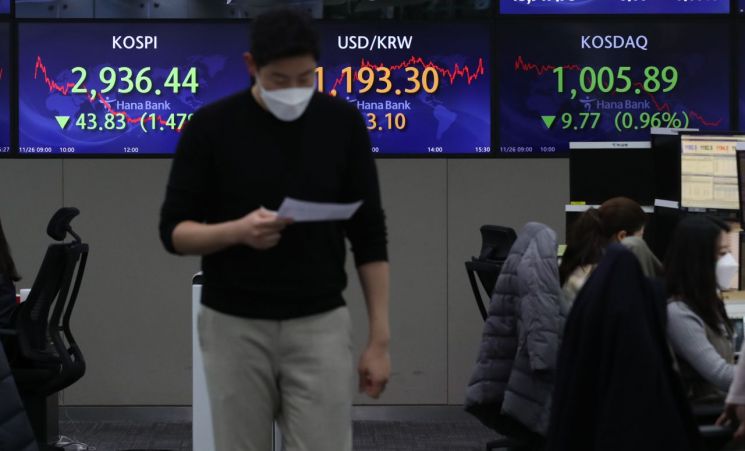
According to the Korea Exchange on the 28th, last week the KOSPI closed at 2,936.44, down 34.58 points (1.16%) from the previous week (2,971.02). In the KOSPI market, institutions led the index decline by net selling 1.2435 trillion KRW, and individuals also sold 58.8 billion KRW. Foreigners purchased 1.1231 trillion KRW.
Brokerages have suggested a KOSPI expected band of 2,900 to 3,050 for this week. Factors supporting an increase include expectations of easing global supply chain disruptions and strong U.S. consumer sales during the peak season. Factors for a decline include concerns over rising long-term U.S. interest rates, year-end selling by individual major shareholders to avoid capital gains tax, and fears of a COVID-19 resurgence.
Kim Young-hwan, a researcher at NH Investment & Securities, said, "In the first week of December, major economic indicators such as manufacturing indices of key countries, Korea’s exports and imports, and U.S. employment data are scheduled to be released in large numbers," adding, "If the manufacturing indices to be announced later consistently show a rebound, it is expected to raise investors’ expectations for easing supply chain disruptions."
He continued, "Positive employment indicators may stimulate concerns about rising interest rates, which may not positively affect the stock market in the short term," and added, "Improvement in economic indicators has increased the possibility of early rate hike concerns among market participants, leading to a rise in U.S. Treasury yields, which in turn raises the discount rate burden on the stock market."
Yeom Dong-chan, a researcher at eBest Investment & Securities, said, "Overall economic indicators may be released more positively than expected," but added, "However, positive economic indicators, such as the U.S. Personal Consumption Expenditures (PCE) price index rising in October compared to September, may rather stimulate concerns about inflation and early base rate hikes, making it difficult to be optimistic about a positive impact on the stock market."
Park Su-jin, a researcher at Mirae Asset Securities, explained, "The reason for a more sensitive reaction to the variant virus discovered in South Africa is the high possibility of vaccine ineffectiveness," adding, "As the World Health Organization has designated it as a Variant of Concern (VOC), discussions on economic normalization may be somewhat delayed. In fact, the financial market is showing declines in bond yields and oil prices, while safe-haven assets like the yen are strengthening."
Meanwhile, Korea’s November export figures, to be announced on the 1st of next month, are expected to show a high growth rate. Park Seok-hyun, a researcher at KTB Investment & Securities, explained, "Although November export performance may not have a significant impact on the stock market, the expectation that export conditions will remain favorable until the end of the year supports the possibility of a mid-term upward trend in the KOSPI."
Attention is also focused on the 'OPEC Plus (OPEC+)' meeting scheduled for the 2nd of next month. OPEC+ is a consultative group of the Organization of the Petroleum Exporting Countries (OPEC) and major non-OPEC oil-producing countries such as Russia. It has hinted at the possibility of suspending previously agreed production increases, which has fueled inflation concerns. Lee Jae-sun, a researcher at Hana Financial Investment, pointed out, "If OPEC Plus reduces its oil production scale compared to before, it is highly likely to push oil prices upward," adding, "This can act as a factor that increases inflation concerns."
© The Asia Business Daily(www.asiae.co.kr). All rights reserved.
![Clutching a Stolen Dior Bag, Saying "I Hate Being Poor but Real"... The Grotesque Con of a "Human Knockoff" [Slate]](https://cwcontent.asiae.co.kr/asiaresize/183/2026021902243444107_1771435474.jpg)















