Next Year's Growth Rate Higher Than Average Growth Rate Over 9 Years Before COVID-19 Pandemic
However, Financial Markets May Be Shaken by Monetary Policy
[Asia Economy Reporter Gong Byung-sun] Economic growth rates for most countries are expected to decline next year compared to this year. However, securities analysts suggest that the expansion phase will still be maintained.
According to IBK Investment & Securities on the 27th, economic growth rates for most countries, including South Korea, will decrease next year compared to this year. In September, the Organisation for Economic Co-operation and Development (OECD) projected the global economic growth rate for this year at 5.7%, but forecasted 4.5% for next year. The Korea Institute for International Economic Policy also expects the global economy to grow by 4.6% next year, which is 1.3 percentage points lower than this year's 5.9%.
The reason for the lower growth rate next year is that the process of policy normalization has begun. Until this year, the level of growth rates by country was determined by the scale of policies responding to COVID-19, but from next year, it will depend on the speed of policy normalization.
As growth rates decline somewhat, investors' concerns are also increasing. Recently, issues such as inflation, sharp rises in raw material prices, and supply chain bottlenecks have negatively affected the economy. Concerns about a peak-out (decline after a peak) in the global economy are growing, and terms like stagflation?where inflation rises during a recession?and slowflation?where prices rise amid sluggish economic conditions?are emerging.
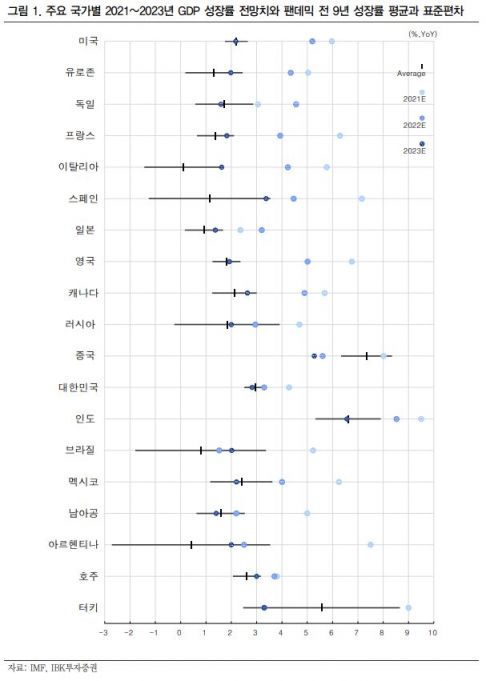
However, although the graph dips next year, IBK Investment & Securities interprets that it is better to see the expansion phase as still continuing rather than mentioning stagflation or slowflation. This is because the growth rate forecasts for most countries next year exceed the average growth rate over the nine years before the COVID-19 pandemic. In the Eurozone, the average growth rate was less than 2%, but next year's forecast exceeds 4%. Countries such as Japan, Canada, Brazil, and Australia also have forecasts exceeding their nine-year averages.
The reason growth rates exceed the average next year is due to expansionary economic policies. Researcher Jeong Yong-taek of IBK Investment & Securities explained, “Although the scale of fiscal policy spending executed last year and this year is smaller and direct demand stimulation policies are reduced, large-scale fiscal policies by major countries such as the United States will continue after next year. This is more than the pre-COVID-19 level.”
In fact, U.S. President Joe Biden announced plans to implement three rounds of stimulus packages after taking office, but only the first round was executed this year. The second and third rounds are expected to be implemented over the next 5 to 8 years.
Nevertheless, the financial market may face instability because monetary policy is changing. On the 25th, the Bank of Korea's Monetary Policy Committee decided to raise the base interest rate from 0.75% to 1%, declaring the end of the zero interest rate era. Researcher Jeong said, “The stock market will show downward pressure or sideways movement at a lower level than now, rather than the previous upward trend. This is because financial imbalances, which expanded due to liquidity factors, are now under adjustment pressure due to changes in monetary policy.”
© The Asia Business Daily(www.asiae.co.kr). All rights reserved.
![Clutching a Stolen Dior Bag, Saying "I Hate Being Poor but Real"... The Grotesque Con of a "Human Knockoff" [Slate]](https://cwcontent.asiae.co.kr/asiaresize/183/2026021902243444107_1771435474.jpg)
















