[Asia Economy Reporter Lee Ji-eun] It is reported that South Korea and the United States have not reached a final agreement on how to describe the North Korean denuclearization issue in the declaration of the end of the war. Aside from this, consultations between the two countries are in the final stages, increasing the likelihood that preparations for the declaration of the end of the war will be completed within President Moon Jae-in's term. However, concerns are emerging that the declaration of the end of the war may be limited to an agreement between South Korea and the U.S. only, as North Korea continues to oppose the declaration while imposing conditions.
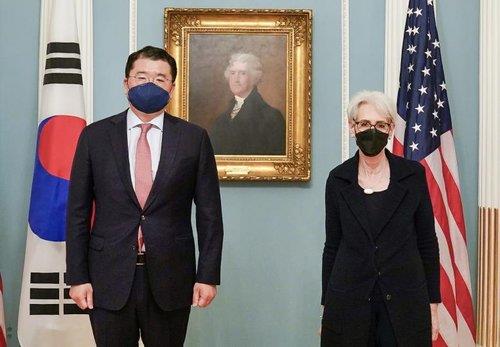
According to diplomatic sources on the 26th, regarding the declaration of the end of the war proposed by President Moon in September, South Korea and the U.S. have completed significant coordination on the form and content and are finalizing the draft. No Kyu-duk, head of the Korea Peace Negotiation Office overseeing North Korean nuclear diplomacy, and Sung Kim, the U.S. Special Representative for North Korea, have prepared drafts and revisions through multiple phone and face-to-face consultations. Subsequently, the draft was coordinated between Choi Jong-geon, First Vice Foreign Minister of South Korea, and Wendy Sherman, U.S. Deputy Secretary of State.
However, during the final draft decision process, the Biden administration insists on including the phrase "complete denuclearization of the Korean Peninsula" and urging North Korea's denuclearization will and actions, while the South Korean government advocates for softer expressions to encourage North Korea to agree to the declaration, resulting in a stalemate in consultations. A diplomatic expert said, "The disagreement between South Korea and the U.S. over the denuclearization wording is not a fundamental difference but a cautious effort to produce the best outcome," adding, "They will present the final draft through close consultations."
It appears that the South Korean government and the Biden administration agree that the declaration of the end of the war is a political and symbolic declaration that does not affect the legal or structural changes of the armistice system. It is expected to be explicitly stated that the current armistice agreement remains valid despite the declaration. This minimizes concerns raised by some about the withdrawal of U.S. troops stationed in South Korea or the dissolution of the United Nations Command. However, experts worry that such a declaration could provoke North Korea's opposition. North Korea repeatedly demands the withdrawal of hostile policies and double standards as preconditions for the declaration of the end of the war and has recently advocated for the dissolution of the United Nations Command on the UN stage. Additionally, commercial satellite images have newly detected signs that North Korea is operating the 5MW reactor at the Yongbyon nuclear facility, adding another variable.
The U.S. also seems to have little incentive to push for the declaration of the end of the war while accepting North Korea's conditions. Given the Biden administration's stance of strengthening sanctions against North Korea while promoting "dialogue without conditions," it is unlikely to accept conditions only for the declaration of the end of the war. The message is to come to the dialogue table for the declaration unconditionally, without attaching conditions such as the withdrawal of hostile policies. Hong Min, a research fellow at the Korea Institute for National Unification, said, "North Korea wanted the declaration of the end of the war in 2018, but now it has shifted its strategy to a 'conditional declaration of the end of the war' based on the withdrawal of hostile policies and double standards," adding, "It is highly unlikely that North Korea will accept a declaration proposal that ties its own hands."
© The Asia Business Daily(www.asiae.co.kr). All rights reserved.

















