[Asia Economy Reporter Ji Yeon-jin] Interest rate hikes have become the key topic in the year-end stock market. Following two interest rate hikes by the Bank of Korea this year, concerns have emerged that the United States may advance the timing of its rate hikes earlier than expected, further increasing uncertainty in the year-end stock market.
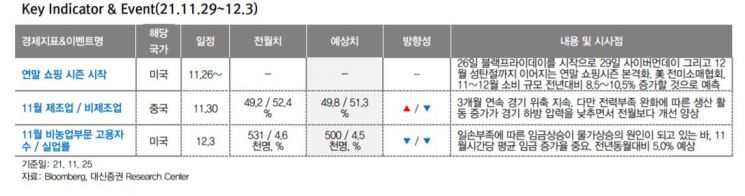
According to the financial investment industry on the 26th, from the end of this month after the conclusion of the biggest discount season of the year, including Black Friday in the U.S. on the 25th (local time), investors' attention is expected to shift to the U.S. Federal Reserve's (Fed) monetary policy. The Fed minutes released on the 24th pointed out that if high inflation persists, the Fed is prepared to conduct early rate hikes along with adjusting the pace of asset purchases. Moon Nam-jung, a researcher at Daishin Securities, evaluated, "The Fed has revealed the hidden talons of the hawk."
In September and October, U.S. employment indicators connected 'labor shortage → wage increase → price increase,' stimulating a shift toward monetary tightening and advancing the expected tapering (asset purchase reduction) from around December to mid-month. Researcher Moon said, "Considering the reappointment of Jerome Powell as Fed Chair and this month's Fed minutes, the possibility of accelerated tapering can be emphasized, but ultimately, it will lead to curiosity about the timing of rate hikes after tapering," adding, "With inflation still high, the acceleration of tapering and early rate hikes could spread such expectations, leading to a reinterpretation of the Fed's monetary policy and potentially increasing stock market volatility."
There is also a possibility that the upside of the domestic stock market will be limited next week. The outcome of the 'OPEC+' meeting on the 2nd of next month remains uncertain. Recently, major countries including the U.S. decided to release about 70 million barrels of Strategic Petroleum Reserves (SPR), while major 'OPEC+' member countries such as Saudi Arabia and Russia have hinted at reviewing the suspension of the existing agreed production increase plan (400,000 barrels per day). If OPEC+ production is reduced compared to the existing level, it could stimulate upward pressure on oil prices, exacerbating inflation concerns. Lee Jae-sun, a researcher at Hana Financial Investment, said, "Until the U.S. Federal Open Market Committee (FOMC) meeting on the 15th of next month, the remarks of Fed officials should be closely monitored." He added, "According to the November minutes, some members suggested that if high inflation persists, the pace of the Fed's bond purchases and the timing of rate hikes could be somewhat accelerated, and the tightening timeline currently reflected in the market is somewhat advancing."
Lee also mentioned regarding the U.S. debt ceiling deadline on the 3rd of next month, "Historically, agreements to raise the debt ceiling have been dramatically reached before a default declaration, but political uncertainty remains one of the factors limiting the upside of risk asset prices, which should be considered."
© The Asia Business Daily(www.asiae.co.kr). All rights reserved.
![Clutching a Stolen Dior Bag, Saying "I Hate Being Poor but Real"... The Grotesque Con of a "Human Knockoff" [Slate]](https://cwcontent.asiae.co.kr/asiaresize/183/2026021902243444107_1771435474.jpg)















