Discussion on Daily Recovery Support Measures
3,938 Confirmed Cases · 612 Critically Ill
Quarantine Pass Likely Applied to Youths
Final Decision at Central Disaster and Safety Countermeasures Headquarters Tomorrow
Timing of Emergency Plan Activation Under Consideration
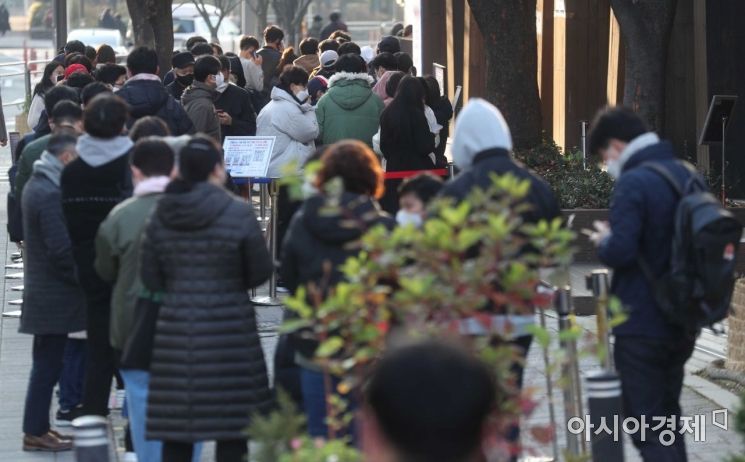 On the 25th, the COVID-19 screening clinic at Songpa-gu Public Health Center in Seoul was crowded with citizens seeking tests. Photo by Mun Ho-nam munonam@
[Asia Economy Reporters Seo So-jeong, Son Seon-hee, Lee Chun-hee] The government is seriously considering introducing the quarantine pass (vaccination certificate and negative test confirmation system) for restaurants and cafes. It has also settled on applying the quarantine pass to adolescents eligible for COVID-19 vaccination.
On the 25th, the government held the 4th COVID-19 Daily Recovery Support Committee meeting at the Seoul Government Complex annex to discuss the expansion plan of the quarantine pass. The quarantine pass is a system that requires presenting proof of COVID-19 vaccination or a negative COVID-19 test to gain entry.
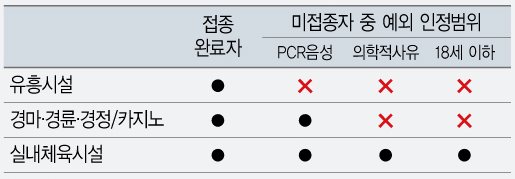
◆ Quarantine Pass to Apply to Restaurants and Cafes = At the meeting, a plan was discussed to allow only fully vaccinated individuals to use restaurants and cafes, where the risk of infection is high due to eating activities. Currently, unvaccinated individuals can freely enter restaurants and cafes in groups of up to four. Opinions were gathered on including adolescents, who had been exempted from the quarantine pass, as subjects of the pass. This is due to the recent sharp increase in COVID-19 infection rates among students. Experts also debated the necessity and timing of activating emergency plans as the number of patients waiting for hospital beds in the metropolitan area increased.
A senior government official said, "We are seriously considering applying the quarantine pass to restaurants and cafes and to multi-use facilities mainly used by adolescents," adding, "While the need to activate emergency plans was raised, there was an opinion that immediate implementation is difficult."
The government plans to review various additional response measures such as the transition of the medical system and booster shots based on expert opinions gathered on the day, and then decide on the direction of the phased daily recovery (With COVID-19) at the Central Disaster and Safety Countermeasures Headquarters meeting on the 26th, followed by an official announcement. Prime Minister Kim Boo-kyum, who chaired the meeting, stated, "After With COVID-19, infections have increased, and we will gather opinions on various alternatives to strengthen quarantine management for the elderly aged 60 and over and children and adolescents, who account for more than half of confirmed cases, and decide on the future direction of daily recovery."
Son Young-rae, head of the Social Strategy Division at the Central Disaster and Safety Countermeasures Headquarters, explained, "In Europe, where the COVID-19 situation has worsened, applying the quarantine pass to restaurants and cafes has become routine. However, in Korea, there is a culture that values food, and concerns about discrimination against the unvaccinated have existed, so it has been avoided until now."
As of midnight on the day, the number of new COVID-19 confirmed cases was 3,938, approaching 4,000. In particular, the number of critically ill patients hospitalized was 612, an increase of 26 from the previous day, marking a record high.
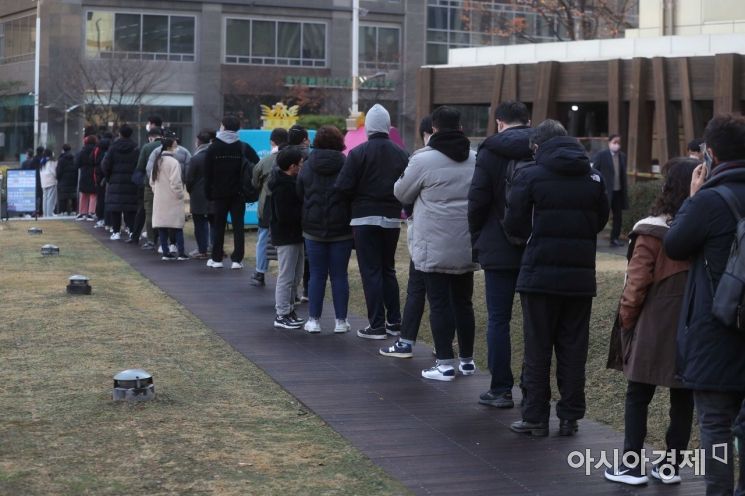 On the 25th, the COVID-19 screening clinic at Songpa-gu Public Health Center in Seoul was crowded with citizens seeking tests. Photo by Mun Ho-nam munonam@
◆ Controversy Over Quarantine Pass for Those Under 18 = Currently, children and adolescents under 18 are fundamentally prohibited from entering age-restricted facilities such as entertainment venues and casinos, as well as vulnerable facilities like nursing hospitals and facilities for visits, and elderly and disabled facilities. However, karaoke rooms, gyms, and other facilities are freely accessible to unvaccinated individuals.
However, with all schools resuming full in-person classes on the 22nd, concerns about cluster infections within schools have grown, leading to calls for expanding the quarantine pass to this age group. Last week (14th to 20th), 530 confirmed cases occurred among school-age children alone, and 79.6% of cluster infection cases were linked to educational facilities, raising concerns.
However, criticism has also been raised, making the issue controversial. Professor Kim Woo-joo of the Infectious Diseases Department at Korea University Guro Hospital pointed out, "Vaccination rates for those aged 12 to 17 are not high, and the quarantine authorities have effectively left it to parents' discretion, so it is not mandatory. Expanding the quarantine pass to children and adolescents is inconsistent." As of the previous day, the first-dose vaccination rate for those aged 12 to 17 was 41.5%, and the full vaccination rate was 16.0%, meaning only a small portion have completed vaccination. However, since the College Scholastic Ability Test ended on the 18th, high school seniors are expected to gather and travel more for admissions processes, leading to arguments that the quarantine pass should be applied at least to this group.
Experts' opinions are divided on activating the 'emergency plan' (circuit breaker) to halt phased daily recovery. Dr. Han Chang-hoon, a pulmonologist at Ilsan Hospital, said, "Ilsan Hospital, currently a base hospital, has already reached saturation. There are many patients waiting, making hospitalization difficult, and even if patients' conditions worsen, they cannot be transferred to the intensive care unit." He added, "Medical staff are being stretched to the limit. The current medical response system cannot hold on like this."
However, the government maintains that the emergency plan is a last resort and will not be activated immediately. Professor Kim Yoon of Seoul National University College of Medicine's Medical Management Department emphasized, "Activating the emergency plan just one month after starting daily recovery would admit to a lack of preparation, so it will be difficult for the government to do so. We must suppress the outbreak as much as possible through securing intensive care beds, medical personnel, and additional vaccinations for high-risk groups."
© The Asia Business Daily(www.asiae.co.kr). All rights reserved.
![Clutching a Stolen Dior Bag, Saying "I Hate Being Poor but Real"... The Grotesque Con of a "Human Knockoff" [Slate]](https://cwcontent.asiae.co.kr/asiaresize/183/2026021902243444107_1771435474.jpg)

















