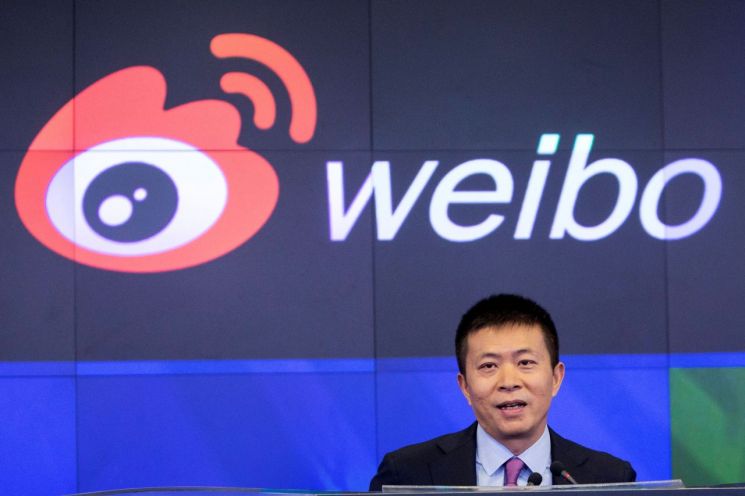
[Asia Economy Reporter Kwon Jae-hee] As Weibo, the "Chinese version of Twitter," moves forward with a secondary listing on the Hong Kong Stock Exchange, it has internally analyzed that there is significant uncertainty due to new regulations imposed by Chinese authorities.
In the draft IPO prospectus submitted to the Hong Kong Stock Exchange on the 18th, Weibo stated, "China's cybersecurity legal system is relatively new and rapidly evolving, and their interpretation and enforcement carry great uncertainty."
Weibo added, "The draft of the new regulations by the authorities does not provide clear descriptions or criteria regarding 'activities that affect or may affect national security,' and if the draft is adopted as is, it could have a substantial impact on fundraising activities."
It further informed investors, "If we fail to obtain approval from regulatory authorities or pass the review, there could be significant restrictions on liquidity, especially when additional funding is needed, which may negatively affect corporate activities and financial results."
Weibo, which has 250 million daily users, was previously listed on NASDAQ in April 2014.
The Hong Kong South China Morning Post (SCMP) explained on the 24th that "Weibo's secondary listing in Hong Kong is a familiar move following Alibaba, Baidu, JD.com, Bilibili, and others," but also noted, "Weibo's Hong Kong listing is being pursued amid increased scrutiny by Chinese authorities on overseas listings of domestic companies."
It also added, "In recent weeks, Weibo has been embroiled in controversy after tennis star Peng Shuai posted allegations of sexual assault against former Vice Premier Zhang Gaoli on the platform."
The Chinese government enacted new regulations in August to strengthen the security of "critical information infrastructure."
Based on the higher-level Cybersecurity Law, the "Regulations on Security and Protection of Critical Information Infrastructure Facilities" define information infrastructure related to information and communication services, energy, transportation, finance, public services, electronic administration, and defense science and industry as "critical information infrastructure," with a focus on systematically enhancing security measures.
The regulations broadly define critical information infrastructure to include "important internet and information systems that, once destroyed or rendered nonfunctional, or if data is leaked, cause serious harm to national security and public interest."
They also impose legal obligations on operators of critical information infrastructure and public institutions to establish dedicated security organizations under their jurisdiction, cooperate with public security and national security agencies, and emphasize that violators will bear criminal responsibility.
Earlier, in July, the Cyberspace Administration of China announced in the revised Internet Security Review Measures that domestic internet companies with over one million members must undergo a pre-review to ensure there are no national security risks before listing on overseas stock markets such as the U.S.
Given China's population of 1.4 billion, the threshold of one million members applies to nearly all companies considering overseas listings, effectively turning overseas listings of Chinese tech companies into a permit system.
On the 14th of this month, the Cyberspace Administration further stated that domestic internet companies planning to list on the Hong Kong Stock Exchange must also undergo a pre-review to ensure there are no national security risks.
Although Hong Kong is a Special Administrative Region of China, it was explicitly emphasized that listings on the Hong Kong Stock Exchange are subject to the same investigations as overseas listings.
SCMP explained, "Weibo is highly likely to be designated as an operator of critical information infrastructure and precisely falls under the scope of the Chinese government's new regulations targeting listings on the Hong Kong Stock Exchange."
In its prospectus, Weibo warned, "We are taking relevant measures to meet the responsibilities required of critical information infrastructure operators, but if we are actually designated as such, it could disrupt our operations."
China has tightened restrictions on overseas listings of domestic companies after the largest ride-hailing company, Didi Chuxing, proceeded with its U.S. stock market listing despite authorities' requests for restraint.
Didi Chuxing was listed on the New York Stock Exchange on June 30, just one day before the 100th anniversary of the founding of the Communist Party.
Three days later, Chinese authorities launched a national security investigation into Didi Chuxing, which later expanded to other companies listed on the U.S. stock market such as Manbang Group and BOSS Zhipin.
Market analysts interpret this as China’s concern, amid the new Cold War dynamics between the U.S. and China, that sensitive geographic and customer information held by domestic tech companies like Didi Chuxing could be extensively leaked to the U.S. side.
© The Asia Business Daily(www.asiae.co.kr). All rights reserved.
![Clutching a Stolen Dior Bag, Saying "I Hate Being Poor but Real"... The Grotesque Con of a "Human Knockoff" [Slate]](https://cwcontent.asiae.co.kr/asiaresize/183/2026021902243444107_1771435474.jpg)















