KAIST Professors Seokwoo Jeon and Ildoo Kim Team
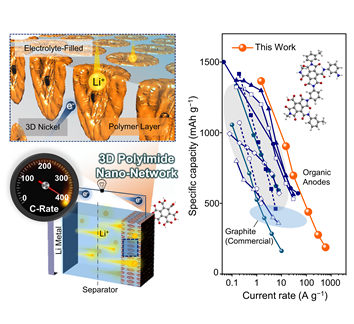
[Asia Economy Reporter Kim Bong-su] A Korean research team has developed a next-generation eco-friendly secondary battery with performance comparable to conventional ones by using organic materials instead of expensive and potentially polluting inorganic substances such as nickel, cobalt, graphite, and silicon.
The Korea Advanced Institute of Science and Technology (KAIST) announced on the 24th that the research team led by Professors Jeon Seok-woo and Kim Il-du from the Department of Materials Science and Engineering, in collaboration with the University of Illinois research team, succeeded in developing core technology for next-generation eco-friendly organic secondary batteries.
The researchers designed an organic anode with a highly aligned nano-network structure through reproducible optical patterning technology, dramatically improving the performance of lithium-organic batteries. In particular, the charging capacity and durability reached the highest levels reported among organic anode materials to date, expected to significantly contribute to commercialization in electric vehicles or portable electronic devices by replacing current inorganic-based electrode materials in the long term.
Organic secondary batteries are based on organic electrode materials that are inexpensive and have fewer supply restrictions, allowing for lightweight electrodes, excellent variability, and easy recyclability, making them highly regarded as sustainable eco-friendly battery systems.
However, to overcome the low electrical conductivity of organic materials, a high content of carbon-based conductive additives was added, limiting the achievement of high energy density. Additionally, slow charging speeds and lifespan degradation issues, which make practical application in electric vehicles and portable electronic devices difficult, have been critical obstacles.
The research team introduced a three-dimensional dual-continuous structure of organic polymer-nickel composite electrodes with aligned sub-micron (less than one-millionth of a meter) sized pore channels instead of the conventional disordered electrode structures that limit electrochemical activity and stability.
As a result, they succeeded in dramatically improving rate performance without carbon-based conductive additives and confirmed high durability and stability, maintaining over 83% of the electrode capacity during 250 charge-discharge cycles even at a high current density of 15 A g-1.
Furthermore, based on the three-dimensional nano-network structure, they elucidated the promoted 'super-lithiation' phenomenon at the unsaturated bonds of multiple carbon rings within the organic material, confirming a high reversible capacity of 1,260 mAh g-1. They also verified the mechanism of ultrafast performance through kinetic analysis of excellent charge transfer.
Professor Jeon explained, "This result newly presents a structural engineering design direction for organic electrodes to realize eco-friendly and promising energy storage," adding, "The three-dimensional aligned nano-network structure developed in this study is compatible with various organic compounds, enabling general use as a platform for organic electrodes."
This research was selected as an Inside Back Cover paper in the November issue of the international journal in the energy and environment field, Energy & Environmental Science (IF: 38.532).
© The Asia Business Daily(www.asiae.co.kr). All rights reserved.
![Clutching a Stolen Dior Bag, Saying "I Hate Being Poor but Real"... The Grotesque Con of a "Human Knockoff" [Slate]](https://cwcontent.asiae.co.kr/asiaresize/183/2026021902243444107_1771435474.jpg)















