Ministry of Education Announces Key Points of 2022 Revised Curriculum Framework
8 Credits Required for Korean, English, Math, and Social Studies; 6 Credits for Korean History
Ministry of Education: "Optimization of General Elective Subjects for College Entrance Exam"
Digital Literacy as Basic Competency, Strengthening Ecological Transition and Democratic Citizenship Education
Final Semester of Elementary, Middle, and High School to be Operated as Career-Linked Semester
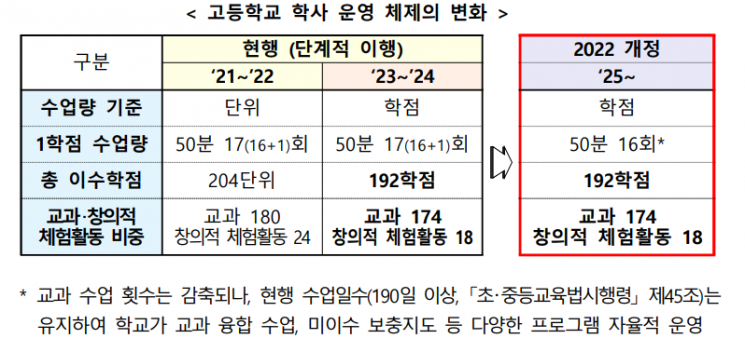
Starting in 2025, when current 6th graders enter high school, the required credits for common subjects such as Korean, English, Math, Social Studies, and Science will be reduced. In line with the implementation of the high school credit system, the number of general elective subjects directly linked to the College Scholastic Ability Test (CSAT) will be decreased, and the subject structure will be reorganized to allow students to take more electives aligned with their career paths.
On the 24th, the Ministry of Education announced the main points of the '2022 Revised Curriculum' general guidelines at Haemil Elementary School in Sejong, together with the National Curriculum Revision Promotion Committee, the National Education Council, and the Council of Superintendents of Education of all provinces and cities. The revised curriculum will be applied sequentially: grades 1 and 2 in early 2024, grades 3 and 4 and 10th grade in 2025, grades 5 and 6, 8th grade, and 11th grade in 2026, and 9th and 12th grades in 2027. A new college entrance system reform plan aligned with the curriculum and the high school credit system will be announced in February 2024.
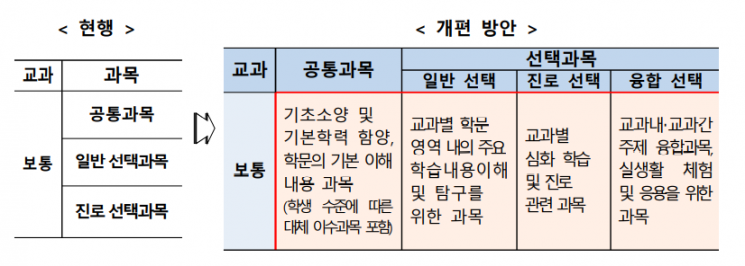
In the 2022 revised curriculum, common subjects will be maintained, but in accordance with the purpose of the high school credit system, the number of general elective subjects directly linked to the CSAT will be optimized, and students will have expanded options to take electives suited to their career paths. For Korean, general electives include Speech and Language, Reading and Writing, and Literature; for Math, they include Algebra, Calculus I, and Probability and Statistics.
An official from the Ministry of Education explained, "Although the college entrance system changes starting in 2028 have not been finalized, based on the current system, reducing general elective subjects in each subject aligns with the purpose of the high school credit system. We designed the curriculum to optimize general electives and allow more choices in career and convergence electives."
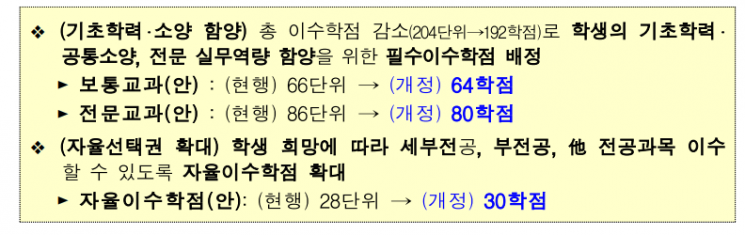
While the required credits decrease from 94 units to 84 credits, the range of voluntary credits expands from 86 units to 90 credits. With the academic operation standard changing from 'units' to 'credits,' common subjects will remain at 8 credits (one credit equals 16 sessions of 50 minutes each), Korean history will remain at 6 credits, and students must complete 10 credits in science. Previously, Korean, English, Math, and Social Studies were 10 units (one unit was 17 sessions), Korean history was 6 units, and science was 12 units. When the high school credit system is implemented, an achievement evaluation system will be introduced for all elective subjects. If students fail to meet attendance (at least two-thirds) or academic achievement rate (40% or higher), they will be considered 'not completed' and must take supplementary courses.
Various elective subjects will be organized for career and academic planning, and convergence electives will also be newly established. For Korean, convergence electives include Reading Discussion and Writing, and Media Communication. Additionally, the existing 'Specialized Subject 1' from specialized high schools will be converted to general subjects, allowing students in regular high schools to take them as electives.
Furthermore, the 2022 revised curriculum incorporates digital literacy as a basic competency, establishing digital literacy standards related to new technologies such as AI across all subjects by school level and reflecting them in the curriculum. Core content frameworks will also be developed to integrate ecological transition education and democratic citizenship education into all subjects. Some periods during the last semester of elementary, middle, and high school will be operated as career-linked semesters to provide opportunities for career exploration. Elementary and middle schools will also be able to develop and operate elective subjects.
The Ministry of Education will promote teacher policies and college entrance system improvements to ensure the new curriculum is well established, and will support school space restructuring and the development of textbooks. A draft for future-oriented assessments and college entrance system reforms will be prepared in the first half of 2023, and after consultation with the National Education Committee, it will be released in February 2024.
Deputy Prime Minister and Minister of Education Yoo Eun-hye said, "The 2022 revised curriculum is a field-based curriculum revision made together with students, parents, teachers, and the public. Through curriculum innovation, we will open the future of education so that everyone can realize their potential in various ways within their own lives."
© The Asia Business Daily(www.asiae.co.kr). All rights reserved.
![Clutching a Stolen Dior Bag, Saying "I Hate Being Poor but Real"... The Grotesque Con of a "Human Knockoff" [Slate]](https://cwcontent.asiae.co.kr/asiaresize/183/2026021902243444107_1771435474.jpg)

















