Korea Federation of SMEs Announces Export Outlook Survey Results
83.4% of SMEs Face Logistics Difficulties... Increased by 10%p
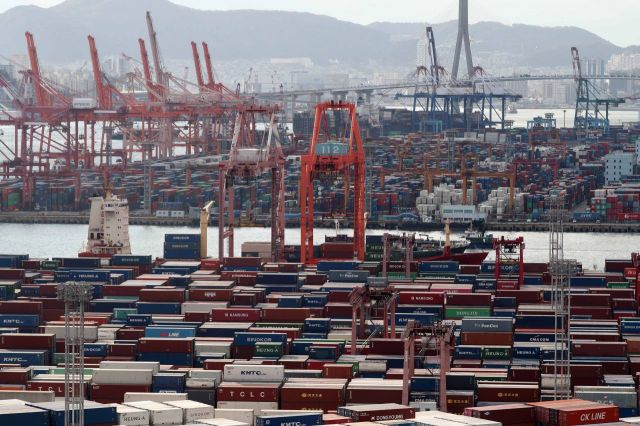
[Asia Economy Reporter Kim Bo-kyung] More than 8 out of 10 small and medium-sized enterprises (SMEs) engaged in export and import expect the current logistics difficulties to continue for more than a year.
According to the Korea Federation of SMEs on the 24th, a survey on export outlook was conducted from the 11th to the 18th targeting 500 export-import SMEs. Regarding the expected duration of the ongoing maritime logistics difficulties, 57.6% responded that it would last until the second half of next year, the highest proportion.
Following that, 21.4% responded it would last until the first half of 2023, 6.0% until the second half of 2023, and 2.6% after 2024, totaling 87.6% who expect logistics difficulties to persist for more than a year. Those who answered until the first half of next year accounted for 12.0%, and only 0.4% said the second half of this year.
The proportion of SMEs experiencing difficulties due to the ongoing export-import logistics issues recently rose to 83.4%, up 10.0 percentage points from the June survey (73.4%).
The main difficulties (multiple responses allowed) were maritime and sea freight rate increases at 83.7%, followed by shipment delays (65.0%), container shortages (43.2%), and space shortages (41.0%).
The impact of rising logistics costs on operating profit was most commonly between 5% and less than 10% at 35.8%, followed by less than 5% at 35.6%, 10% to less than 15% at 15.2%, and no impact at 7.6%.
The shipping routes perceived as having severe logistics situations (multiple responses) were the U.S. West Coast (59.8%), U.S. East Coast (47.6%), Europe (30.4%), and Southeast Asia (26.6%), in that order.
To resolve export-import logistics difficulties, the government’s priority measures should be expanding freight support (47.8%), additional vessel deployment (42.6%), container procurement support (19.0%), and providing cargo storage locations (5.2%).
Regarding the export outlook for SMEs next year, 40.4% responded "good," which was much higher than the 5.2% who said "bad." "Average" accounted for 54.4%.
The export risks perceived by companies (multiple responses) were logistics difficulties such as space and container shortages and freight rate increases at 61.2%, and the top priority tasks for the government to continuously expand SME exports (multiple responses) were securing export cargo ships and aircraft and freight support at 72%.
When asked whether there are countermeasures for changes in the trade environment such as carbon neutrality, Environmental, Social, and Governance (ESG), and digital transformation, 95.4% answered no.
© The Asia Business Daily(www.asiae.co.kr). All rights reserved.
![Clutching a Stolen Dior Bag, Saying "I Hate Being Poor but Real"... The Grotesque Con of a "Human Knockoff" [Slate]](https://cwcontent.asiae.co.kr/asiaresize/183/2026021902243444107_1771435474.jpg)















