[Asia Economy Reporter Yujin Cho] U.S. President Joe Biden's renomination of Jerome Powell as Chair of the Federal Reserve (Fed) appears to be a decision prioritizing stability over change, with an emphasis on 'inflation control.' Facing a decline in approval ratings due to severe price increases, President Biden judged Powell to be the right person to tackle the significant challenges of controlling inflation and economic uncertainty, which will determine his political fate.
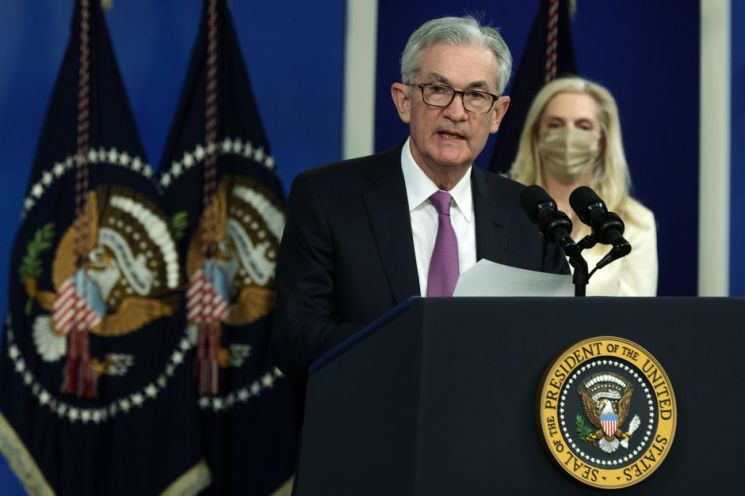
On the 22nd (local time), President Biden held a press conference at the White House to officially announce Powell's renomination as Fed Chair and Lael Brainard's nomination as Vice Chair of the Fed. Biden affectionately referred to Powell as 'Jay,' stating, "Our economy needs the Fed's stability and independence due to its tremendous potential and uncertainties," and praised, "Jay helped stabilize the market and put the economy on a solid recovery path last year with steady and resolute leadership amid the COVID-19 crisis."
Currently, U.S. inflation is driven by a mix of factors including monetary expansion, global supply shortages, widespread increases in raw material prices and logistics costs, and wage hikes. Through this renomination, President Biden highlighted the importance of price stability and maximum employment, clearly signaling his intention to pursue continuity and stability in economic policy rather than reforms by retaining Chair Powell.
Immediately after his renomination, Chair Powell emphasized the importance of controlling inflation in his speech. He said, "We recognize that high inflation is hitting everyday Americans through food, housing, and transportation costs," and added, "We will use our tools to support the economy and labor market and to prevent higher inflation from becoming entrenched."
On the same day, Treasury Secretary Janet Yellen also mentioned that "inflation was partly influenced by COVID-19," suggesting that factors beyond the pandemic are at play. This implies that even as the temporary COVID-related factors subside, controlling overall inflation will remain challenging.
The Wall Street Journal (WSJ) reported that administration officials said Biden's decision reflects his desire to maintain stability at the Fed amid public concerns over high prices ranging from groceries to fuel.
The Washington Post (WP) cited Powell's swift and strong response during the early stages of the COVID-19 crisis last year, which effectively supported the U.S. economy and led to its recovery, as the background for his renomination.
Powell was appointed Fed Chair in February 2018 and had clashes with former President Donald Trump, who openly demanded interest rate cuts. However, immediately after the COVID-19 outbreak, Powell implemented bold monetary policies, lowering the benchmark interest rate to near zero. He convened an unscheduled emergency Federal Open Market Committee (FOMC) meeting for the first time in 12 years since the 2008 Lehman Shock during the global financial crisis, cutting the U.S. benchmark interest rate by 0.50 percentage points. This move anticipated that the COVID-19 pandemic would have an impact comparable to the 2008 Lehman Shock.
Bloomberg News evaluated that the Fed's rate cuts and economic support measures during the two-year COVID-19 pandemic helped the U.S. avoid a recession and earned recognition from investors. WSJ also reported that Powell made a definite contribution to restoring bipartisan support for the Fed, whose reputation was damaged by the 2008 global financial crisis. When Powell was confirmed as Fed Chair in 2018, he received 84 votes in the Senate, gaining support across the political spectrum.
© The Asia Business Daily(www.asiae.co.kr). All rights reserved.
![Clutching a Stolen Dior Bag, Saying "I Hate Being Poor but Real"... The Grotesque Con of a "Human Knockoff" [Slate]](https://cwcontent.asiae.co.kr/asiaresize/183/2026021902243444107_1771435474.jpg)















