3rd Quarter Regional Economic Trends
Manufacturing Up 5% and Employment Rises for Second Consecutive Quarter
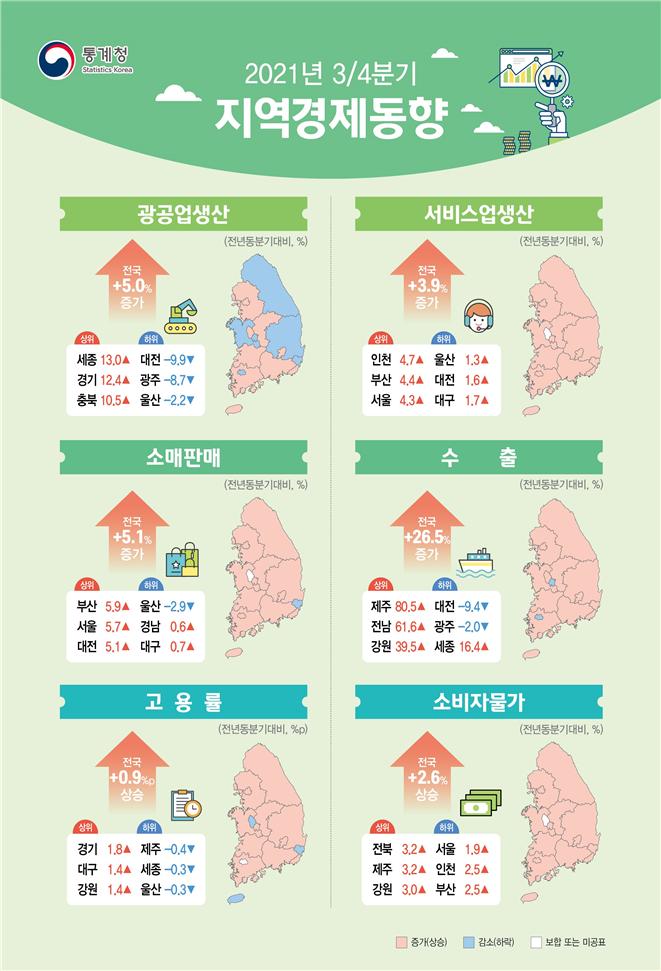
[Sejong=Asia Economy Reporter Moon Chaeseok] In the third quarter, nationwide manufacturing production increased by 5% compared to the same period last year, driven by growth in semiconductor and electronic component production. The national employment rate continued its upward trend for the second consecutive quarter. Although the impact of the fourth wave of COVID-19 was expected to be fully reflected from the third quarter, the figures showed that the upward trend did not falter.
According to the 'Third Quarter Regional Economic Trends' released by Statistics Korea on the 22nd, nationwide manufacturing production rose by 5% compared to the third quarter of last year. Manufacturing production increased in Gyeonggi (semiconductors, electronic components, medical precision), Chungbuk (semiconductors, electronic components, electrical equipment), and Seoul (machinery equipment, clothing and fur). Service sector production increased by 3.9% overall across all regions.
Exports increased by 26.5% year-on-year. Consumption (retail sales) rose by 5.1%. In terms of consumption, only Ulsan (-2.9%) saw a decrease due to reduced sales at passenger car and fuel retail stores, while all other regions experienced growth.
The employment rate turned upward in the second quarter for the first time in five quarters and continued to rise in the third quarter. The national employment rate in the third quarter was 61.3%, up 0.9 percentage points from the same period last year. Increases were seen among those in their 20s (2.7 percentage points), 50s (1.3 percentage points), and ages 15-19 (1.0 percentage point). By region, the employment rate rose in 13 cities and provinces including Ulsan (-0.3 percentage points), Sejong (-0.3 percentage points), and Jeju (-0.4 percentage points).
The national unemployment rate was 2.8%, down 0.8 percentage points from the same period last year. The unemployment rate fell in 15 cities and provinces except Seoul (0.0%) and Jeju (0.5%). Regions with high unemployment rates included Incheon (4.7%), Seoul (4.4%), and Gwangju and Gyeongnam (4.0%).
National consumer prices rose by 2.6 percentage points year-on-year due to increases in petroleum products and personal services. Jeonbuk (3.2%), Jeju (3.2%), and Gangwon (3.0%) had inflation rates higher than the national average. Seoul (1.8%), Busan (2.4%), and Incheon (2.4%) saw declines in public services, resulting in lower inflation rates than average in Seoul (1.9%), Incheon (2.5%), and Busan (2.5%).
Regions with net population inflows included Gyeonggi (37,000 people), Incheon (5,000 people), and Sejong (3,000 people), totaling six cities and provinces. Eleven cities and provinces including Seoul (-25,000 people), Gyeongnam (-5,000 people), and Daegu (-4,000 people) experienced net population outflows.
© The Asia Business Daily(www.asiae.co.kr). All rights reserved.
![Clutching a Stolen Dior Bag, Saying "I Hate Being Poor but Real"... The Grotesque Con of a "Human Knockoff" [Slate]](https://cwcontent.asiae.co.kr/asiaresize/183/2026021902243444107_1771435474.jpg)

















