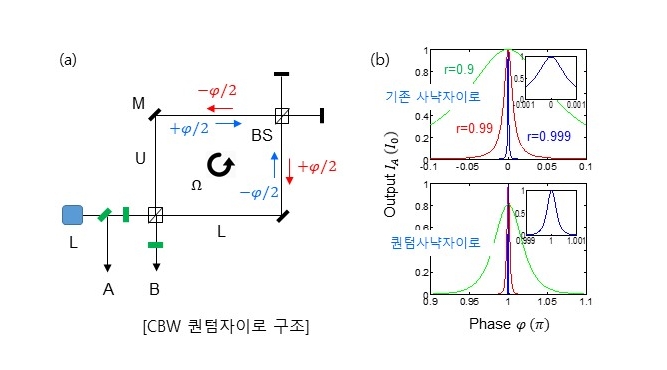
 Figure (a) Quantum Sagnac Gyroscope structure, (b) Resolution calculation comparison. Provided by Gwangju Institute of Science and Technology
[Asia Economy Reporter Kim Bong-su] Domestic researchers have created the world's most precise gyroscope using the principles of quantum mechanics. It is gaining attention for its potential use in providing more accurate and faster information for positioning and navigation devices such as Global Positioning System (GPS), smartphones, autonomous vehicles, and the Internet of Things (IoT).
The research team led by Professor Ham Byung-seung of the Department of Electrical, Electronics and Computer Engineering at Gwangju Institute of Science and Technology (GIST) announced on the 22nd that they have developed a quantum gyroscope theory applying Coherence de Broglie Wave (CBW), a result of wave quantum optics, to the Sagnac gyroscope. This new principle allows the implementation of a quantum Sagnac gyroscope that surpasses the resolution of existing Sagnac gyroscopes by at least four times under the same conditions.
A gyroscope is an essential tool not only for inertial navigation in unmanned aerial vehicles, guided weapons, submarines, and spacecraft but also for geodesy, which is crucial in earth sciences. It is an experimental device that observes the mechanical motion of a rotating body, with fiber optic gyroscopes being representative examples. Recently, micro-electromechanical systems (MEMS) technology has enabled the production of ultra-small electronic components. These are widely used in electronic devices such as tablets and smartphones and play an important role in various fields including information and communication technology (ICT), the Internet of Things (IoT), and automobiles.
The best existing gyroscope sensors are based on the Sagnac effect and consist of ring laser interferometers measuring hundreds of square meters in size. They can measure Earth's rotation error limits with a resolution better than one part in 100 million. Typically, fiber optic gyroscopes are used to achieve high resolution, which is a core technology for inertial navigation essential in drones, guided weapons, and submarines.
The quantum gyroscope developed by the research team has the same structure as existing gyroscopes but applies the CBW quantum sensor technique based on a superposed Mach-Zehnder interferometer to measure angular acceleration changes using quantum methods. Unlike conventional quantum sensing technologies based on single photon pairs, this applies laser light directly to achieve a macroscopic quantum gyroscope sensor that exceeds the resolution of existing gyroscopes by up to four times. 'Macroscopic quantum sensing' is a new quantum sensing principle that uses the wave nature of light, independent of light intensity, unlike conventional quantum sensing based on the particle nature of light. The CBW quantum sensor is a wave quantum sensor that secures quantum sensing regardless of photon intensity based on phase superposition in the interferometer, unlike existing quantum sensing principles based on single photon pairs, and was first proposed by Professor Ham Byung-seung.
Professor Ham explained, "In conventional quantum sensing, securing multi-photon entangled pairs remained unresolved, making the application of quantum sensors difficult. In CBW quantum sensors, the adoption of a round-trip path interferometer made unidirectional applications based on light reflection, such as Lidar, difficult. However, in gyroscopes that fundamentally involve bidirectional rotation, the round-trip path interferometer is automatically formed, making it easy to apply."
The research results were published online on the 3rd in 'Advanced Devices & Instrumentation,' a sister journal of Science.
© The Asia Business Daily(www.asiae.co.kr). All rights reserved.
![Clutching a Stolen Dior Bag, Saying "I Hate Being Poor but Real"... The Grotesque Con of a "Human Knockoff" [Slate]](https://cwcontent.asiae.co.kr/asiaresize/183/2026021902243444107_1771435474.jpg)















