 Total Amount of Contributions to International Organizations by Country [Image Source= Center for Global Development (CGD)]
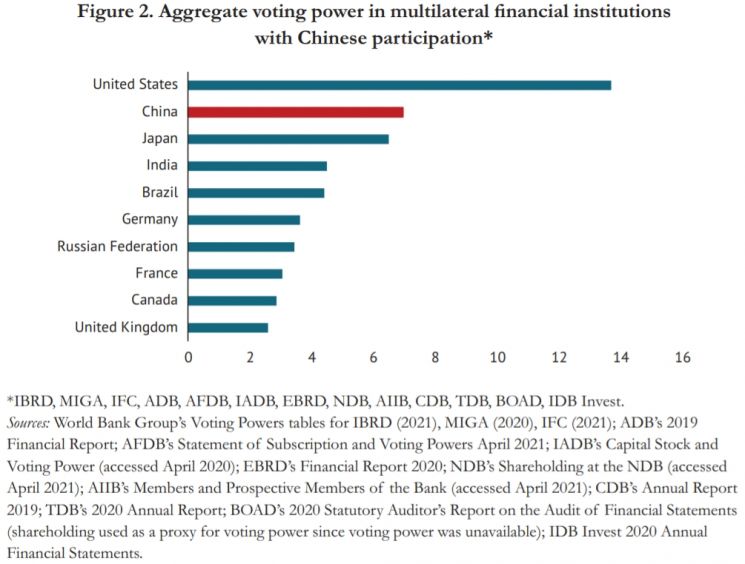
[Asia Economy Reporter Park Byung-hee] A report has emerged showing that China has surpassed Japan to become the world's second-largest contributor in terms of financial contributions to international development organizations such as the World Bank and the International Monetary Fund (IMF), following the United States. Since a larger financial contribution corresponds to a higher voting share, this indicates that China's influence in the international community is steadily increasing.
According to major foreign media, the U.S. think tank Center for Global Development (CGD) released a report on the 18th analyzing the scale of financial contributions by country to 76 international organizations, including the World Bank, IMF, and International Finance Corporation (IFC). The analysis showed that China's total contributions exceeded $66 billion, ranking second in the world after the United States.
Over the past decade, China has increased its contributions to these international organizations more than fourfold. Part of this surge is naturally due to the rapid growth of China's economy, which has led to a sharp increase in contribution amounts. However, there are also many institutions where China voluntarily increased its contributions.
The International Development Association (IDA) is one such institution where China significantly increased its contributions. China's contribution ranking in the IDA was 20th in 2012, rising to 17th in 2016, 11th in 2018, and currently 6th. During this period, the IDA's financial capacity also grew from $50 billion to $82 billion.
What is unique is that while China is expanding its influence in international organizations, it still receives substantial financial support from these organizations. In other words, China is both a donor and a borrower.
The CGD analyzed, "China holds an unprecedentedly unique position as an important financial contributor, shareholder, aid recipient, and commercial partner."
China's voluntary contributions to United Nations-affiliated organizations in 2019 tripled compared to 2010, though this increase was relatively modest. China voluntarily increased its contributions significantly to the International Fund for Agricultural Development (IFAD), World Food Programme (WFP), and UNICEF among UN agencies. However, China's overall contribution to UN agencies such as the United Nations Development Programme (UNDP), WFP, and the World Health Organization (WHO) ranks only fifth globally.
The reason for China's large contribution scale is largely due to its leading role in establishing international development banks. China, along with BRICS countries, spearheaded the establishment of the New Development Bank (NDB) in 2014 and the Asian Infrastructure Investment Bank (AIIB) in 2015. China's voting share in the NDB remained unchanged at 20% in both the 2017 and 2020 reports. However, its voting share in the AIIB increased from 26.1% in 2016 to 26.6% this year.
Scott Morris, a senior fellow and co-author of the report, explained, "Although China is investing a lot of funds in the Belt and Road Initiative to help underdeveloped countries, its presence in international organizations like the World Bank is relatively limited."
This can be interpreted as China increasing its contributions while building its own new international order. The United States does not hide its discomfort, viewing this as a potential threat to the existing international order.
However, Fellow Morris expressed opposition to the view that China's expanding influence is a threat. He explained, "It is better for everyone if China operates within the existing system rather than outside of it."
© The Asia Business Daily(www.asiae.co.kr). All rights reserved.
![Clutching a Stolen Dior Bag, Saying "I Hate Being Poor but Real"... The Grotesque Con of a "Human Knockoff" [Slate]](https://cwcontent.asiae.co.kr/asiaresize/183/2026021902243444107_1771435474.jpg)















