"Presentation of 9 Mandatory Requirements... Allocation of Personnel and Budget for Removal of Harmful and Risk Factors"
"Deaths Due to Personal Diseases Such as Hypertension and Diabetes Excluded from Legal Application"
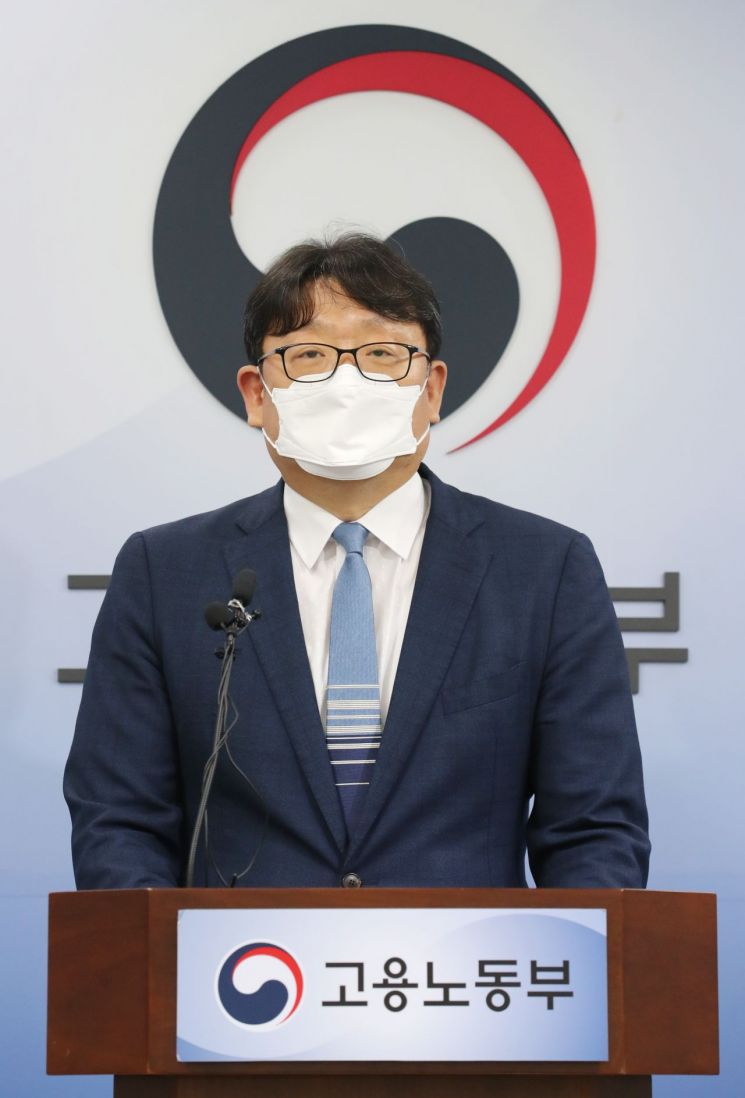 Kwon Gi-seop, Director of the Occupational Safety and Health Headquarters at the Ministry of Employment and Labor. (Photo by Yonhap News)
[Sejong=Asia Economy Reporter Moon Chaeseok] The government has outlined the scope of 'management responsibility' subject to punishment two months before the enforcement of the Serious Accidents Punishment Act. On the 17th, the government announced an explanatory guide to the Serious Accidents Act, stating, "The decision-maker who oversees the business is the (punishable) management responsible person, and simply appointing a safety-related representative does not exempt one from responsibility."
The explanatory guide released by the government on the same day contains detailed explanations regarding definitions such as management responsibility in serious industrial accidents, which have been frequently inquired about by companies. Serious industrial accidents refer to cases where ▲ one or more deaths occur ▲ two or more injured persons require treatment for six months or longer due to the same accident ▲ three or more people suffer from any of the 24 occupational diseases listed in the enforcement decree, such as acute poisoning caused by the same harmful factor, within one year. If a worker dies, the employer may be sentenced to imprisonment for one year or more or fined up to 1 billion KRW; for other accidents, imprisonment for up to seven years or fines up to 100 million KRW may be imposed.
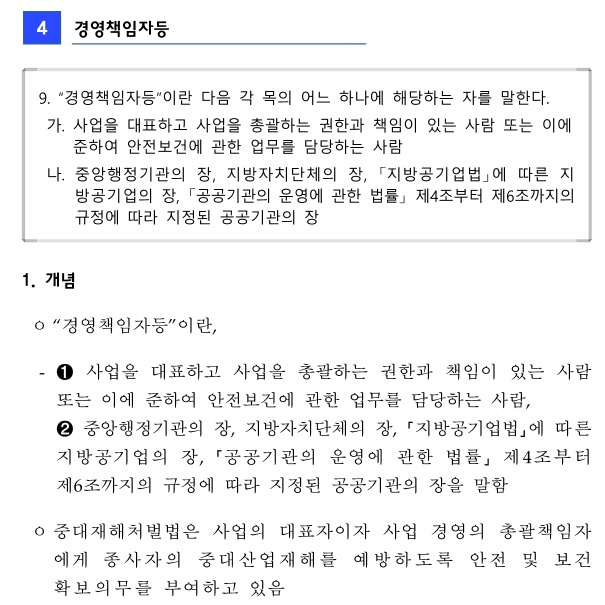
The key point is that the highest executive officer (CEO) under the Commercial Act, i.e., the 'decision-maker' who oversees the company's business, organization, budget, and safety, is subject to punishment. Having a safety and health officer in the company does not exempt one from punishment. If there are two or more representatives in a partnership, all are subject to the law, and if a corporation has multiple business division representatives, all division representatives are included. A Ministry of Employment and Labor official explained, "Externally, it refers to the CEO; internally, it includes those with experience and responsibility for overseeing and executing affairs, such as the CEO of a joint-stock company, heads of central administrative agencies and public institutions, and representatives under the Commercial Act, who fall under the scope of the law. If the head of a safety-related organization exercises decision-making authority, they can also be held responsible for serious accidents in principle." The official added, "If the head of the safety organization holds a staff-level position, it is difficult to consider them subject to punishment; they must be at least appointed by the board of directors."
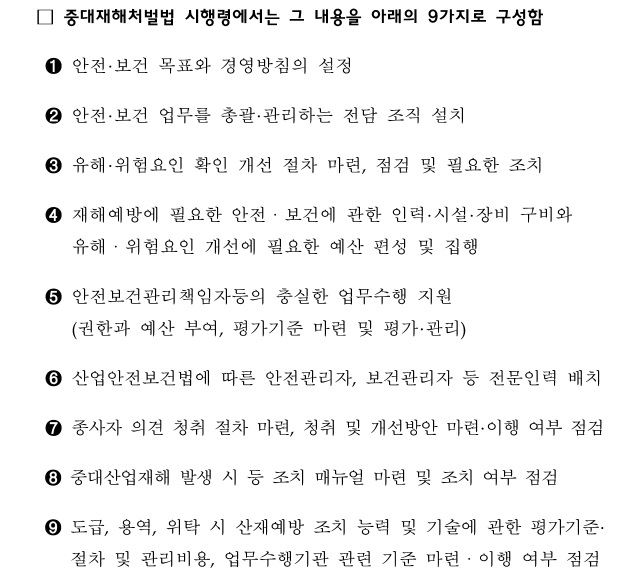
The government also presented nine mandatory measures related to the implementation of the safety and health management system stipulated in the enforcement decree that management responsible persons must fulfill. These include ▲ setting safety and health goals and management policies ▲ establishing a dedicated organization responsible for overall safety and health ▲ implementing procedures and measures to identify and improve harmful and dangerous factors. The most important aspect here is to identify and improve harmful and dangerous factors. Companies must proactively identify factors that could cause serious industrial accidents through accident history, listening to on-site workers' opinions, accident cases in the same industry, expert diagnoses, and so on. If a serious accident occurs without such identification and improvement, and this fact is revealed after investigation, management responsible persons will be punished according to the law. A Ministry of Employment and Labor official emphasized, "Identifying harmful and dangerous factors is the most important and the most frequently inquired part by companies," adding, "Individual business owners or management responsible persons must take related improvement measures at least once every six months."
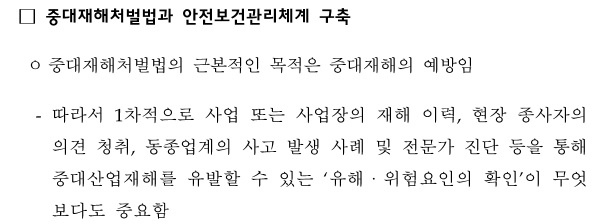
The government did not provide uniform standards by subdividing the number of workers, safety organizations, or budgets by industry. However, it stated that, at a minimum, ▲ a reasonable budget allocation sufficient to improve harmful and dangerous factors ▲ personnel, facilities, and equipment specified in safety and health-related laws such as the Industrial Safety and Health Act must be secured. For example, principles such as assigning signalmen during tower crane operations, working in pairs for scuba diving tasks, and working in teams of three for transporting household waste must be followed to avoid punishment. Furthermore, it was clearly stated that even if the construction industry secures safety and health management expenses according to Article 72 of the Industrial Safety and Health Act, it cannot avoid punishment if a serious accident occurs. A Ministry of Employment and Labor official said, "It is more important whether a budget has been allocated for evaluating and improving harmful and dangerous factors than how much money is spent," adding, "In the construction industry, spending safety and health management expenses under the Industrial Safety and Health Act will not be interpreted as having allocated a budget under the Serious Accidents Punishment Act."
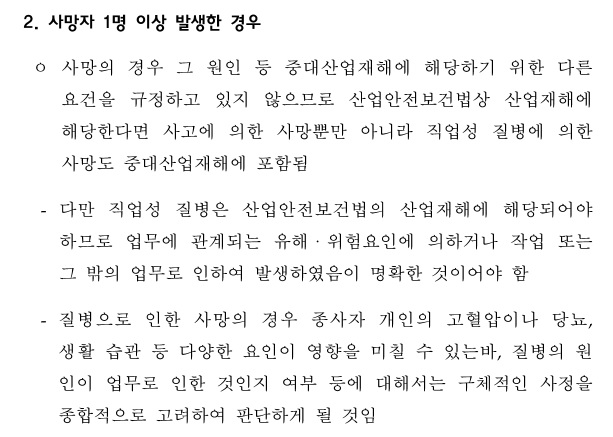
The government emphasized that it will continuously verify whether 'serious accidents have not been neglected and improvement measures have been prepared.' According to this principle, deaths caused by individual workers' conditions such as hypertension or diabetes, which are not included in the list of 24 occupational diseases in the enforcement decree, are excluded from the law's application. Due to this, concerns have arisen that companies might exclude individuals with diseases like hypertension or diabetes from hiring to reduce risks. In response, Kwon Kisup, Director of the Occupational Safety and Health Headquarters at the Ministry of Employment and Labor, said, "Accidents subject to investigation under the Serious Accidents Punishment Act are 'clearly' revealed, and whether the cause of the serious accident during the investigation process is due to personal illness will be comprehensively considered," adding, "The law will mainly apply to accidental deaths, and if there are personal underlying diseases, these will not be recognized as grounds for punishment."
© The Asia Business Daily(www.asiae.co.kr). All rights reserved.
![Clutching a Stolen Dior Bag, Saying "I Hate Being Poor but Real"... The Grotesque Con of a "Human Knockoff" [Slate]](https://cwcontent.asiae.co.kr/asiaresize/183/2026021902243444107_1771435474.jpg)

















