Mid-sized Company Employees 'Swayed' by Large Overseas Corporate Bribes
358 of 504 Cases Over 4 Years Committed by Insiders
460 Cases in Mid-sized Companies... 10 Times More Than Large Corporations
National-level Control Difficult Due to Non-face-to-face Leaks
Formation of Public-Private-Academic Council
Urgent Need to Strengthen Punishment and Investigation Capabilities
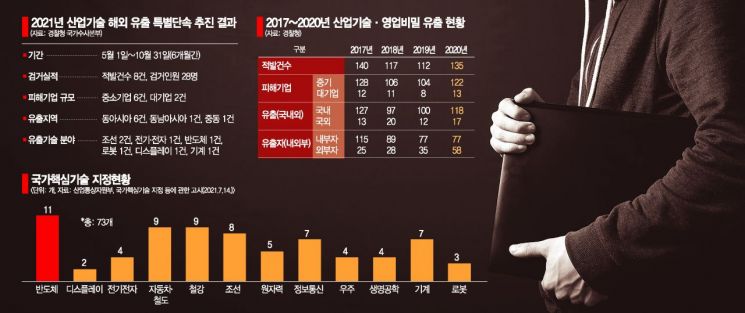
[Asia Economy Reporter Lee Gwan-ju] The recent trends in core technology leakage can be summarized into three points: acts committed by current and former insiders, involvement of small and medium-sized enterprises (SMEs) including large corporations' partner companies, and China as the final destination of technology leakage. It has been reported that all eight cases of overseas technology leakage detected in this year's special crackdown by the National Police Agency's National Investigation Headquarters were caused by insiders leaking technology abroad. This is consistent with past detection cases. Among the 504 cases of technology leakage (both domestic and overseas) detected by the police over the past four years, 358 cases (71.0%) were committed by insiders. Even if outsiders are involved, many are employees of partner companies or cases where technology was stolen upon resignation, according to related agencies.
Insider Crimes Becoming the Main Trend
Insider crimes include the so-called activities of 'industrial spies,' but most are committed for the purpose of changing jobs or obtaining financial gain. The relatively high number of technology leakage attempts in SMEs proves this. From 2017 to 2020, the number of detected technology leakage cases in SMEs was 460 (91.2%), more than ten times higher than in large corporations (44 cases). In a case last January where 17 people were prosecuted for attempting to leak technology from a major electronics company to China, key personnel such as the research director of a partner company, sales group leader, and factory manager were involved.
Compared to large corporations, SMEs have weaker security systems but inevitably lag behind foreign companies in labor costs and financial resources. Ultimately, neither companies nor the nation stand firm in the face of money. A representative of an SME that suffered damage from national core technology leakage in 2019 said, "Even if dozens of CCTVs are installed inside the company, if a foreign company secretly approaches with a huge salary offer, there is no way to prevent it unless it is recognized in advance."
Technology Leakage Becoming More Sophisticated and Intelligent
In the future, technology leakage crimes are expected to evolve in detailed methods while maintaining the broad framework of attempts through insiders. The National Intelligence Service recently analyzed that "due to COVID-19, not only the work environment but also technology leakage has shifted to 'non-face-to-face' methods." Non-face-to-face methods include hacking, misuse of cloud services, and disabling security systems. If someone inside opens the door to allow remote access to the company system, technology leakage cannot be prevented.
This also indicates that simple national-level control alone is insufficient to respond to technology leakage. The formation and active operation of the 'Public-Private-Academic New Technology Leakage Threat Response Council (TRAT)' in May this year by the National Intelligence Service, Ministry of Science and ICT, Ministry of SMEs and Startups, and Korea Information Security Industry Association (KISIA) is therefore meaningful. With information sharing on technology leakage as well as cooperation among government agencies, industry, and academia in security management, awareness improvement, and national policy development for SMEs, practical countermeasures against technology leakage are expected to be established.
Strengthen Punishments and Enhance Investigation Capabilities
Offenders of overseas industrial technology leakage face up to 15 years imprisonment or fines up to 1.5 billion KRW. However, if the actual damage is minor or trade secrets are not leaked externally and are recovered, these factors act as mitigating circumstances. Also, passive involvement or negligence in managing trade secrets are considered mitigating factors. This runs counter to the current situation where strong legislation is being promoted and implemented recognizing the seriousness of industrial technology security. In Japan, the principle of zero tolerance is applied to industrial spies to the extent that responsibility is even assigned to deceased industrial spies. Experts point out that "South Korea should also raise the level of handling infringement acts related to national core technologies and industrial technologies as a matter of national security to meet the demands of the times."
Another key to preventing technology leakage lies in investigation. Investigative agencies must obtain intelligence in advance to prevent technology leakage and, even if leakage has already occurred, must prevent further leakage. Since the launch of the National Investigation Headquarters (Guksubon) in January this year, there have been changes in police investigations of technology leakage. The work previously handled by the Police Agency's Foreign Affairs Bureau has been unified under the Security Investigation Bureau of Guksubon, enabling more systematic investigation command. Following the adjustment of investigative authority between prosecutors and police, technology leakage investigations are expected to be centered on Guksubon in the future. Professor Lee Woong-hyuk of Konkuk University's Department of Police Science said, "Investigations into industrial technology leakage are not easy to prove and require knowledge of industry trends, making it an advanced investigative field. To respond to this 'war without gunfire,' it is necessary to train specialized investigators and research the latest techniques, requiring continuous capacity building of Guksubon going forward."
© The Asia Business Daily(www.asiae.co.kr). All rights reserved.
![Clutching a Stolen Dior Bag, Saying "I Hate Being Poor but Real"... The Grotesque Con of a "Human Knockoff" [Slate]](https://cwcontent.asiae.co.kr/asiaresize/183/2026021902243444107_1771435474.jpg)











