[Asia Economy Reporter Lee Seon-ae] The surge in rights offerings and initial public offerings (IPOs) by listed companies this year is putting pressure on the supply and demand dynamics of the domestic stock market.
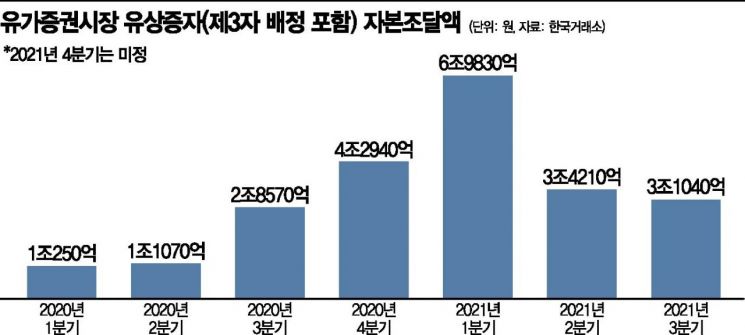
According to the Korea Exchange's KOSPI Market Headquarters on the 16th, the amount of funds raised through rights offerings by KOSPI-listed companies this year was 6.983 trillion won in Q1, 3.421 trillion won in Q2, and 3.104 trillion won in Q3. Fundraising through rights offerings in Q3, including F&F Holdings (1.2121 trillion won) and Heung-A Shipping (1.1715 trillion won), decreased by 9% compared to the previous quarter. However, this is different when compared to the previous year. Compared to 2.857 trillion won in Q3 last year, it surged by 9%. The amounts in Q1 and Q2 last year were also significantly lower at 1.025 trillion won and 1.107 trillion won, respectively, compared to this year.
The fourth quarter is traditionally a season for rights offerings, and the scale is expected to increase further. Just this week, newly issued shares from rights offerings by a total of seven companies are scheduled to be traded in the market. Among them, Samsung Heavy Industries is the listed company with the largest new share issuance. Samsung Heavy Industries resolved a rights offering in mid-August for operational funds and debt repayment. After finalizing the issue price and subscription, the new shares will be circulated on the 19th. They will raise a total of 1.28 trillion won by issuing 250 million shares at a price of 5,130 won per share.
Accordingly, capital raised in Q4 this year is expected to be at least 5 trillion won. Last year’s Q4 amount was recorded at 4.294 trillion won.
Besides rights offerings, the IPO market this year is also boasting record-breaking scale. Up to last week, 104 companies (including SPACs and REITs) have newly listed on the KOSPI and KOSDAQ markets, with a total public offering amount reaching 20.1279 trillion won. By market, 17 companies on the KOSPI raised 16.8694 trillion won, while 87 companies on the KOSDAQ raised about 3.2586 trillion won through IPOs.
This is 3.4 times the total public offering amount of last year (5.9355 trillion won from 95 companies) and about twice the previous record high in 2010 (10.1453 trillion won). This was influenced by the entry of major “blue-chip” IPOs such as SK Bioscience (1.4918 trillion won), SK IE Technology (2.246 trillion won), KakaoBank (2.5526 trillion won), Krafton (4.3098 trillion won), Hyundai Heavy Industries (1.08 trillion won), and KakaoPay (1.53 trillion won).
In the securities industry, it is analyzed that the increased number of shares due to the numerous IPOs and rights offerings throughout the year is having a negative impact on the stock market. In particular, the decoupling phenomenon between the U.S. and Korea is also pointed out as one factor in the domestic stock market’s supply and demand situation caused by large-scale IPOs and rights offerings. Choi Yoo-jun, a researcher at Shinhan Financial Investment, said, “As stock prices have maintained higher levels compared to the past, capital raising through the stock market has increased,” adding, “It is necessary to consider the possibility that this could act as a supply and demand burden.”
Park Seung-young, a researcher at Hanwha Investment & Securities, who pointed out that supply and demand is currently the biggest factor weighing on the domestic stock market, explained, “When the supply of shares increases due to rights offerings and IPOs, the market capitalization growth rate is higher than the index fluctuation rate,” adding, “Until last year, there was little difference between the index fluctuation rate and the market capitalization change rate in the domestic stock market, but this year, while the index rose 3.3%, market capitalization increased by 10.9%.” He continued, “There is almost no difference between the S&P 500 index fluctuation rate and market capitalization change rate,” and added, “With large IPOs such as LG Energy Solution still pending, supply and demand pressure will continue to act as a factor weighing on the valuation of the domestic stock market.”
© The Asia Business Daily(www.asiae.co.kr). All rights reserved.

















