Nature Publishes Paper Overturning Previous Theories on Trans-Eurasian Language Origins
Concludes Origin from 9,000-Year-Old Northeast Asia Liaohe Agriculturalists Instead of 4,000-Year-Old Nomads
Some Use 'Jungguk Yoha' Region Expression Not in Paper... Concerns Over Dongbukgongjeong Victimization
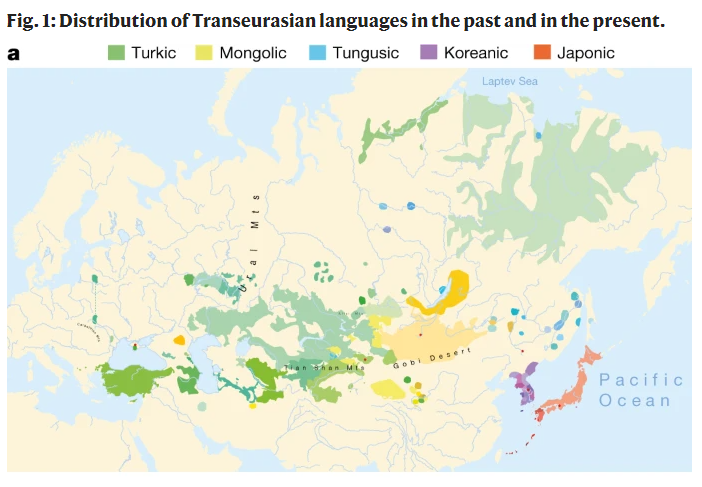
[Asia Economy Reporter Kim Bong-su] A study has revealed that the origin of the 'Altaic language family' (Trans-Eurasian languages), which includes Korean, Japanese, Mongolian, and Turkic languages, was not the nomads of the Central Asian steppes as previously thought, but rather the languages of Neolithic agricultural peoples around the Liaohe River (Yoha) region in Northeast Asia about 9,000 years ago. At that time, the Liaohe River area was the homeland of the Dongyi people, whose language spread east and west, forming the foundation of over 90 Altaic languages. However, some domestic media outlets have specified the Yoha region as 'China' when reporting on this research paper, raising concerns about potential misunderstandings. Given that Chinese authorities are aggressively incorporating the Yoha area and Manchuria into their history through the Northeast Project, there is a risk that the language could also be portrayed as 'Chinese-made.'
On the 12th, the international academic journal Nature published a paper led by the Max Planck Institute in Germany, involving linguists, archaeologists, and geneticists from 10 countries including Korea, Japan, and the United States, which reached this conclusion about the origin of Trans-Eurasian languages. The research team analyzed ancient agricultural and pastoral vocabulary, archaeological findings from 255 Neolithic and Bronze Age sites in Northeast Asia, and genetic studies of early farming populations in Korea, Ryukyu, and Japan.
As a result, the team concluded that Trans-Eurasian languages spread as Neolithic agriculturalists who cultivated millet in the Yoha region about 9,000 years ago migrated across the continent. Previously, the academic consensus was that the roots of Trans-Eurasian languages lay with nomads living on the Central Asian steppes about 4,000 years ago.
The issue arose when this paper was introduced domestically, and some sources labeled the Yoha region as 'China.' Around 9,000 years ago, the Yoha area was just beginning to develop Neolithic civilizations and small states were forming. Notably, the Yoha region was the main sphere of influence of the Dongyi people and is chronologically presumed to be the foundation of Gojoseon in ancient Korean history. Strictly speaking, since the modern concept of a nation-state did not exist then, the Yoha area should not be labeled as 'China.' The paper itself carefully mentions the place names of the Yoha region without any wording that could be 'misunderstood' as Chinese territory.
While the historical academic community recognizes this research as confirming that the roots of the Altaic language family were the Dongyi people, there are concerns that some reports might turn it into a victim of the 'Northeast Project.' Lee Deok-il, director of the Hangaram Institute of Historical and Cultural Studies, stated, "It is difficult to specify a country for the Neolithic civilization in the Yoha region 9,000 years ago, but archaeological excavation results clearly show it was ethnically the Dongyi people's area. This research confirms that the Dongyi language became the Altaic language family," adding, "However, since China is incorporating the Yoha area into its history as part of the Northeast Project, misunderstandings may arise."
© The Asia Business Daily(www.asiae.co.kr). All rights reserved.
![Clutching a Stolen Dior Bag, Saying "I Hate Being Poor but Real"... The Grotesque Con of a "Human Knockoff" [Slate]](https://cwcontent.asiae.co.kr/asiaresize/183/2026021902243444107_1771435474.jpg)















