Achieving Carbon Neutrality by 2045
Supporting Carbon Neutrality in Parts and Raw Material Supply Chains
Marine Ecosystem Restoration Projects for Blue Carbon
Global Sites to Switch to Renewable Energy by 2040
Pre-release of 'EV9,' Symbol of Sustainable Mobility Solutions
 Kia announced its sustainable corporate vision, "Sustainable Mobility Solutions Provider," and presented "carbon neutrality by 2045" as a key initiative.
Photo by Kia
[Asia Economy Reporter Ki-min Lee] Kia announced its corporate vision as a 'Sustainable Mobility Solutions Provider' and set 'carbon neutrality by 2045' as a key goal.
On the 11th at 5 p.m., Kia held the 'Kia Sustainability Movement' event online and declared its commitment to contributing to the development of customers, communities, and global society through sustainable mobility solutions.
At the vision announcement, Kia President Ho-sung Song said, "We will make a tangible contribution to global efforts to address climate change through various means," adding, "Kia's vision for a sustainable future is not only about reaching set goals but also inspiring many people and changing the world."
Achieving Carbon Neutrality by 2045... "Making a Tangible Contribution to Creating a Sustainable Planet"
 Kia announced its sustainable corporate vision, "Sustainable Mobility Solutions Provider," and presented "carbon neutrality by 2045" as a key initiative. Kia plans to carry out marine ecosystem restoration projects to reduce the Earth's carbon footprint.
First, to achieve carbon neutrality by 2045, Kia aims for ▲Sustainable Mobility ▲Sustainable Planet ▲Sustainable Energy as its guiding principles and will work on reducing and offsetting carbon emissions. Specifically, Kia plans to reduce carbon emissions to 97% of 2019 levels by 2045 while making carbon emissions across the entire vehicle lifecycle?including supply, production, logistics, and disposal?'zero.'
To achieve carbon neutrality in the vehicle usage phase, which accounts for the largest share of carbon emissions, Kia will expand electrification based on its mid- to long-term future strategy, 'Plan S.' Starting with the European market in 2035, Kia expects to offer only electrified vehicles in all major markets by 2040, eliminating carbon emissions generated during vehicle operation.
Kia will also support reducing carbon emissions in the supply chain of key parts and raw materials. By next year, it will establish a system to accurately monitor carbon emissions of first-tier suppliers and select key management targets based on accumulated data. Kia plans to set long-term carbon reduction targets for these selected suppliers and support them through joint investments, financial aid, and education. In particular, from 2030, Kia will gradually source eco-friendly green steel produced with minimal use of fossil fuels such as coal and apply it to mass-produced vehicles.
Moreover, Kia is promoting the 'Blue Carbon Project,' a marine ecosystem creation and restoration initiative that contributes tangibly to building a sustainable planet beyond just reducing carbon emissions. Blue carbon refers to carbon absorbed by marine ecosystems such as seaweed and tidal flats. Korea’s tidal flats (Seocheon, Gochang, Sinan, Boseong-Suncheon), registered as UNESCO World Natural Heritage sites in July, are known to absorb 260,000 tons of CO2 annually, equivalent to the emissions of 110,000 internal combustion engine vehicles per year.
For the Blue Carbon Project, Kia is exploring cooperation with the Ministry of Oceans and Fisheries domestically and, from next year, will collaborate with the Dutch nonprofit organization The Ocean Cleanup to collect marine plastic waste overseas. Beyond simply cleaning rivers and seas, Kia plans to recycle collected plastics into Kia vehicle production and support the use of recycled materials in The Ocean Cleanup’s Interceptor barges. Through these efforts, Kia aims to increase the recycled plastic usage rate in finished vehicles to over 20% by 2030.
Additionally, Kia will establish a 'Virtuous Recycling Loop' to minimize climate impact when vehicles are disposed of. Once activated, this system is expected to increase recycling rates of waste batteries, plastics, and more, further contributing to environmental protection. In line with this, since 2022, Kia has planned demonstration projects for energy storage systems (SLBESS) reusing electric vehicle batteries in collaboration with various domestic and international energy companies.
Transitioning All Global Sites to Renewable Energy by 2040 for Carbon Neutrality by 2045
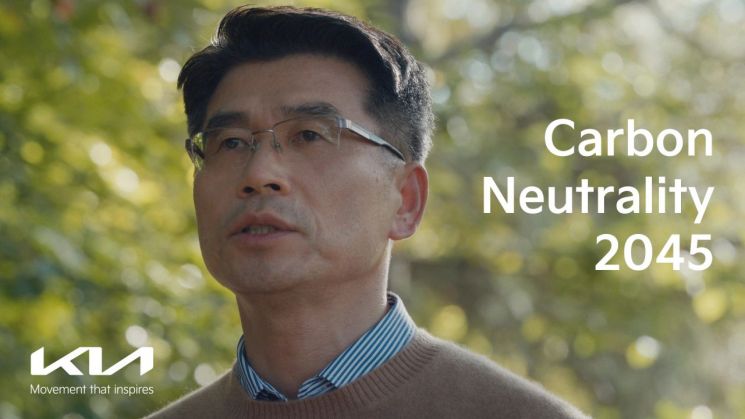 On the 11th, Song Hoseong, President of Kia, stated at Kia's vision announcement, "We will make a tangible contribution to global efforts to address climate change through various methods," emphasizing, "Kia's vision for a sustainable future is not only to achieve the set goals but also to inspire many people and change the world."
Photo by Kia
Kia has committed to achieving RE100 by 2040, replacing 100% of electricity demand at all global sites with renewable energy. This is part of the effort to make carbon emissions from all production sites and office facilities zero by 2045.
Specifically, energy transition will be completed by 2030 at overseas sites and by 2040 at domestic sites. Among overseas production bases, the Slovakia plant has been operating entirely on renewable energy since 2019.
To accelerate energy transition, Kia will actively introduce solar power systems in production facilities in Korea, the United States, China, and India in the short term.
Furthermore, to reduce carbon emissions from business sites, Kia will replace all company vehicles used worldwide with electric vehicles by 2030.
Additionally, Kia plans to reduce carbon emissions by 1% annually through equipment efficiency improvements and apply various new technologies such as carbon capture, utilization, and storage (CCUS) to production facilities.
Pre-release of The Kia Concept EV9… Symbolizing Commitment to Realizing 'Sustainable Mobility Solutions'
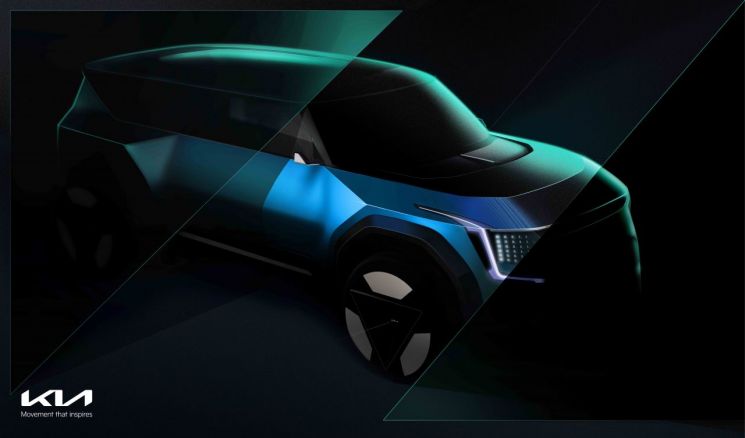 On the 11th, Kia unveiled the EV9 Concept, the second dedicated electric vehicle symbolizing Kia's sustainable mobility solutions, at its vision presentation. The actual vehicle is scheduled to be revealed on the 17th (local time) at Automobility LA.
Photo by Kia
At the vision announcement event, Kia unveiled preview images of 'The Kia Concept EV9,' the second model based on the dedicated electric vehicle platform (E-GMP).
‘The Kia Concept EV9,’ symbolizing Kia’s strong commitment to realizing 'Sustainable Mobility Solutions,' features a futuristic design inspired by nature and materials upcycled from marine waste that seriously threatens marine ecosystems.
Kia used discarded fishing nets collected from the sea for the vehicle floor and applied a blend of recycled plastic bottles and wool fibers for the seat upholstery. Additionally, ethical and eco-friendly vegan leather was used for the interior instead of animal leather, and Kia plans to completely phase out animal leather use in all vehicles step by step.
The actual vehicle of ‘The Kia Concept EV9’ will be unveiled for the first time at 'Automobility LA' on the 17th (local time).
© The Asia Business Daily(www.asiae.co.kr). All rights reserved.
![Clutching a Stolen Dior Bag, Saying "I Hate Being Poor but Real"... The Grotesque Con of a "Human Knockoff" [Slate]](https://cwcontent.asiae.co.kr/asiaresize/183/2026021902243444107_1771435474.jpg)


















