Government Discusses Annual Vaccination Like Influenza Vaccine
Also Promotes Establishment of Separate Institution Dedicated to Vaccination
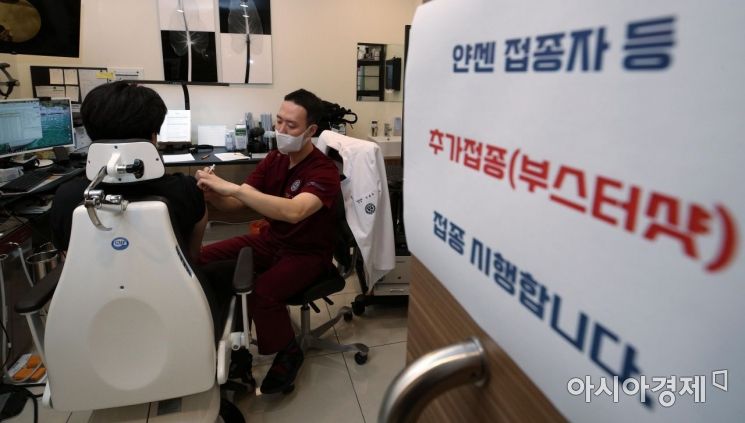 On the 8th, when the additional COVID-19 vaccination (booster shot) began for Janssen vaccine recipients and inpatients, residents, and workers of nursing hospitals and nursing facilities, a Janssen vaccine recipient is receiving a booster shot at Yonsei With ENT Clinic in Seocho-gu, Seoul. Photo by Hyunmin Kim kimhyun81@
[Asia Economy Reporter Lee Chun-hee] The government is pushing for an annual COVID-19 vaccination plan. The idea is to vaccinate against COVID-19 according to the epidemic situation, similar to how the government mandates influenza vaccines for high-risk groups. To this end, a separate institution will be established instead of the current vaccination response system under the Korea Disease Control and Prevention Agency (KDCA) or the temporary organization, the COVID-19 Vaccination Response Promotion Team.
According to the government on the 11th, the KDCA stated in the recently released "Government Major Policy Implementation Status and Future Tasks" report that as a long-term task, it will consider including COVID-19 vaccination as a national essential vaccination to regularize the vaccination schedule. This means discussing the possibility of receiving the COVID-19 vaccine annually, similar to the influenza vaccine currently administered annually with national support.
There is ongoing debate about the duration of the preventive effect of the COVID-19 vaccine. Recent studies have shown that the effectiveness decreases over time after completing vaccination, leading to the implementation of additional booster shots, but even these are not considered a permanent solution. Albert Bourla, CEO of Pfizer, said on the 9th (local time), "The preventive effect of the third booster shot seems to last for about a year," adding, "If so, the vaccine will be administered annually."
Some argue that if oral COVID-19 treatments become game changers like Tamiflu, vaccination may no longer be necessary. However, Ryu Geun-hyuk, Vice Minister of Health and Welfare, stated, "Oral treatments cannot completely block severe illness or death caused by COVID-19," emphasizing, "The most important measures against COVID-19 are compliance with quarantine rules and vaccination." Roche also explains the efficacy of Tamiflu by stating, "The primary prevention for influenza is vaccination," and "This drug cannot replace vaccination."
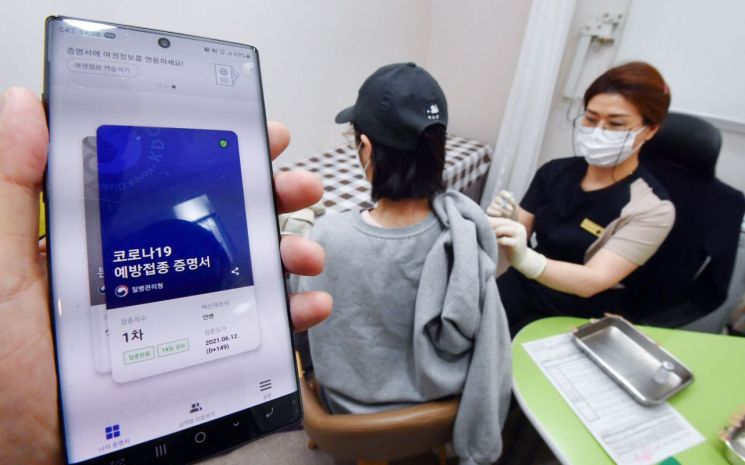 On the afternoon of the 8th, when the additional vaccination (booster shot) for Janssen vaccine recipients began, a citizen visiting a hospital in Yangcheon-gu, Seoul, is receiving the booster shot. [Image source=Yonhap News]
Following the start of additional vaccinations last month, the government plans to introduce a total of 90 million doses next year, combining 80 million messenger RNA (mRNA) vaccine doses and 10 million domestic vaccine doses. Contracts for 60 million mRNA vaccine doses have already been signed with Pfizer. However, regarding the possibility of annual COVID-19 vaccination, a KDCA official explained, "Unlike the already confirmed additional vaccinations for next year, regularizing vaccination is a long-term task," adding, "Since it is unknown when COVID-19 will end and how long vaccinations will be necessary, long-term research is required, and this is intended to prepare for that."
The KDCA plans to replace the temporary COVID-19 Vaccination Response Promotion Team with a new specialized public institution to respond to emerging infectious diseases and ensure vaccine safety. A KDCA official said, "The current promotion team is only a temporary organization and has limitations," adding, "There is no guarantee that a second COVID-19 will not occur, so the goal is to establish an adequately prepared organization that can respond at any time."
© The Asia Business Daily(www.asiae.co.kr). All rights reserved.


















