Shock Grows Over 'Gang Doyoung Incident' Where Father Was Killed
'Young Carers' Suffering Financial Hardship... Inadequate Reality Survey
Support Policies Already Established in Advanced Countries Like UK and Japan
Experts Say "Family Support Is a Public Responsibility, Not an Individual One"
 The issue of 'young carers' who bear the responsibility of supporting their parents at a young or early age is coming to light. The photo is unrelated to specific expressions in the article.
[Asia Economy Reporter Lim Juhyung] The case of a 22-year-old young man, 'Kang Doyeong (alias),' who neglected his father, a stroke patient, leading to his death, has shocked the public. Initially, this case was known as a filial impiety incident where a father, unable to move even a single finger, was starved to death. However, it has been revealed that Kang himself was forced to let his father die due to severe financial hardship.
The Kang case is also pointed out as one of the many 'young carer' tragedies gradually coming to light in South Korea. A young carer refers to youths who take on caregiving duties due to a sudden illness in the family. While advanced countries such as the UK and Japan have relatively well-established social systems to support these young people, South Korea has never properly conducted a survey on the actual situation, raising serious concerns.
◆"I heard my father's calls for help but pretended not to know"
On August 13, the Daegu District Court Criminal Division 11 (Presiding Judge Lee Sang-oh) sentenced Kang to four years in prison on charges of killing a dependent. Kang is accused of neglecting his father, who had been in a vegetative state for nearly a year after suffering a stroke, without providing proper treatment, leading to his death.
The court ruled, "The son had a legal duty to take necessary measures to ensure the victim continuously received nutrition and to prevent any risk to life and body."
However, investigative reporting by the specialized media outlet 'Sherlock' revealed that Kang was overwhelmed by unbearable financial difficulties behind the case.
At the time Kang's father, Mr. A, a factory worker, suddenly collapsed due to a stroke, Kang was a young man who had just taken a leave of absence from university and was about to begin public service work. With income abruptly cut off, hospital bills for Mr. A's surgery, hospitalization, and rehabilitation treatment amounted to nearly 20 million KRW. As the head of the household who already had to cover living expenses, rent, and utilities, Kang could not possibly afford these costs.
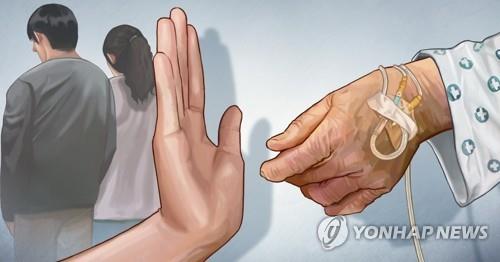 It has been revealed that behind the case of 22-year-old young man Kang Do-yeong (alias), who stopped the nutritional feeding of his father in a vegetative state, causing his death, there was a terrible financial hardship. / Photo by Yonhap News
With rent overdue, gas and internet services cut off, and even rice to eat running out, Kang ultimately had no choice but to discharge his father from the hospital.
During the prosecution investigation, Kang confessed, "After my father was discharged, I thought it would be difficult to live like this, so I decided to just let him pass away." He added, "From May 1, despite intermittently hearing my father's calls for help saying 'Son, son,' I pretended not to know. I just watched silently, cried, closed the door, and did not enter the room until my father died."
◆The shadow of an aging and low birthrate society: 'Young Carers'
The Kang case is criticized as a typical tragedy of a 'young carer.' The term 'young carer' refers to young people who care for their parents from an early age. It was coined in the UK in 2014 and has since spread. Young carers often take on caregiving duties during a period when they should be focusing on their studies and frequently suffer from financial hardship due to insufficient income.
In South Korea, books featuring confessions from young carers have recently been published and gained attention. In 2019, author Jo Gihyeon released the book “I Became My Father's Father”. This book details the memoir of a young man who cared for his father with dementia for about nine years starting from age 20.
Jo wrote in the book, "People around me sometimes called me a 'filial son,' but before I knew it, I became the head of the household responsible for two lives, overwhelmed and exceeded by money, work, and caregiving."
The increasing number of young people burdened with parental care is presumed to be closely related to the transition to an aging and low birthrate society. As the average age of parents having their first child rises, the children who bear caregiving responsibilities are actually getting younger. In the past, when a parent was ill, multiple children could take turns providing care, but now one or two children must bear the full burden, which has increased dramatically.
◆No proper surveys conducted... Long way to go for young carer welfare
Advanced countries that experienced aging societies earlier have already established support measures for young carers. The UK, which coined the term 'young carer,' legally defined young carers in the 2014 Children and Families Act and has implemented various policies, including subsidies, since 2019.
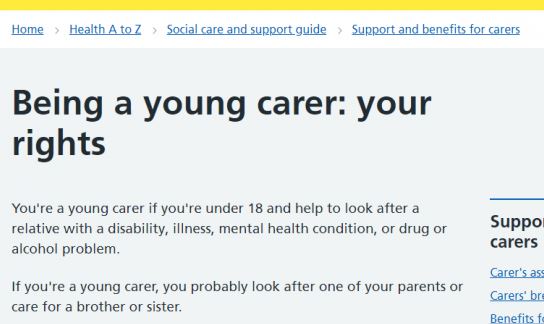 In 2014, the UK health authorities legally defined young carers through the 'Children and Families Act' and have already been implementing related support policies. The photo shows an explanation of the rights and benefits for young carers by the UK's National Health Service (NHS). / Photo by NHS official website capture
The UK's National Health Service (NHS) explains in detail on its official website the rights and benefits given to young carers. According to the description, young carers can always receive help from social workers affiliated with local governments who care for their parents on their behalf. If necessary, they can also get advice on their studies or job training and receive job placement assistance.
Japan, which entered a super-aged society with a national average age of 48.4 as of last year, has also established a welfare system providing various services such as household labor support, caregiving, and online counseling for young carers' families.
In contrast, South Korea has yet to conduct a proper survey on young carer households, so it does not know how many young people currently bear caregiving responsibilities. This is why concerns are growing that tragedies like the 'Kang Doyeong case' could happen again at any time.
◆Experts: "Urgent need to define the specific scope of young carers"
As the controversy grows, voices in the political sphere are also calling for the establishment of welfare systems to guarantee a dignified life for young carers.
Prime Minister Kim Boo-kyum mentioned young carers during a comprehensive policy inquiry at the National Assembly on the 5th, saying, "It is our responsibility that even those who could receive help did not feel that the state was reaching out to them," and promised to improve the system.
 Japan, which experienced aging earlier than Korea, already provides various welfare services for young carers. The photo is unrelated to specific expressions in the article. / Photo by Yonhap News
Related legislation is also being proposed. On the 28th of last month, Assemblyman Kim Seong-ju of the Democratic Party of Korea introduced a partial amendment to the Youth Welfare Support Act. The core of this bill is to designate young carers as 'family caregiving youth,' conduct surveys on them, and establish specific support measures.
Experts advise that to support those in welfare blind spots, a detailed and proactive welfare system is necessary.
Professor Kim Seong-ho of the Department of Social Welfare at Seongseo University said, "The most urgent task in supporting young carers is first to define the specific definition and scope of young carers. Only by clearly defining up to what age adult caregivers are considered young carers can surveys and related support measures follow."
He added, "Efforts to reduce welfare blind spots are ongoing domestically, but it is true that there are still shortcomings. To build proactive and detailed welfare, social awareness that family caregiving is a public responsibility of society, not just individuals, must come first."
© The Asia Business Daily(www.asiae.co.kr). All rights reserved.
![Clutching a Stolen Dior Bag, Saying "I Hate Being Poor but Real"... The Grotesque Con of a "Human Knockoff" [Slate]](https://cwcontent.asiae.co.kr/asiaresize/183/2026021902243444107_1771435474.jpg)

















