IMF Fiscal Monitor Report… South Korea's General Government Debt to GDP at 66.7% in 2026
An increase of 15.4 percentage points compared to the end of this year
35 Advanced Economies Expected to See a 3.0 Percentage Point Decrease
[Sejong=Asia Economy Reporter Kim Hyunjung] A forecast has emerged that South Korea will have the fastest growth rate in national debt relative to economic size among advanced countries over the next five years. Despite the structural inevitability of rising national debt due to low birth rates and aging population, fiscal tightening has not been implemented since the COVID-19 pandemic. This contrasts with the claim made by Lee Jae-myung, the Democratic Party candidate, during the ruling and opposition parties' presidential debates, who referred to South Korea as a "rich country with poor citizens." The Organisation for Economic Co-operation and Development (OECD) also stated that South Korea's potential growth rate, which indicates economic capacity, will fall to the 0% range after 2030.
According to the International Monetary Fund (IMF) Fiscal Monitor Report released on the 8th, South Korea's general government debt ratio is expected to reach 66.7% of Gross Domestic Product (GDP) by 2026. This represents an increase of 15.4 percentage points from the general government debt ratio of 51.3% of GDP at the end of this year.
The general government debt-to-GDP ratio, which compares a country's national debt to its economic size, is typically compiled by the IMF using medium-term projections from various governments for standardized comparison. South Korea's ratio is projected to rise the most among the 35 countries classified as advanced economies by the IMF over the next five years. During the same period, the debt-to-GDP ratio of these 35 advanced economies is expected to decrease from 121.6% to 118.6%, a drop of 3.0 percentage points. Among the Group of Seven (G7) countries?the United States, United Kingdom, France, Germany, Japan, Canada, and Italy?the ratio is expected to fall from 139.0% to 135.8%, a decrease of 3.2 percentage points. The countries with the highest increases are the Czech Republic (8.7 percentage points), Belgium (6.3 percentage points), Singapore (6.0 percentage points), and Hong Kong (3.8 percentage points), but these increases are much smaller compared to South Korea's 15.4 percentage points.
The trends in debt-to-GDP ratios for South Korea and advanced countries diverge this year and next. The IMF projects that the debt-to-GDP ratio for the 35 advanced economies will decrease from 122.7% last year to 121.6% this year, a 1.1 percentage point drop, and further decline to 119.3% next year, a 2.3 percentage point decrease. In contrast, South Korea's debt-to-GDP ratio rose from 47.9% last year to 51.3% this year, an increase of 3.4 percentage points, and is expected to rise again to 55.1% next year, a 3.8 percentage point increase.
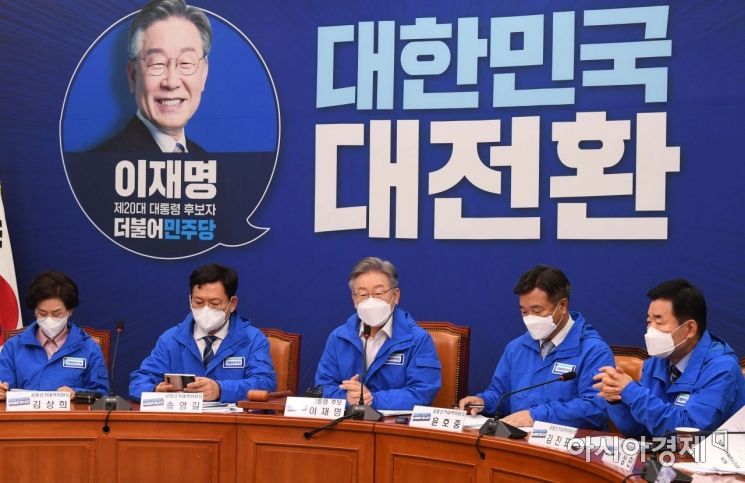 Lee Jae-myung, the Democratic Party presidential candidate, is delivering opening remarks at the Central Election Countermeasures Committee meeting held at the National Assembly on the 8th. Photo by Yoon Dong-joo doso7@
This year alone, South Korea has allocated 14.9 trillion won in the first supplementary budget and 35 trillion won in the second supplementary budget. Additionally, some members of the ruling party have advocated for a third supplementary budget to provide further support, and Democratic Party candidate Lee Jae-myung has called for additional nationwide disaster relief payments. On his social media, he mentioned the projected excess tax revenue for this year (about 40 trillion won) and wrote, "The national treasury is fully stocked. Is it right for a rich country to have poor citizens?"
Concerns have also been raised that South Korea's economic growth will slow to a very low level globally. According to the OECD's recent fiscal outlook report through 2060, assuming no policy changes and continuation of the current situation, South Korea's per capita potential GDP growth rate from 2030 to 2060 is projected at 0.8% annually. Potential GDP refers to the maximum production level a country can achieve without triggering inflation. The OECD expects South Korea's per capita potential GDP growth rate to decline from 1.9% during 2020?2030 to 0.8% during 2030?2060. While the 2020?2030 rate is higher than the OECD average of 1.3%, the 2030?2060 rate falls below the average of 1.1%, ranking joint last among 38 countries alongside Canada (0.8%).
© The Asia Business Daily(www.asiae.co.kr). All rights reserved.
![Clutching a Stolen Dior Bag, Saying "I Hate Being Poor but Real"... The Grotesque Con of a "Human Knockoff" [Slate]](https://cwcontent.asiae.co.kr/asiaresize/183/2026021902243444107_1771435474.jpg)

















