Presentation of Rational Review Criteria by Detailed Items
Basic Construction Costs Cannot Be Arbitrarily Adjusted by Local Governments
Specification of Varied Additional Cost Review Items
 Apartment complexes in Songpa and Gangnam areas as seen from the 'Seoul Sky' observatory at Lotte World Tower, Jamsil, Songpa-gu, Seoul [Image source=Yonhap News]
The government has decided to specifically organize the review criteria for the price ceiling system on pre-sale prices, which have been ambiguous and varied across local governments. The aim is to increase the predictability of price reviews and support supply expansion. Additionally, standards and procedures for estimating pre-sale prices have been established for cases where private developers conduct preliminary subscription.
The Ministry of Land, Infrastructure and Transport announced on the 8th that it has prepared and distributed the 'Price Ceiling System Review Manual' and the 'Estimated Pre-sale Price Verification Manual' to local governments nationwide and the private sector to ensure rational and predictable operation of the price ceiling system and implementation of private preliminary subscriptions.
Considering criticisms from the private sector that the price ceiling system has not adequately reflected appropriate market prices and lacked transparency, the Ministry formed a task force (TF) last September with related organizations such as the Korea Institute of Civil Engineering and Building Technology, Korea Real Estate Board, and Korea Land and Housing Corporation to develop improvement measures.
According to the Price Ceiling System Review Manual announced on this day, reasonable review criteria are first presented for each detailed item, and operations considering regional characteristics will be strengthened.
For land costs, the review method for public land has been improved to eliminate unreasonable practices, and for private land, the review criteria for evaluating the appropriateness of land costs have been specified.
Although the basic construction cost is presented as a unified standard through the Ministry’s regular notices, considering cases where some local governments arbitrarily reduced costs during reviews, the manual now specifies that basic construction costs cannot be arbitrarily adjusted without separate local government notices, and administrative guidance will also be implemented.
For additional costs, which have different adjustment standards across local governments, the review items will be specified and recommended adjustment standards presented. Previously, arbitrary adjustments by local governments for additional items lowered the predictability of review results and caused disagreements between project owners and local governments. Accordingly, based on analysis of existing review data, major items have been classified into three types: recognized, unrecognized, and adjusted, and review criteria have been specified.
In particular, for adjustment items, recommended adjustment rates by construction type relative to the amounts submitted by companies (design prices) are presented to enhance predictability, but considering regional and project-specific conditions, adjustments of ±10 percentage points are allowed through review.
Furthermore, precautions regarding review errors such as duplicate calculations and arbitrary reductions have been clarified, and criteria have been specified for items with uncertain judgment standards.
The Estimated Pre-sale Price Verification Manual stipulates the calculation methods and procedures necessary for estimating pre-sale prices when private developers promote preliminary subscriptions.
Project owners calculate pre-sale prices based on the 'Price Ceiling System Manual' after design progress, but for items that cannot be calculated at the preliminary subscription stage, separate estimation methods are presented in the manual.
When recruiting preliminary winners, the estimated pre-sale price must be clearly communicated as an estimated price based on the application date, which may change at the actual subscription stage due to design and permit changes, fluctuations in basic construction costs, and other reasons.
Regarding the estimated pre-sale price verification procedure, once the estimated pre-sale price data is prepared, the project owner must apply for price verification to the HUG Estimated Pre-sale Price Verification Committee. The HUG Verification Committee is composed of public institutions with expertise in price review and local government officials responsible for price reviews, and verifies the appropriateness of the estimated pre-sale price according to the manual and related laws, notifying the results.
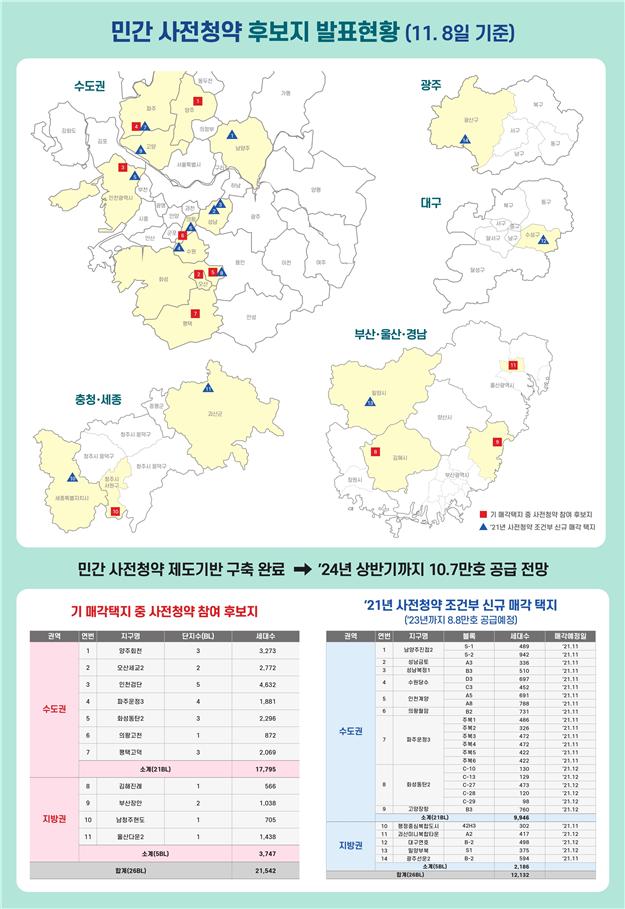
In addition, the Ministry of Land, Infrastructure and Transport explained that follow-up measures for the private sector expansion plan for preliminary subscriptions announced last August are being steadily implemented. The public land supply system reform reflecting detailed preliminary subscription incentives was announced on the 18th of last month, and the Housing Supply Rules, which stipulate detailed procedures for preliminary subscriptions, will be revised by mid-month.
They are pushing forward with the goal of implementing private preliminary subscriptions within this year, and it is expected that 107,000 units can be supplied by the first half of 2024, exceeding the original plan of 101,000 units.
If 85% of all units are supplied through preliminary subscriptions, up to 18,000 units can be supplied, which greatly exceeds the originally planned 12,000 units.
The Ministry explained, "Most of the application units are located in preferred areas in the metropolitan area, and it is expected that various brands tailored to consumer preferences as well as medium- to large-sized housing supply will be possible."
Kim Su-sang, Director of the Housing and Land Office at the Ministry, said, "With this revision, the review criteria have been specified, greatly enhancing the predictability of the pre-sale price review process, which is expected to promote private housing supply." He added, "While preliminary subscriptions for public land public sales are proceeding successfully, once private preliminary subscriptions are in full swing, a total of 169,000 units, including public sale units, will be supplied through preliminary subscriptions."
© The Asia Business Daily(www.asiae.co.kr). All rights reserved.


















