Deputy Prime Minister Hong Nam-ki Holds 2nd Foreign Economic Security Strategy Meeting
Promotes Import of Urea Solution from China, Australia, etc. Using Military Transport Aircraft
Operates Emergency Customs Support Team and Shortens Vehicle Inspection Period from 20 Days to 3-5 Days
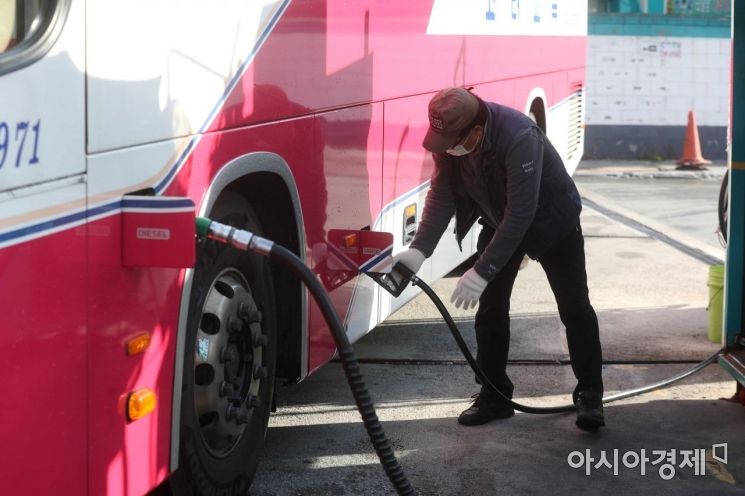 On the 7th, amid a nationwide shortage of urea solution, a vehicle is refilling urea solution at the Seoul Express Bus Terminal in Seocho-gu, Seoul. Photo by Moon Honam munonam@
[Sejong=Asia Economy Reporter Kim Hyun-jung] The government announced on the 7th that it will mobilize all available diplomatic channels to procure urea and urea solution from major producing countries such as China and Australia. It has decided to import 20,000 liters (ℓ) of urea solution from Australia this week and plans to use military transport aircraft for faster delivery. Additionally, to stabilize supply, hoarding will be banned starting from the 8th, and joint inspections by relevant ministries will be conducted.
Deputy Prime Minister and Minister of Economy and Finance Hong Nam-ki held the 2nd Foreign Economic Security Strategy Meeting at the government Seoul office on the afternoon of the 7th to discuss these matters.
First, the government will secure overseas supplies and expedite imports. It will continue diplomatic negotiations with the Chinese government to expedite export customs clearance procedures focusing on already contracted volumes (tens of thousands of tons), while actively engaging diplomatic efforts to ensure the import of several thousand tons within the year from other urea-producing countries such as Australia and Vietnam. This week, 20,000 liters of urea solution will be imported from Australia.
Furthermore, the government will provide compensation for excess costs and logistics expenses due to import substitution, swiftly implement tariff quotas, and if urgent, utilize military transport aircraft.
Efforts are also focused on rapid importation. An 'Emergency Customs Support Team' will be operated, and 'pre-arrival import declarations' will be allowed, prioritizing emergency customs clearance. The inspection period for vehicle-use urea solution will be shortened from the existing 20 days to 3-5 days, and testing and evaluation institutions will be expanded for prompt quality inspection.
The conversion of industrial-use urea solution to vehicle use will be reviewed by mid-November and, if deemed feasible, immediate action will be taken. Additionally, after completing testing and analysis of industrial urea and urea solution, a vehicle safety evaluation will be conducted to decide on conversion.
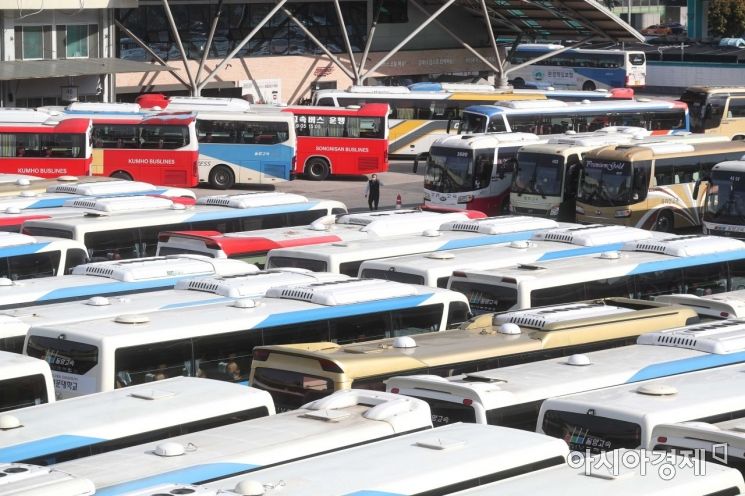 On the 7th, vehicles are parked at the Seoul Express Bus Terminal in Seocho-gu, Seoul, amid a nationwide shortage of urea solution. Photo by Moon Honam munonam@
The government expects no disruption to essential vehicle operations such as fire-fighting and emergency vehicles, as three months’ worth of supply is currently held. To further stabilize supply, measures include ▲identifying corporate (production and distribution) inventories ▲preventing hoarding ▲implementing emergency supply measures. In particular, a portion of the urea solution reserves held by domestic public sectors such as military units will be converted and allocated to urgent demand sites. Alongside this, a notice banning hoarding of urea and urea solution will be enforced from the 8th. Immediately upon enforcement, joint inspections will begin involving the Ministry of Industry, Ministry of Environment, Fair Trade Commission, National Tax Service, and Customs Service.
Additionally, a notice on 'Emergency Supply Adjustment Measures' for supply stabilization, including inventory assessment, sales restrictions, and designated sales outlets, will be enacted and implemented within this week by minimizing related procedures such as holding an interim Cabinet meeting.
In the mid-to-long term, the government will prepare measures to secure domestic urea production facilities and long-term supply stabilization plans such as strategic stockpiling by the Public Procurement Service. Demand management will also be pursued through the development of alternative catalysts that decompose nitrogen oxides without urea solution and expansion of facilities capable of using ammonia water as a substitute for urea solution. Furthermore, programs, R&D, investment costs, and environmental impacts will be comprehensively considered, focusing on public vehicles such as emergency, police, and fire vehicles, to review promotion plans. The government plans to regularly monitor items with high dependence on production from specific countries for potential supply instability and prepare timely response measures as needed.
At the meeting, the government also discussed the progress and response plans regarding the U.S. request for semiconductor information. It announced that it will strengthen the Korea-U.S. semiconductor supply chain cooperation partnership through high-level communication with the U.S. side after the submission deadline of the 8th.
Regarding the global summit on supply chain resilience held in conjunction with the G20 Summit, the government confirmed its stance that efforts should focus not only on short-term responses to supply chain disruptions but also on building long-term resilience. It also stated that it will prepare for more active multilateral discussions in the future by strengthening cooperation with major countries.
© The Asia Business Daily(www.asiae.co.kr). All rights reserved.
![Clutching a Stolen Dior Bag, Saying "I Hate Being Poor but Real"... The Grotesque Con of a "Human Knockoff" [Slate]](https://cwcontent.asiae.co.kr/asiaresize/183/2026021902243444107_1771435474.jpg)

















