Shortage of Diesel Exhaust Fluid Causes Long-Haul Truck Transport Suspensions
Prolonged Issue May Trigger Nationwide Logistics Crisis
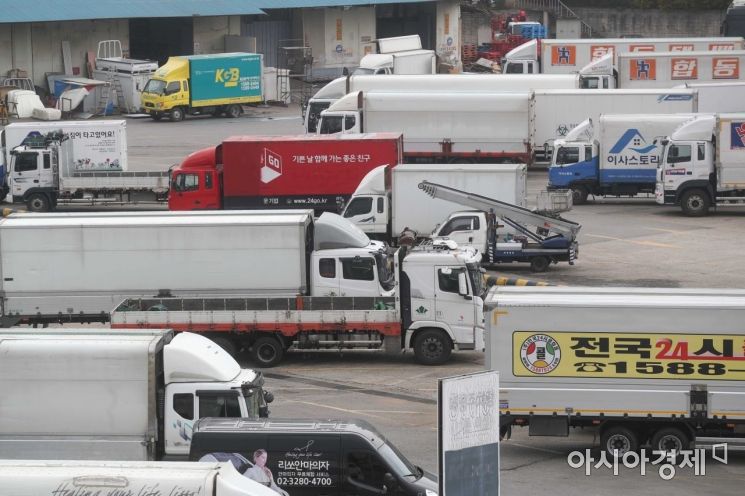 On the 4th, a cargo truck is stopped at the Western Truck Terminal in Yangcheon-gu, Seoul, where the shortage of diesel vehicle urea solution, an essential element for diesel vehicle operation, is worsening day by day. The government is reviewing all necessary measures to ensure a stable supply of urea solution, including resuming exports through consultations with China, converting industrial urea for vehicle use, import substitution, and customs clearance support. / Photo by Moon Honam munonam@
[Asia Economy Reporter Changhwan Lee] As the shortage crisis of urea solution originating from China continues, the possibility of a nationwide logistics crisis is increasing. It is forecasted that the entire industrial sector, including finished vehicles, home appliances, and essential consumer goods, will fall under the influence of logistics paralysis within 1 to 2 weeks.
According to related industries on the 6th, it has been concluded that there is only 1 to 2 weeks left before logistics using freight trucks stop due to the shortage of urea solution.
Urea solution is an essential item used in the Selective Catalytic Reduction (SCR) emission reduction devices that have been mandatory for diesel vehicles manufactured or imported domestically since 2016. Operating vehicles without urea solution exposes nitrogen oxides, which are fine dust substances. Therefore, manufacturers design vehicles so that the engine will not start if urea solution is insufficient.
The shortage of urea solution began when China restricted the export of urea, the raw material for urea solution. China started export regulations after the import of Australian coal was halted, causing a sharp decline in urea production. South Korea is suffering because it depends on China for 90% of its urea imports.
The sector suffering the most from the urea solution shortage is the long-distance freight industry. Long-distance freight trucks need to replenish urea solution every day or two, but as it becomes difficult to obtain urea solution, truck operations are being suspended one after another.
Port cargo handling is also facing difficulties. According to the Incheon City Freight Truck Transport Business Association, there have been continuous cases of freight trucks transporting containers at Incheon New Port in Yeonsu-gu, Incheon, stopping operations due to the inability to obtain urea solution. The Incheon Port Authority expressed concern that if the urea solution shortage continues until the end of this month, cargo handling at Incheon Port will inevitably face disruptions.
Courier companies have also been directly hit. Major courier companies such as CJ Logistics and Hanjin are experiencing disruptions not only in long-distance but also short-distance operations because their freight truck owners cannot obtain urea solution. A representative of the CJ Logistics agency union said, "Large trailer trunk vehicles connecting regions are struggling with urea solution supply," adding, "As logistics movement times lengthen at sub-terminals and delivery sites directly connected to them, consumers are also suffering."
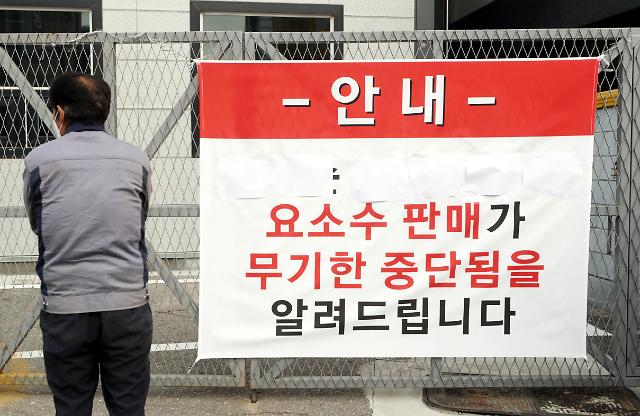
The automotive industry is experiencing a complete blockage in freight transportation carrying parts and new vehicles. A representative of an automotive partner company in the metropolitan area said, "Due to the urea solution shortage causing a freight crisis, we are having difficulties securing vehicles," expressing concern, "If this situation continues for just a week, the parts supply chain will completely collapse."
There is also a forecast that if the situation prolongs, general diesel passenger car drivers may suffer damage. Urea solution is mostly needed for commercial vehicles such as trucks or buses, and passenger cars have longer replenishment cycles. Although it varies by model, commercial vehicles usually need urea solution replenishment every 1,000 to 2,000 km, while diesel passenger cars require it around every 10,000 km.
Currently, commercial vehicle drivers are facing significant difficulties due to the urea solution shortage, but if the supply shortage prolongs, diesel passenger car drivers are also expected to face difficulties operating their vehicles.
The government is struggling daily to devise countermeasures but is cautious because it believes that once the emission regulations related to urea solution are relaxed, it will be difficult to restore them to their original state.
The Ministry of Environment has stated that it will actively cooperate with the Ministry of Trade, Industry and Energy's urea supply measures but will first review the impact on air quality and public health of manufacturing industrial-grade urea or urea solution for use as automotive urea solution, and then decide on relaxing emission standards for industrial air pollutants.
© The Asia Business Daily(www.asiae.co.kr). All rights reserved.
![Clutching a Stolen Dior Bag, Saying "I Hate Being Poor but Real"... The Grotesque Con of a "Human Knockoff" [Slate]](https://cwcontent.asiae.co.kr/asiaresize/183/2026021902243444107_1771435474.jpg)
















