Ministry of Environment Lost in 'K-Taxonomy'
Out of Sync with Nuclear Phase-Out Strategy
Funding for Projects Likely to Become Difficult
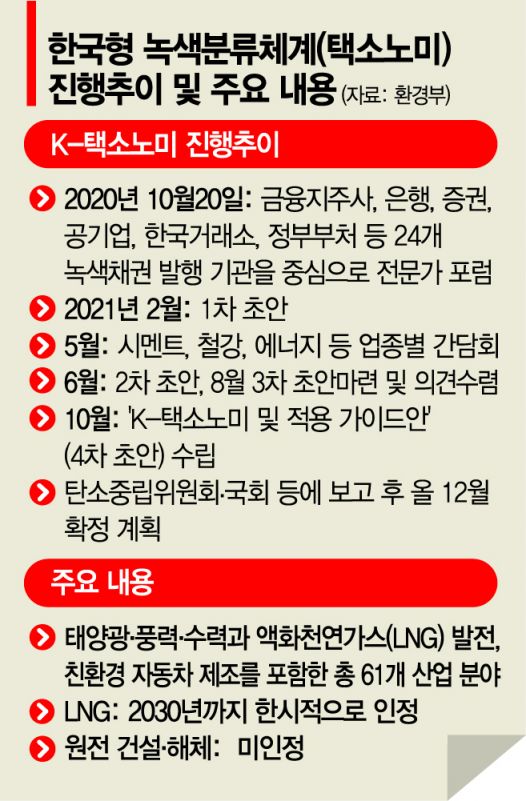
[Sejong=Asia Economy Reporter Joo Sang-don] It has been confirmed that the ‘Korean Green Taxonomy (K-Taxonomy)’ being prepared by the government does not include not only ‘nuclear power generation’ but also ‘nuclear power plant decommissioning,’ which the current administration aims to promote. Taxonomy is a standard applied by financial institutions to facility and operational loans provided to companies. Although not being recognized as a green project under the taxonomy does not completely block funding channels, considering the recent trend toward eco-friendly investments, the possibility of receiving investments is significantly reduced. This directly contradicts the current government’s intention to foster the decommissioning industry as a future growth engine for the nuclear power sector amid the nuclear phase-out.
According to the ‘Korean Green Taxonomy and Application Guide’ submitted by the Ministry of Environment to Rep. Kim Jeong-jae of the People Power Party on the 5th, ‘nuclear plant decommissioning’ was not included in the green taxonomy. The Ministry of Environment recently distributed the guide for feedback from related agencies.
An official from the Ministry of Environment stated, "The final draft of the K-Taxonomy did not recognize nuclear power plant construction or decommissioning as part of the green taxonomy." The Ministry’s judgment is based on the European Union (EU) draft. Since the K-Taxonomy is being developed based on the EU taxonomy, and nuclear decommissioning is not included in the EU draft, it was not reflected in Korea’s version either.
The EU announced a draft taxonomy excluding nuclear power and liquefied natural gas (LNG), but it has not yet been finalized. However, the EU Joint Research Centre (JRC) released a ‘Nuclear Environmental Impact Assessment Report’ stating that "there is no scientific evidence that nuclear power is more harmful to the environment and health compared to wind and solar power," sparking active discussions on whether nuclear power can be considered ‘green energy.’ The government prematurely decided to exclude not only nuclear power but also the decommissioning industry from green energy before the EU’s final decision.
In particular, nuclear decommissioning is an industry the government decided to foster amid strong opposition from the industry to the nuclear phase-out policy. At the permanent shutdown ceremony of Kori Unit 1 in June 2017, President Moon Jae-in said, "The government will spare no effort and support to make Korea a leading country in the nuclear decommissioning industry."
If nuclear decommissioning is ultimately excluded from the taxonomy, the government’s goal to foster it as an eco-friendly industry will be undermined. Not only will the rationale be weakened, but it will also become difficult to attract financial sector investments, making it hard to realize practical benefits. If the label ‘nuclear decommissioning is not eco-friendly’ is attached, investments beyond green finance are likely to shrink significantly.
Professor Jeong Dong-wook of Chung-Ang University’s Department of Energy Systems Engineering said, "It is difficult to understand why the government, while promoting nuclear phase-out and aiming to foster nuclear decommissioning as an alternative, excluded nuclear decommissioning from the K-Taxonomy. Ultimately, this means that the nuclear decommissioning industry will not receive green project-related investments from financial institutions, which could seriously disrupt the government’s strategy to develop the decommissioning industry."
The nuclear industry pointed out that excluding the decommissioning industry from the K-Taxonomy reflects the contradictions in the government’s nuclear phase-out policy. An industry official said, "Recently, as European leaders from countries like Hungary emphasized the importance of nuclear projects, President Moon made statements defending nuclear power, showing a disconnect with the phase-out policy. This also reveals the government’s contradictory perception of the decommissioning industry. There is an ironic situation where perceptions of nuclear power differ domestically and internationally."
The Ministry of Environment plans to finalize the K-Taxonomy in December this year after collecting additional opinions from the Carbon Neutrality Committee and related ministries based on the fourth and final draft.
© The Asia Business Daily(www.asiae.co.kr). All rights reserved.

















