Position Against Phasing Out Coal Power Amid Uncertain Nuclear Plant Operations
US, China, and India Also Do Not Join
Moon Administration's Concurrent Nuclear and Coal Phase-Out Raises Serious Energy Crisis Concerns
IEA Secretary-General: "Probability of Achieving Paris Agreement Goals Nears 0%"
[Asia Economy Reporter Kim Suhwan] Over 40 countries including South Korea, Vietnam, Poland, and Canada have agreed to phase out coal power generation as early as 2030, while major carbon-emitting countries such as the United States, China, and India did not participate in the agreement. Notably, Japan was confirmed to have ultimately withdrawn from the agreement, citing that it cannot abandon coal power generation without a clear plan to restart nuclear power plants. This is interpreted as Japan expressing a negative stance on 'carbon neutrality without nuclear power.'
Japan, which reduced nuclear power, cannot phase out coal either
According to the Nihon Keizai Shimbun on the 5th, Japan did not participate in the coal phase-out agreement announced at the 26th United Nations Climate Change Conference of the Parties (COP26) held the previous day.
The Nihon Keizai Shimbun stated, "Currently, 30% of Japan's energy sources come from coal power," and "there is still no plan to phase out coal." The newspaper further analyzed that "(the reason for not phasing out coal) is due to delays in the introduction of renewable energy and the lack of progress in restarting nuclear power plants."
An official from the Ministry of Economy, Trade and Industry, responsible for energy policy, told the Asahi Shimbun, "For stable power supply, we have no choice but to rely on a certain amount of coal-fired power." This means that in the uncertain situation regarding nuclear power restarts, Japan must depend on coal power to ensure stable electricity supply.
However, Japan plans to reduce the share of coal power to 19% by 2030. The Japanese government intends to continue using coal-fired power while promoting 'decarbonization' measures to suppress carbon dioxide emissions, such as mixing ammonia?which does not produce carbon dioxide when burned?with coal.
Japan's nuclear power share rose to 29.2% in 2010 but sharply declined after the 2011 Fukushima nuclear accident, dropping to 5.1% last year. The recently launched Kishida Fumio Cabinet is pushing for the restart of nuclear power plants.
The Moon Jae-in administration, which maintains a nuclear phase-out policy by gradually reducing the share of nuclear power, participated in the coal phase-out agreement this time, showing a different approach from Japan.
According to Korea Electric Power Corporation, last year South Korea's coal power capacity accounted for the largest share among all energy sources at 35.6%. Nuclear power recorded 29%, and renewable energy was only 6.8%. Experts express concerns that if nuclear phase-out and coal phase-out are pursued simultaneously while the share of renewable energy remains low, South Korea could face an energy crisis.
S&P: "China and India cannot phase out coal power within 20 years"
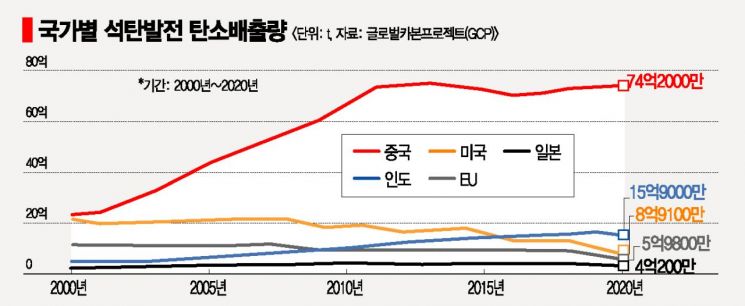
A total of 46 countries agreed to phase out coal power this time. However, criticism has arisen that the agreement is meaningless as countries accounting for over 70% of global carbon emissions from coal power, such as China, India, the United States, and Japan, did not participate.
Fatih Birol, Executive Director of the International Energy Agency (IEA), strongly criticized in an interview with a foreign media outlet that the probability of achieving the Paris Climate Agreement goals has "decreased to nearly 0%" due to the absence of China, the United States, and Japan from the coal phase-out agreement.
In the interview, he said, "If the coal issue is not resolved, the goal of limiting the temperature rise to 1.5 degrees Celsius above pre-industrial levels, agreed upon in the Paris Agreement, cannot be achieved," and urged "all countries to participate in the agreement and take early action to close coal power plants."
China and India, the world's first and third largest carbon emitters, are known to have high dependence on coal power, making it difficult for them to phase out coal. Dan Klein of energy information company S&P Global Platts said, "Given that China and India rely on coal power to meet electricity demand, it is practically impossible for these countries to phase out coal within the next 20 years."
In the case of the United States, the Biden administration has announced policies to support companies reducing carbon emissions by providing subsidies and to halt investments in overseas fossil fuel industries as part of its clean energy transition policy. However, the passage of the Biden administration's green budget bill in Congress has become uncertain due to opposition from Democratic Senator Joe Manchin, whose constituency is West Virginia, a state with a developed coal industry.
There are also criticisms that the timeline for phasing out coal agreed upon by over 40 countries is vague. These countries agreed that developed countries will phase out coal power starting in the 2030s, and developing countries from the 2040s. However, no specific phase-out dates were set, only that it should be done "as soon as possible."
"If you want carbon neutrality, give us the money"… Developing countries reach out
Meanwhile, many developing countries reportedly demanded that developed countries raise $1.3 trillion (approximately 1,540 trillion KRW) in funds to address climate change.
The Wall Street Journal (WSJ) disclosed a letter submitted to the United Nations (UN) at COP26 by China, India, Indonesia, and others, reporting that these countries demanded "half of the funds be invested in renewable energy development in developing countries, and the other half be used to mitigate damages caused by global warming in developing countries."
Developed countries have expressed reluctance. An official from a European country told the WSJ, "We do not believe we have the capacity to provide such support," and said, "It is not the appropriate time to discuss this now."
© The Asia Business Daily(www.asiae.co.kr). All rights reserved.
![Clutching a Stolen Dior Bag, Saying "I Hate Being Poor but Real"... The Grotesque Con of a "Human Knockoff" [Slate]](https://cwcontent.asiae.co.kr/asiaresize/183/2026021902243444107_1771435474.jpg)
















